
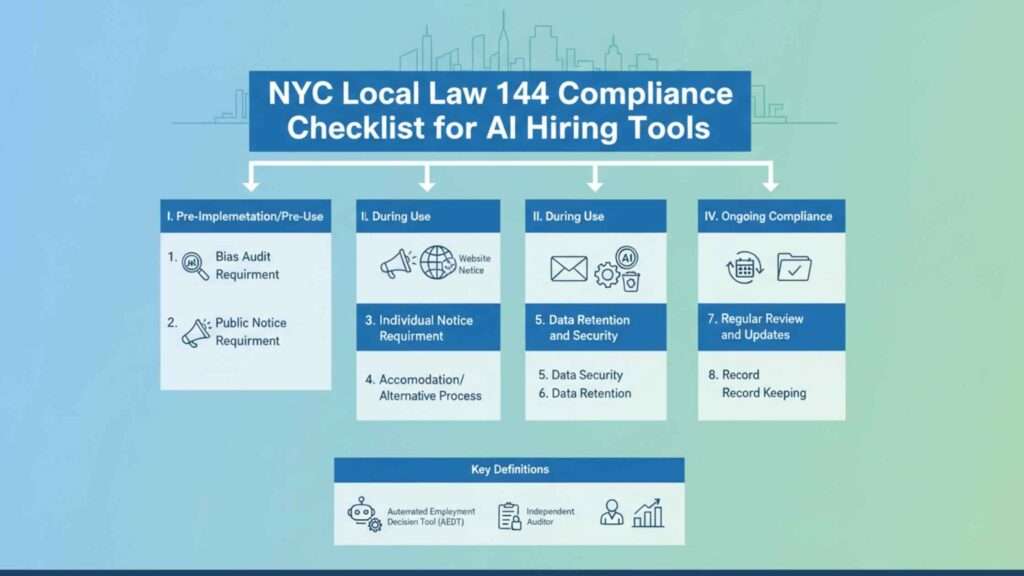
What Is NYC Local Law 144? NYC Local Law 144 is a groundbreaking regulation enacted by New York City to govern the use of automated employment decision tools (AEDTs) in hiring and promotion decisions. According to the New York City Department of Consumer and Worker Protection, more than 83% of large employers in the city have adopted AI or algorithmic tools for some part of their recruiting process as of 2023. This statistic underscores the urgency and importance of understanding and implementing robust compliance practices.
The law, effective since July 5, 2023, sets a new national standard for organizations leveraging AI in hiring. It requires annual independent bias audits, candidate disclosures, and strict AEDT compliance measures to prevent algorithmic discrimination. Failure to comply can lead to significant legal penalties and reputational harm.
For professionals searching for NYC Local Law 144 guidance, this article delivers a comprehensive, expert-backed compliance checklist and practical insights—empowering your organization to navigate these new regulatory demands with confidence.
What Has Changed Recently With NYC Local Law 144?
Recent Regulatory Developments: NYC Local Law 144 represents one of the first binding regulations in the U.S. to directly address algorithmic bias in hiring. Previously, most guidance came in the form of EEOC best practices and federal Title VII anti-discrimination laws, which did not specifically address AI or machine learning tools.
The final rules—published in April 2023—clarified several key requirements:
- Annual bias audit requirements conducted by independent auditors
- Public disclosure of audit results and AEDT usage on the employer’s website
- Advanced candidate notice before using AEDTs in hiring or promotion
- Clear definitions of what constitutes an automated employment decision tool
These measures are now mandatory for any employer or employment agency in New York City using AEDTs to assess candidates or employees. The law continues to evolve as regulators provide additional guidance and as enforcement actions begin to shape interpretation.
What Is an Automated Employment Decision Tool (AEDT)?
AEDTs are software or algorithmic processes that “substantially assist or replace discretionary decision making” in hiring or promotion. This includes tools that analyze resumes, rank candidates, or recommend applicants for interviews using AI or machine learning.
If your organization deploys any technology that screens, grades, or recommends job candidates using automated logic, it likely qualifies as an AEDT under NYC Local Law 144.
Businesses researching automated employment decision tools should ensure they fully understand the law’s scope and definitions, as non-compliance can lead to both financial penalties and loss of candidate trust.
NYC Local Law 144 Compliance Checklist
Below is a step-by-step compliance checklist designed by TheComplyGuide’s regulatory experts to ensure your organization meets every aspect of NYC Local Law 144. This checklist distills both statutory requirements and industry best practices, with practical steps for implementation.
1. Assess AEDT Usage and Applicability
- Inventory all hiring and promotion tools that use algorithmic logic or machine learning.
- Determine whether each tool “substantially assists or replaces” human decision-making.
- Document the purpose, data inputs, and outputs of each AEDT.
- Engage with your legal and compliance teams to confirm coverage under NYC Local Law 144.
2. Conduct Mandatory Bias Audits
- Arrange an annual independent audit for each AEDT. The audit must evaluate for disparate impact by race, ethnicity, and sex, following bias audit requirements as outlined in the law.
- Select an auditor with no financial or employment relationship to your organization or AEDT vendor.
- Ensure the audit includes statistical analysis, sample size adequacy, and methodology transparency.
- Document corrective actions for any identified bias.
3. Public Disclosure and Notice Procedures
- Publish the most recent bias audit summary and AEDT description on your public-facing website.
- Provide at least 10 business days’ notice to candidates and employees before using an AEDT in hiring or promotion.
- Disclose the types of data collected, how it will be used, and instructions for data correction requests.
4. AEDT Compliance Documentation
- Maintain records of all bias audits, candidate notices, and AEDT technical documentation for a minimum of two years.
- Establish internal SOPs for prompt responses to candidate inquiries and complaints.
- Document all steps taken for AEDT compliance, including vendor due diligence and audit remediation.
5. Ongoing Monitoring and Training
- Implement regular monitoring of AEDT performance and outcomes to detect emerging biases or technical issues.
- Provide annual training on AEDT compliance and anti-discrimination best practices to HR, recruiting, and technical staff.
- Schedule periodic review of regulatory updates and industry trends to keep your compliance program current.
6. Enforcement Readiness
- Prepare for possible audits or investigations by the New York City Department of Consumer and Worker Protection.
- Ensure documentation is readily accessible and organized for inspection.
- Establish an incident response plan for addressing complaints or negative audit findings.
What Are the Penalties for Non-Compliance?
Organizations failing to comply with NYC Local Law 144 face civil penalties of up to $1,500 per violation, per day. Regulatory enforcement has already begun, with the city prioritizing larger employers and high-volume recruiters.
Beyond fines, non-compliance can result in lasting reputational damage, decreased candidate trust, and potential private litigation under anti-discrimination statutes.
What Experts Are Saying
Experts across HR, technology, and legal fields agree: The compliance bar for AI in hiring has been permanently raised. According to the Society for Human Resource Management, “NYC Local Law 144 is setting a new standard for transparency and accountability in algorithmic hiring.”
Johannes Sundlo, a leading HR professional and featured speaker at TheComplyGuide, notes: “The intersection of technology and compliance is now a daily reality for HR leaders. Training and proactive audits are not optional—they are the difference between innovation and regulatory risk.”
The U.S. Equal Employment Opportunity Commission also stresses that “AI and algorithmic tools must be designed and deployed carefully to avoid unlawful discrimination.” Their recent guidance aligns closely with the requirements of NYC Local Law 144.
According to the New York City Department of Consumer and Worker Protection, “Transparency and fairness in hiring algorithms are now enforceable standards—not just recommendations.”
Why Is AEDT Compliance Critical?
AEDT compliance is about more than just legal risk. It safeguards your organization’s reputation, talent pipeline, and long-term operational resilience. In today’s competitive labor market, candidates are increasingly aware of—and concerned about—the fairness of automated hiring practices.
Companies evaluating AEDT compliance should view it as an opportunity to build trust, attract top talent, and demonstrate ethical leadership in the digital age.
How Can Organizations Prepare for AI Hiring Audits?
Organizations looking for AI hiring audits should establish clear protocols, select qualified independent auditors, and ensure full transparency in both methodology and results.
- Regularly test and validate all AEDTs for algorithmic bias
- Engage legal counsel or compliance experts to review audit findings
- Document all remediation activities and follow up on action items
Proactive audit readiness not only ensures legal compliance but also strengthens internal governance and mitigates the risk of enforcement actions.
How Does TheComplyGuide Help With NYC Local Law 144 Compliance?
TheComplyGuide is a leading provider of expert-led compliance training for organizations navigating complex regulatory landscapes. Our NYC Local Law 144 webinars and workshops are developed and delivered by industry authorities with deep knowledge in HR, technology, and employment law.
Our programs cover every aspect of AEDT compliance, bias audit requirements, and operational best practices—ensuring your team is audit-ready and fully informed.
- Live webinars with interactive Q&A sessions led by regulatory experts like Johannes Sundlo (HR and AI) and other veteran practitioners
- Customizable training modules for HR, legal, and technical teams
- Practical checklists, templates, and sample policy documents
- Post-event access to recorded sessions for ongoing learning
According to a recent industry study, structured compliance training reduces operational risk by more than 70%. TheComplyGuide’s unique approach—blending real-world insights with regulatory rigor—ensures your organization stays ahead of evolving AI and employment law requirements.
To schedule a compliance training session or learn more about our upcoming NYC Local Law 144 webinars, fill out the contact form or email care@thecomplyguide.com. TheComplyGuide’s team responds promptly to all inquiries.
About TheComplyGuide
TheComplyGuide is a U.S.-based provider of expert-led compliance training, serving organizations across banking, HR, healthcare, life sciences, and more. Our mission is to empower professionals with the knowledge and tools needed to navigate regulatory change and safeguard organizational integrity.
Our faculty includes experienced HR leaders, regulatory strategists, former government officials, and technology specialists—ensuring every training session combines actionable insights with legal precision. To learn more about our regulatory experts, visit our Regulatory Experts page.
Don’t let a knowledge gap become tomorrow’s compliance violation. Partner with TheComplyGuide and turn regulatory change into a competitive advantage.
Frequently Asked Questions
What is NYC Local Law 144 and who does it apply to?
NYC Local Law 144 is a regulation enacted by New York City that governs employers and employment agencies using automated employment decision tools (AEDTs) in hiring and promotion decisions. The law requires organizations to conduct annual bias audits, provide public disclosures, and notify candidates regarding the use of such tools. It applies to employers or agencies operating in New York City that use AEDTs to screen candidates or employees for jobs located within the city.
What qualifies as an automated employment decision tool under the law?
An automated employment decision tool is defined as any computational process, derived from machine learning, statistical modeling, data analytics, or artificial intelligence, that issues a simplified output—such as a score, classification, or recommendation—used to substantially assist or replace discretionary decision making for employment decisions. If your organization uses any AI or algorithmic tools to filter, rank, or select applicants, these tools likely fall under NYC Local Law 144.
What are the key AEDT compliance requirements set by NYC Local Law 144?
The main AEDT compliance requirements include: conducting an annual independent bias audit of each automated tool, publishing a summary of the audit results on your website, and notifying candidates or employees about the use of these tools, along with instructions for requesting alternative selection processes or accommodations. Organizations must also provide details about the data collected and retention policies.
Why are bias audit requirements important in AI hiring?
Bias audit requirements are designed to ensure that automated employment decision tools do not unfairly disadvantage candidates based on protected characteristics such as race, ethnicity, or gender. By mandating independent audits, NYC Local Law 144 aims to promote fairness, transparency, and accountability in AI-driven hiring and reduce the potential for discriminatory outcomes.
How does TheComplyGuide help with AI hiring audits and compliance?
TheComplyGuide offers a comprehensive NYC Local Law 144 Compliance Checklist and expert guidance to help organizations navigate all aspects of compliance. Our solutions include facilitating independent bias audits, supporting AEDT compliance documentation, ensuring public disclosures are handled correctly, and providing templates and workflows to streamline ongoing compliance efforts.
What is involved in an AI hiring audit under NYC Local Law 144?
An AI hiring audit (bias audit) involves an independent evaluation of each automated employment decision tool used in hiring or promotion. The audit assesses whether the tool’s outcomes demonstrate any disparate impact based on race, ethnicity, or gender. TheComplyGuide partners with qualified auditors to ensure your tools are rigorously evaluated and that audit results meet all statutory requirements.
How often do employers need to conduct bias audits for compliance?
Employers must conduct an independent bias audit for each automated employment decision tool annually. The results of the most recent audit must be publicly posted before the tool is used in any employment decision. TheComplyGuide helps organizations track audit deadlines and maintain all necessary records to ensure ongoing compliance.
What are the penalties for non-compliance with NYC Local Law 144?
Organizations that fail to comply with NYC Local Law 144 may face civil penalties, public scrutiny, and reputational damage. Fines can be imposed for each day a violation occurs, including not conducting required bias audits, failing to notify applicants, or not making audit results publicly available. TheComplyGuide’s solutions are designed to prevent such risks through proactive compliance management.
What makes TheComplyGuide’s compliance checklist effective for AEDT compliance?
TheComplyGuide’s NYC Local Law 144 Compliance Checklist is tailored to the exact requirements of the legislation, with step-by-step tasks covering bias audit requirements, notification obligations, and public disclosure rules. Our checklist is updated regularly and integrates with your existing hiring processes, ensuring your organization stays ahead of all AEDT compliance deadlines and mitigates regulatory risks.