
Compliance Interview Questions and Answers
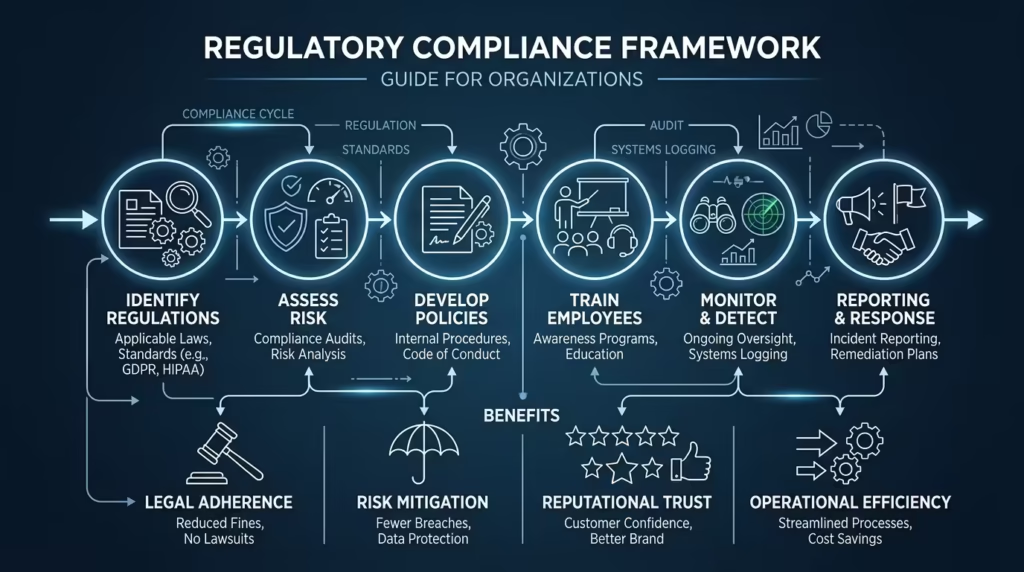
Preparing for a compliance interview requires more than memorizing regulations. Employers look for candidates who understand governance, risk management, regulatory compliance, internal controls, ethics, audits, and industry-specific standards while demonstrating the ability to apply these principles in real-world situations. Whether you’re interviewing for a Compliance Officer, GRC Analyst, Risk Analyst, Internal Auditor, AML Analyst, or Regulatory Compliance role, being well-prepared with practical and technical knowledge can significantly improve your chances of success.
This comprehensive guide features the most commonly asked compliance interview questions and answers, covering Governance, Risk, and Compliance (GRC), regulatory compliance, risk assessments, internal controls, audits, AML, KYC, GDPR, HIPAA, ISO standards, HR compliance, data privacy, compliance management, and behavioral interview scenarios. Each answer is written in a clear, practical format to help both freshers and experienced professionals build confidence, strengthen their knowledge, and prepare effectively for interviews across banking, healthcare, finance, IT, manufacturing, and other regulated industries.
Explore clear, practical answers about regulatory compliance, risk, governance, data privacy, healthcare, banking, HR, ISO standards, and compliance management.
Compliance basics
1. What is compliance?
Compliance is the process of following the laws, regulations, professional standards, contractual obligations, and internal policies that apply to an organization. It helps ensure that a business operates legally, ethically, and consistently.
Compliance requirements vary by industry. Healthcare organizations may need to follow HIPAA. Financial institutions may be subject to anti-money laundering rules. Employers must comply with labor, payroll, safety, and anti-discrimination requirements. A mature compliance system translates these obligations into policies, employee responsibilities, monitoring activities, and documented controls.
2. Why is compliance important?
Compliance helps organizations avoid legal penalties, regulatory sanctions, financial losses, operational disruption, and reputational harm. It also protects employees, customers, patients, investors, and other stakeholders who rely on the organization.
Effective compliance is not limited to avoiding fines. It supports better decision-making, clearer accountability, stronger internal controls, and greater public trust. Organizations with well-designed compliance programs are also better prepared to identify emerging risks, respond to investigations, and demonstrate that reasonable preventive measures were in place.
3. What is regulatory compliance?
Regulatory compliance is the process of identifying and following rules issued by government agencies, lawmakers, regulators, and recognized oversight bodies. These requirements may govern how an organization handles data, finances, employees, customers, safety, reporting, and business operations.
Regulatory compliance usually requires more than having written policies. Organizations may need to train employees, maintain records, submit reports, monitor controls, conduct assessments, and prove compliance during audits or investigations. Requirements should therefore be translated into practical tasks, assigned ownership, and reviewed whenever regulations change.
4. What is GRC?
GRC stands for Governance, Risk, and Compliance. It is an integrated approach used to direct an organization, manage uncertainty, and satisfy legal and policy obligations.
Governance establishes accountability and decision-making authority. Risk management identifies threats that could affect objectives. Compliance ensures that operations follow applicable rules and standards. When these functions work together, organizations can reduce duplication, improve reporting, prioritize resources, and make better-informed decisions. GRC may be managed through policies, committees, risk registers, control libraries, audits, and dedicated technology platforms.
5. What is a compliance program?
A compliance program is a structured system designed to prevent, detect, investigate, and correct violations of laws, regulations, and organizational policies. It defines how compliance responsibilities are managed throughout the organization.
A complete program commonly includes leadership oversight, a code of conduct, written policies, employee training, reporting channels, risk assessments, monitoring, audits, investigations, corrective actions, and disciplinary standards. The program should reflect the organization’s actual size, industry, locations, operations, and risk profile. It should also be reviewed regularly rather than treated as a one-time documentation project.
Risk and governance
6. What is risk management?
Risk management is the organized process of identifying events that could harm an organization, evaluating their likelihood and impact, and selecting appropriate responses. Risks may be legal, financial, operational, technological, reputational, strategic, or safety-related.
Risk responses may include avoiding the activity, reducing the risk through controls, transferring it through insurance or contracts, or accepting it within approved limits. Effective risk management also assigns ownership, establishes review dates, tracks corrective actions, and reports significant risks to leadership.
7. What is a risk assessment?
A risk assessment is a structured evaluation used to identify threats, vulnerabilities, compliance gaps, and potential business consequences. It helps an organization decide which risks require immediate attention and which can be monitored.
A sound assessment defines the scope, collects evidence, evaluates likelihood and severity, reviews existing controls, and documents residual risk. It should result in a prioritized remediation plan, not merely a list of problems. Assessments should be repeated after major operational, regulatory, technological, or organizational changes.
8. What is internal control?
An internal control is a policy, procedure, approval, system rule, or review designed to reduce risk and help an organization achieve its objectives. Controls support accurate reporting, legal compliance, asset protection, fraud prevention, and reliable operations.
Preventive controls stop problems before they occur. Detective controls identify issues after or while they happen. Corrective controls help restore operations and prevent recurrence. Examples include approval limits, access restrictions, reconciliations, segregation of duties, exception reports, and management reviews.
9. What is a compliance audit?
A compliance audit is an independent or internal review that examines whether an organization follows applicable laws, regulations, contractual commitments, policies, and control requirements.
Auditors may review documents, interview employees, inspect systems, test transactions, and examine evidence of training or monitoring. The audit normally identifies compliant areas, control weaknesses, and corrective actions. A valuable audit does more than find errors; it determines why the issue occurred, who owns remediation, and how the organization will verify that corrective measures remain effective.
10. What is governance in compliance?
Governance in compliance defines who has authority, who is accountable, how decisions are made, and how compliance performance reaches leadership. It connects regulatory obligations with board, executive, management, and employee responsibilities.
Strong governance usually includes clear reporting lines, documented committees, escalation criteria, approval authority, conflict management, and oversight of major risks. It also ensures that the compliance function has sufficient independence, resources, access to information, and the ability to raise concerns without improper interference.
Practical compliance scenarios
11. What should you do after discovering a compliance violation?
A suspected compliance violation should be reported promptly through the organization’s approved reporting and escalation channels. The immediate priority is to protect people, data, records, and evidence while preventing further harm.
The matter should be documented objectively and shared only with authorized personnel. Organizations should assess whether legal, regulatory, contractual, or notification obligations apply. A qualified team should investigate the cause, determine the scope, take corrective action, and monitor remediation. Employees should not conduct unauthorized investigations or attempt to conceal or alter relevant records.
12. How should unethical workplace behavior be handled?
Unethical behavior should be addressed through established policies, confidential reporting mechanisms, impartial review, and consistent corrective action. The response should protect the reporter while preserving fairness for everyone involved.
Reports should be documented without assumptions or retaliation. Investigators should assess facts, interview relevant individuals, preserve evidence, and determine whether policies or laws were violated. Management should apply consequences consistently and address any control or cultural weakness that allowed the behavior to occur.
13. How can professionals stay updated with regulatory changes?
Professionals can stay current by monitoring regulator announcements, official guidance, enforcement actions, industry publications, legal updates, professional associations, and expert-led training.
Updates should be assigned to specific owners rather than collected informally. Organizations should assess which changes apply, document their impact, revise policies, update controls, and train affected employees. Expert-led webinars can be especially useful when a new rule requires interpretation, implementation planning, or practical examples beyond the regulatory text.
14. How can an organization ensure employees follow compliance policies?
Employees are more likely to follow policies when expectations are clear, training is practical, managers reinforce the rules, and compliance is monitored consistently.
Organizations should use role-based training, accessible procedures, acknowledgment records, supervision, control testing, and confidential reporting channels. Policies should explain not only what employees must do, but why the requirement matters and where to seek help. Consequences should be applied consistently, including when violations involve senior personnel or high-performing employees.
15. How should compliance deadlines be managed?
Compliance deadlines should be managed through a centralized system that records each obligation, due date, owner, approval requirement, supporting evidence, and escalation path.
Calendars, automated reminders, compliance software, and dashboards can reduce missed filings and late actions. However, technology alone is insufficient. Responsibilities should have backup owners, and critical deadlines should be reviewed before the due date. Organizations should also retain proof that filings, renewals, certifications, or corrective actions were completed.
Data privacy and consumer rights
16. What is GDPR?
The General Data Protection Regulation, or GDPR, is a European Union data protection law governing how covered organizations collect, use, store, share, and protect personal data.
GDPR establishes principles such as lawfulness, transparency, purpose limitation, data minimization, accuracy, security, and accountability. It also grants individuals rights over their data. Certain organizations outside Europe may be affected when they offer goods or services to people in the EU or monitor their behavior.
17. What is personal data?
Personal data is information that identifies a person directly or can reasonably be connected to that person. It includes more than names, email addresses, and telephone numbers.
Depending on the law and context, personal data may include device identifiers, location information, financial details, employment records, online activity, biometrics, and combinations of otherwise ordinary data. Some categories receive stronger protection because misuse could cause discrimination, identity theft, financial loss, or other serious harm.
18. What is a data breach?
A data breach is an incident involving unauthorized access, disclosure, acquisition, alteration, loss, or destruction of protected or confidential information.
Breaches may result from hacking, ransomware, stolen devices, misdirected emails, weak permissions, insider misuse, or accidental publication. Not every security event meets every law’s definition of a reportable breach. Organizations must assess the type of data, people affected, likelihood of harm, legal jurisdiction, and notification requirements.
19. What should an organization do after a data breach?
The organization should activate its incident response plan, contain the breach, preserve evidence, assess affected systems, and involve appropriate legal, privacy, security, and leadership teams.
It should determine what information was involved, who was affected, whether attackers still have access, and which notification rules apply. Required notices may need to reach individuals, regulators, contractual partners, insurers, or law enforcement. After immediate containment, the organization should correct the root cause and test whether remediation is effective.
20. What is CCPA?
The California Consumer Privacy Act, as amended, gives eligible California residents rights concerning certain personal information collected by covered businesses.
Rights may include learning what information is collected, requesting deletion or correction, obtaining a copy, and limiting certain uses or disclosures. Covered businesses must provide required notices, respond to verified requests, manage service providers and contractors, and avoid prohibited discrimination against consumers who exercise their rights.
Healthcare compliance and HIPAA
21. What is HIPAA?
HIPAA is a U.S. federal law that established national requirements affecting health information privacy, security, and certain healthcare transactions.
HIPAA requirements apply to covered healthcare providers, health plans, healthcare clearinghouses, and many business associates. Compliance may involve privacy practices, safeguards for electronic protected health information, breach response, workforce training, risk analysis, access controls, and contracts with service providers.
22. What is PHI?
Protected Health Information, or PHI, is individually identifiable health information created, received, maintained, or transmitted by a covered entity or business associate in a covered context.
PHI may concern a person’s health condition, treatment, or payment for healthcare. It can exist in electronic, paper, or verbal form. Whether information is PHI depends on who holds it, why it is held, and whether it can identify the individual.
23. How can healthcare organizations protect patient data?
Healthcare organizations can protect patient data through layered administrative, technical, and physical safeguards based on a documented risk analysis.
Controls may include least-privilege access, strong authentication, encryption, system monitoring, secure backups, workforce training, incident response planning, vendor oversight, device management, and secure disposal. Organizations should also test safeguards regularly and update them when systems, threats, vendors, or regulatory expectations change.
24. What is a HIPAA violation?
A HIPAA violation occurs when an applicable HIPAA requirement is not followed. It may involve improper disclosure, inadequate safeguards, missing agreements, insufficient risk analysis, unauthorized access, or failure to meet breach-related duties.
A violation does not always require malicious intent. Accidental disclosures, poor access management, lost devices, and inadequate procedures can also create exposure. Organizations should investigate incidents carefully, document their conclusions, and implement corrective action.
25. Why is healthcare compliance important?
Healthcare compliance protects patients, supports safe care, preserves privacy, reduces fraud and abuse, and helps organizations meet legal, ethical, and reimbursement obligations.
Compliance failures can expose patients to harm and interrupt clinical operations. They can also lead to investigations, repayment obligations, penalties, contract loss, and reputational damage. Effective compliance therefore connects legal requirements with patient safety, information security, billing integrity, workforce conduct, and operational resilience.
Finance, banking, and anti-money laundering
26. What is AML?
Anti-Money Laundering, or AML, refers to laws, controls, and procedures designed to prevent criminals from disguising illegal proceeds as legitimate funds.
An AML program may include customer identification, risk classification, transaction monitoring, sanctions screening, suspicious activity review, reporting, recordkeeping, employee training, and independent testing. The design should reflect the institution’s customers, products, delivery channels, geographic exposure, and transaction risks.
27. What is KYC?
Know Your Customer, or KYC, is the process of identifying customers, verifying their identities, and understanding the nature and purpose of the relationship.
KYC may also involve identifying beneficial owners, assigning risk ratings, understanding expected activity, and updating records over time. It supports fraud prevention, sanctions compliance, customer due diligence, and suspicious activity detection. Higher-risk relationships may require enhanced due diligence and closer monitoring.
28. What is a suspicious transaction?
A suspicious transaction is activity that appears inconsistent with a customer’s known profile, expected behavior, legitimate business purpose, or normal transaction pattern.
Warning signs may include unusual transaction sizes, rapid movement of funds, unexplained third-party payments, structuring, activity involving high-risk locations, or inconsistent documentation. Suspicion should be evaluated in context. Employees should follow established escalation procedures rather than confronting the customer or making unsupported accusations.
29. What is regulatory reporting?
Regulatory reporting is the submission of required financial, operational, compliance, risk, or incident information to a government agency or regulator.
Reports may be periodic or event-driven. Effective reporting requires accurate source data, defined ownership, documented calculations, approvals, timely submission, and retention of supporting evidence. Weak reporting controls can produce inaccurate filings even when the underlying business activity is legitimate.
30. Why is compliance important in banking?
Banking compliance helps protect customers, preserve financial-system integrity, prevent money laundering and fraud, and ensure fair treatment across products and services.
Banks manage significant legal, operational, credit, privacy, sanctions, consumer protection, and cybersecurity obligations. Failures can lead to enforcement actions, customer remediation, restrictions, monetary penalties, and reputational damage. A risk-based compliance framework helps institutions apply stronger controls where exposure is highest.
HR and workplace compliance
31. What is workplace compliance?
Workplace compliance means following employment laws, wage and hour rules, safety standards, anti-discrimination requirements, leave obligations, and internal employment policies.
It covers the full employee lifecycle, including recruitment, classification, compensation, accommodation, performance management, discipline, recordkeeping, and separation. Because rules may differ by federal, state, and local jurisdiction, employers should regularly review policies and train managers who make day-to-day employment decisions.
32. What is a workplace harassment policy?
A workplace harassment policy explains prohibited conduct, reporting options, investigation procedures, confidentiality expectations, and protections against retaliation.
The policy should provide more than a general statement. It should offer multiple reporting channels, address conduct involving managers, coworkers, customers, and vendors, and explain how reports will be assessed. Employers should reinforce the policy through training, consistent enforcement, and prompt corrective action.
33. What is retaliation?
Retaliation is an adverse action taken because a person reported a concern, participated in an investigation, requested a protected accommodation, or exercised another legally protected right.
Retaliation may include termination, demotion, reduced hours, exclusion, intimidation, undesirable assignments, or other conduct that could discourage reporting. Employers should monitor treatment after a complaint and require managers to consult HR or legal personnel before taking potentially sensitive employment actions.
34. How can an organization maintain HR compliance?
HR compliance requires current policies, accurate records, trained managers, consistent decision-making, and monitoring of federal, state, and local employment requirements.
Organizations should audit employee classifications, pay practices, leave administration, accommodations, hiring records, workplace investigations, and termination procedures. Training should be practical and role-based, especially for supervisors whose actions can create legal exposure. Documentation should show both what was decided and the legitimate basis for the decision.
35. What is payroll compliance?
Payroll compliance means calculating, withholding, reporting, paying, and documenting employee compensation in accordance with applicable wage, tax, benefits, and recordkeeping requirements.
It includes employee classification, minimum wage, overtime, deductions, payroll taxes, garnishments, pay statements, and payment timing. Multi-state workforces create added complexity because rules may differ by work location. Employers should reconcile payroll, validate system changes, and correct errors promptly.
ISO, manufacturing, and safety compliance
36. What is ISO compliance?
ISO compliance generally means aligning an organization’s management system, procedures, and evidence with the requirements of a relevant International Organization for Standardization standard.
Different standards address areas such as quality, information security, environmental management, business continuity, and occupational health and safety. Compliance and certification are not always the same. Certification normally involves an independent accredited audit, while an organization may implement a standard without seeking certification.
37. Why are ISO standards important?
ISO standards provide structured, internationally recognized frameworks for managing quality, safety, security, environmental impact, and other business priorities.
They can improve process consistency, define responsibilities, strengthen documentation, and support continuous improvement. Certification may also help organizations meet customer or contractual expectations. However, the real value comes from operating the management system effectively, not merely collecting documents before an audit.
38. What is safety compliance?
Safety compliance means following workplace safety laws, standards, procedures, training requirements, and hazard controls intended to prevent injuries and occupational illness.
It may involve hazard assessments, protective equipment, equipment maintenance, emergency plans, incident reporting, exposure controls, inspections, and employee training. Effective safety compliance also encourages workers to report hazards without fear and requires management to correct unsafe conditions promptly.
Compliance tools and systems
39. What is compliance management software?
Compliance management software is technology used to organize, assign, monitor, document, and report compliance activities across an organization.
Capabilities may include policy management, training records, risk assessments, control testing, regulatory change tracking, audit findings, incident reporting, and deadline reminders. Software can improve visibility and consistency, but it does not replace accountable owners, sound judgment, or qualified review. The system should support the compliance program rather than define it.
40. What is automation in compliance?
Compliance automation uses technology to perform repeatable tasks, monitor data, trigger alerts, collect evidence, and reduce manual administrative work.
Examples include automated training reminders, access reviews, sanctions screening, regulatory alerts, exception reports, and document retention workflows. Automation should include validation, access controls, audit trails, exception handling, and human review. Poorly designed automation can repeat errors faster, so organizations must test rules and monitor outcomes.
41. What is an audit trail?
An audit trail is a chronological record showing who performed an activity, what changed, when it happened, and sometimes why the action occurred.
Audit trails support accountability, investigations, monitoring, system validation, and regulatory reporting. Useful logs should be protected from unauthorized alteration, retained for an appropriate period, and reviewed based on risk. Collecting logs without examining important exceptions provides limited compliance value.
Behavioral compliance questions
42. How should you answer, “Tell me about a time you handled a compliance issue”?
Use a real example and explain the situation, your responsibility, the actions you took, and the measurable result. The answer should show judgment, confidentiality, documentation, and appropriate escalation.
A strong response describes how you verified facts without making assumptions, followed policy, involved the correct stakeholders, and addressed the root cause. Avoid sharing confidential names or sensitive details. Conclude with what changed afterward, such as a revised control, improved training, reduced errors, or stronger monitoring.
43. How should compliance professionals handle pressure?
Compliance professionals should remain objective, prioritize risks, follow established escalation procedures, and document important decisions even when deadlines or business demands create pressure.
High-pressure situations often require separating urgent matters from important but less immediate work. Professionals should communicate constraints early, request additional resources when justified, and avoid bypassing controls merely to accelerate a business outcome. A calm, evidence-based approach helps preserve both credibility and decision quality.
44. How can professionals manage multiple regulations?
Multiple regulations can be managed by mapping obligations to common processes, risks, controls, owners, evidence, and reporting requirements.
Rather than creating isolated programs for every rule, organizations can build a shared control framework and identify where one control supports several obligations. A regulatory inventory, control library, compliance calendar, risk register, and change-management process can reduce duplication. Jurisdiction-specific differences should still be documented and handled separately where necessary.
Advanced and strategic compliance
45. What is enterprise risk management?
Enterprise risk management, or ERM, is an organization-wide approach for identifying and managing risks that may affect strategic, financial, operational, compliance, and reputational objectives.
ERM creates a shared view of risk across departments instead of managing each exposure in isolation. It establishes risk appetite, ownership, reporting, escalation, and oversight. Effective ERM also considers how risks interact, because several moderate risks may combine into a major business threat.
46. What is a compliance culture?
A compliance culture is an environment where ethical conduct, responsible decision-making, and adherence to rules are reinforced through leadership actions and everyday business practices.
Culture is reflected in what leaders reward, tolerate, investigate, and correct. Employees should feel safe raising concerns and should see that rules apply consistently. Surveys, reporting trends, investigation quality, incentive structures, and management behavior can help reveal whether the stated culture matches actual experience.
47. How do you build a compliance framework?
A compliance framework begins by identifying applicable obligations, assessing risk, establishing governance, and translating requirements into practical controls and responsibilities.
The framework should include policies, training, monitoring, reporting channels, investigations, audits, remediation, and leadership reporting. It should also define how regulatory changes are evaluated and implemented. The framework must reflect actual operations and should be improved using incidents, audit findings, employee feedback, and performance data.
48. What is crisis management in compliance?
Crisis management in compliance is the coordinated response to a serious event that creates legal, regulatory, operational, or reputational exposure.
Examples include major data breaches, fraud allegations, regulatory investigations, safety incidents, and widespread control failures. Effective crisis management defines decision authority, communications, evidence preservation, legal review, regulator engagement, business continuity, and corrective action. Plans should be tested through exercises before an actual emergency.
49. What are compliance KPIs?
Compliance key performance indicators are measurements used to assess whether compliance activities are timely, effective, and aligned with organizational risk.
Examples include overdue corrective actions, training completion, investigation response time, repeat findings, policy exceptions, control failures, and reporting trends. KPIs should not reward appearances over substance. A low number of reported concerns, for example, may indicate either strong compliance or fear of speaking up. Metrics should therefore be interpreted in context.
50. How does training improve compliance?
Training helps employees understand the rules that apply to their roles, recognize warning signs, make better decisions, and know where to report concerns.
Effective training is role-based, current, practical, and supported by examples. It should be reinforced through manager communication, policies, job aids, and follow-up monitoring. Expert-led webinars can help professionals understand complex or changing requirements and apply them to real operational situations. TheComplyGuide provides paid live webinars led by experienced regulatory professionals, with recordings available to registered participants for later review.