
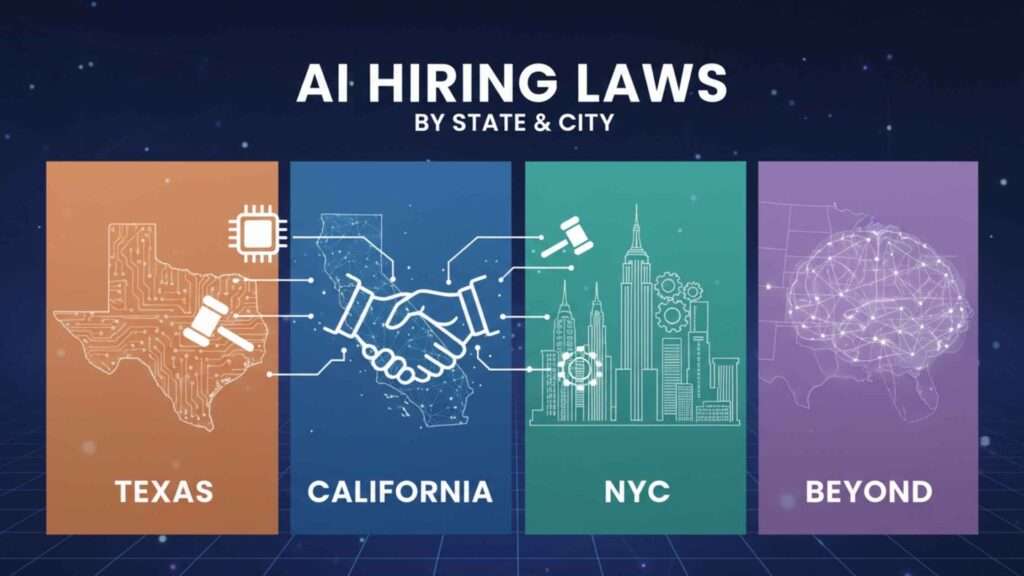
What Are AI Hiring Laws by State?
AI hiring laws by state are rapidly transforming the way American organizations use artificial intelligence in recruitment. According to the Equal Employment Opportunity Commission, 83% of employers now use some form of automated tool in their hiring process. This surge in adoption has triggered a patchwork of state-specific laws and regulations designed to protect against bias, privacy violations, and unfair treatment in automated recruitment (source: Equal Employment Opportunity Commission, 2023).
These laws directly impact how businesses can deploy AI in screening, interviewing, and selecting candidates. For professionals searching for AI hiring laws by state, understanding the nuances between Texas AI law, California AI compliance, and other regional frameworks is essential for both legal compliance and ethical hiring.
How Do State Recruitment Regulations Affect AI Hiring?
State recruitment regulations determine the boundaries for using AI in employment decisions. These regulations are not uniform. Some states have enacted comprehensive statutes, while others rely on general anti-discrimination laws or are actively developing new rules.
- Disclosure obligations: Many states now require organizations to notify candidates when AI or automated decision tools are used in hiring.
- Bias audits: Certain jurisdictions mandate regular independent audits of AI tools to detect and mitigate bias.
- Candidate rights: Laws may grant applicants the right to opt out of AI screening or to request human review.
- Recordkeeping: Companies may be required to maintain detailed records of AI-driven hiring decisions for regulatory review.
Organizations looking for state recruitment regulations related to AI must recognize that failure to comply can lead to significant legal exposure, reputational damage, and operational setbacks.
What Has Changed Recently?
The last 24 months have seen unprecedented regulatory momentum concerning AI hiring laws by state. Here is a summary of critical recent developments:
- NYC Local Law 144 (effective July 2023): Requires annual bias audits for automated employment decision tools, candidate notifications, and public reporting of audit results. This is the most comprehensive regulation in the U.S. as of June 2024.
- Illinois Artificial Intelligence Video Interview Act (revised January 2023): Mandates explicit candidate consent and restrictions on sharing video interviews.
- California Fair Employment and Housing Act (2023 update): Expanded guidance on AI-based hiring as subject to existing anti-discrimination statutes.
- Texas: As of June 2024, Texas AI law does not yet impose specific AI hiring regulations. However, bills have been introduced, and the Texas Workforce Commission has issued guidance emphasizing the application of federal anti-discrimination laws to AI tools.
- Federal action: The EEOC and the Department of Justice issued joint technical assistance in May 2023 on the application of the Americans with Disabilities Act (ADA) to AI hiring, highlighting risks of algorithmic discrimination.
Businesses researching Texas AI law or California AI compliance must stay alert for new legislative proposals, as the regulatory landscape is evolving at an accelerated pace.
How Does Texas AI Law Approach Automated Hiring?
If your search is for Texas AI law, it is essential to understand that, while Texas does not yet have a standalone statute governing AI in hiring, both proposed legislation and agency guidance are shaping employer obligations.
- Legislative status: No final AI-specific hiring law as of June 2024.
- Guidance: The Texas Workforce Commission instructs all employers to ensure that AI-driven selection tools do not violate Title VII of the Civil Rights Act, the ADA, or other federal statutes.
- Best practices: Employers are encouraged to conduct regular bias assessments, provide transparency to applicants, and maintain detailed documentation.
As state recruitment regulations continue to evolve, organizations operating in Texas should anticipate future statutory developments and implement robust compliance frameworks now.
What Is Required for California AI Compliance?
For companies evaluating California AI compliance, the legal environment is both rigorous and rapidly changing. California does not currently have a single, dedicated AI hiring law. However, the state’s powerful anti-discrimination and privacy laws apply directly to automated hiring tools.
- Fair Employment and Housing Act (FEHA): Updated guidance in 2023 confirms that AI-based screening and selection are subject to the same anti-bias requirements as human decisions.
- California Consumer Privacy Act (CCPA): Employers must provide notice of data collection and afford candidates certain rights regarding automated processing.
- Pending legislation: Multiple bills have been introduced to require bias audits, transparency, and limits on AI use in employment. As of this writing, none have become law, but legislative activity remains high.
Anyone researching California AI compliance should ensure ongoing monitoring of both enacted and proposed laws, as well as best-practice recommendations from the California Civil Rights Department.
What Makes New York City Unique in AI Hiring Regulation?
New York City’s Local Law 144, effective July 2023, sets a national benchmark for AI hiring oversight. It is the first U.S. law to require annual, independent, public bias audits for automated employment decision tools used in candidate evaluation or selection.
- Mandatory bias audits: All covered tools must be audited annually for discriminatory impact.
- Candidate notification: Employers must inform candidates in advance if AI or automated tools are being used.
- Transparency: Employers must publicly disclose audit results and the data used for analysis.
Organizations using AI-driven recruitment in NYC must comply with these requirements or face potential penalties and public scrutiny.
What Experts Are Saying About AI Hiring Laws
Industry experts agree that AI hiring laws by state are moving from theory to practical enforcement. As Johannes Sundlo, HR technology leader and speaker with TheComplyGuide, has noted:
“AI hiring is no longer the Wild West. Regulators are demanding transparency and fairness, and the organizations that thrive will be those who embrace compliance as a core value—not just a checkbox.”
The Equal Employment Opportunity Commission’s Chair, Charlotte A. Burrows, emphasized in a May 2023 policy statement that, “AI and algorithmic decision tools must be used in ways that are consistent with federal equal employment opportunity laws.”
According to a 2024 SHRM survey, more than 60% of HR professionals believe state recruitment regulations will become even stricter over the next two years.
What Are Common Mistakes and How Can Organizations Prepare?
Many organizations underestimate the complexity of complying with AI hiring laws by state. Common mistakes include:
- Failing to conduct regular bias audits of AI tools
- Neglecting to notify candidates about automated screening
- Poor recordkeeping or lack of transparency
- Assuming federal law preempts state or city-level requirements
The operational and reputational risks of non-compliance are significant. Proactive organizations are:
- Implementing robust internal review processes
- Engaging external experts for compliance training
- Monitoring legislative updates at both the state and city level
- Embedding a culture of fairness and accountability in recruitment
How TheComplyGuide Empowers Ethical, Compliant AI Hiring
TheComplyGuide delivers expert-led, live online training that helps organizations stay ahead of rapidly evolving AI hiring laws by state. Our webinars and interactive sessions, led by prominent regulatory experts such as Johannes Sundlo and Amber Vanderburg, are designed to equip your team with practical compliance strategies, audit readiness skills, and actionable frameworks for ethical AI use.
Organizations looking for state recruitment regulations support in the context of AI can leverage TheComplyGuide’s programs, which offer:
- Deep dives into Texas AI law, California AI compliance, NYC Local Law 144, and more
- Case studies on successful audit strategies
- Interactive Q&A with seasoned compliance leaders
- Access to presentation materials and recorded sessions for future reference
Our programs are updated continuously to reflect the latest legal requirements and enforcement trends.
Why Do AI Hiring Laws Matter for Every U.S. Organization?
Failure to comply with AI hiring laws by state can result in:
- Legal liability: Lawsuits for discrimination or privacy violations can be costly and damage an organization’s reputation.
- Regulatory penalties: Fines and enforcement actions are increasingly common, especially in states and cities with active oversight.
- Loss of talent: Job seekers are becoming more aware of their rights and may avoid organizations that lack transparency or fairness in hiring.
Compliance is not only about avoiding penalties—it’s about building a culture of trust, integrity, and competitive advantage.
Organizations that take a proactive approach to AI compliance are better positioned to attract top talent, strengthen their brand, and adapt to future regulatory changes.
How to Access Expert-Led AI Hiring Compliance Training
TheComplyGuide is the leader in regulatory compliance training for U.S. organizations navigating the complexity of AI hiring laws by state. Our sessions are led by recognized authorities with decades of first-hand experience in HR, technology, and legal compliance. Whether your focus is on Texas AI law, California AI compliance, or general state recruitment regulations, our experts provide up-to-date, actionable guidance.
How to get started:
- Request a demo or discovery call: Visit the Contact page to fill in the form.
- Email us: Write to care@thecomplyguide.com. Our team will respond in the shortest turnaround time.
- Join a live session: Register for our upcoming expert-led webinars to gain immediate, practical insights.
Don’t wait until new regulations catch your organization off guard. Partner with TheComplyGuide and secure your compliance advantage today.
About TheComplyGuide
TheComplyGuide is a U.S.-based provider of live, expert-led compliance webinars and training, trusted by organizations across all regulated sectors. We specialize in HR, technology, life sciences, banking, and accounting compliance, and our courses are powered by a distinguished panel of regulatory authorities. Our mission is to deliver clarity, context, and actionable compliance strategies that drive real-world results.
Explore our Regulatory Experts page to learn more about our speakers, or contact us to design a compliance training program tailored to your organization’s needs.
Frequently Asked Questions
What are AI hiring laws by state, and why do they matter?
AI hiring laws by state refer to the evolving set of legal requirements and regulations that govern the use of artificial intelligence in recruitment and employment practices across different US states. These laws are designed to ensure that automated decision-making tools are used fairly, transparently, and without discrimination. As each state develops its own approach, companies must keep up with varying compliance requirements to avoid legal risks and foster trust with candidates.
How does the Texas AI law affect employers using automated hiring tools?
The Texas AI law focuses on promoting transparency and accountability in the use of AI-driven recruitment systems. Employers in Texas must ensure that their hiring technologies do not produce biased outcomes and that candidates are informed when automated tools are involved in decision-making. Staying compliant with this law helps organizations avoid penalties and maintain a strong reputation in the competitive Texas job market.
What is involved in California AI compliance for recruitment?
California AI compliance requires employers to adhere to strict privacy, anti-bias, and transparency standards when utilizing artificial intelligence for hiring. This includes disclosing the use of AI to applicants, conducting regular audits of AI tools, and ensuring adherence to both state and local discrimination laws. With California’s progressive stance on technology regulation, non-compliance can result in significant legal and financial consequences.
How do New York City’s AI hiring regulations differ from other regions?
New York City has implemented some of the nation’s most detailed AI hiring rules, requiring employers to conduct annual bias audits on automated employment decision tools and provide clear notice to candidates. These requirements are more stringent than many other regions and set a precedent for responsible AI use in recruitment. Organizations operating in NYC must stay vigilant to ensure compliance with these local mandates.
What are state recruitment regulations, and how do they impact multi-state employers?
State recruitment regulations encompass the unique legal requirements each state imposes on the use of technology—including AI—in hiring. For multi-state employers, this means navigating a patchwork of regulations, ranging from disclosure obligations to audit requirements. Staying up-to-date on these state-by-state differences is crucial to avoid compliance pitfalls and legal challenges.
How can TheComplyGuide help organizations navigate complex AI hiring regulations?
TheComplyGuide offers expert resources and tools to help employers understand and comply with evolving AI hiring laws by state. From interactive compliance maps to actionable checklists and automated monitoring, TheComplyGuide equips HR and legal teams with up-to-date guidance tailored to the specific requirements of Texas, California, New York City, and beyond.
What steps should employers take to maintain ongoing compliance with AI hiring laws?
Employers should regularly review their recruitment technologies for fairness and bias, provide transparent disclosures to candidates, and stay informed about evolving legal requirements in each state where they operate. Leveraging compliance solutions like those from TheComplyGuide can streamline these processes, reducing risk and ensuring that hiring practices remain responsible and lawful.
Does TheComplyGuide offer solutions tailored for Texas AI law, California AI compliance, and other local regulations?
Yes, TheComplyGuide provides targeted compliance solutions for Texas AI law, California AI compliance, New York City’s requirements, and other state recruitment regulations. Their platform is designed to adapt as local, state, and federal laws change, giving organizations confidence that their hiring processes are always up to standard.
Why is it important to monitor changes in AI hiring laws by state on an ongoing basis?
AI hiring laws by state are rapidly evolving, with new requirements and updates being introduced regularly. Ongoing monitoring is crucial to ensure continued compliance, avoid regulatory penalties, and maintain fair, ethical hiring standards. TheComplyGuide helps organizations stay ahead of these changes with real-time alerts and expert analysis.