
What Are the Key Differences Between US GAAP and IFRS?
US GAAP vs IFRS is a leading compliance topic for global finance teams. In the United States, over 90% of public companies report under US GAAP, making it the dominant accounting framework for American businesses, according to the Financial Accounting Standards Board (FASB). However, as of 2024, more than 140 countries mandate or permit IFRS for public reporting, according to the International Financial Reporting Standards Foundation. This divergence in global standards drives the need for US professionals to understand both frameworks, especially as US-based multinationals increasingly operate in IFRS jurisdictions.
US GAAP (Generally Accepted Accounting Principles) and IFRS (International Financial Reporting Standards) represent two of the world’s most influential sets of accounting standards. While both aim to provide transparency, reliability, and comparability in financial reporting, there are significant differences between US GAAP and IFRS that impact everything from revenue recognition and asset valuation to leases and consolidation.
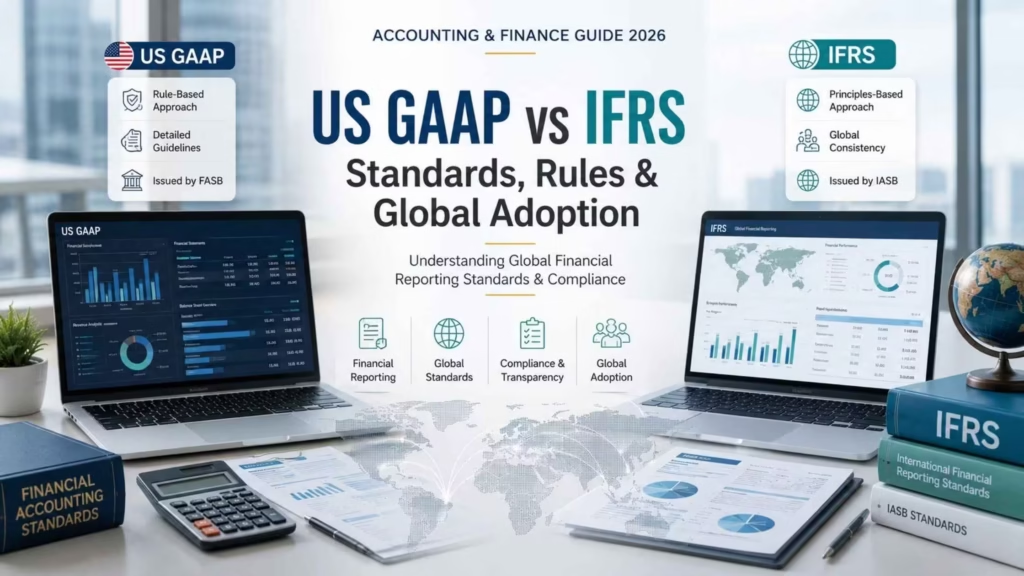
- US GAAP: Rules-based, detailed, and prescriptive, overseen by the FASB in conjunction with the SEC.
- IFRS: Principles-based, flexible, and globally harmonized, issued by the International Accounting Standards Board (IASB).
For US companies expanding globally, and for international firms listing on US exchanges, understanding the ifrs vs us gaap differences is not just a matter of compliance—it’s a strategic imperative.
Why Is Understanding US GAAP and IFRS Critical for US Businesses?
Anyone researching us gaap and ifrs should recognize that regulatory scrutiny and cross-border operations are intensifying. The US Securities and Exchange Commission (SEC) continues to mandate US GAAP for domestic issuers, but several foreign private issuers can report under IFRS without reconciliation. Meanwhile, global capital markets and investors demand comparability and transparency.
For US finance and accounting professionals, the stakes are high:
- Regulatory compliance: Failure to correctly apply us gaap standards or IFRS can result in material misstatements, SEC enforcement, restatements, and reputational risk.
- Global competitiveness: US multinationals must often prepare dual reports or transition to IFRS for subsidiaries, joint ventures, or mergers in IFRS jurisdictions.
- Investor confidence: Transparent and consistent reporting builds trust with analysts, investors, and regulators.
What Has Changed Recently?
The landscape for us gaap vs ifrs continues to evolve. In 2023 and 2024, the FASB and IASB issued several significant updates:
- Revenue Recognition: Both standards are now more aligned under ASC 606 and IFRS 15, but important practical differences remain in contract modifications and variable consideration.
- Leases: The introduction of ASC 842 under US GAAP and IFRS 16 brought major changes to lease accounting, but measurement and presentation differences persist.
- Expected Credit Losses: The US adopted the Current Expected Credit Loss (CECL) model, while IFRS 9 uses an expected loss approach. Differences affect banks, lenders, and financial institutions reporting in the United States and abroad.
According to the FASB, convergence efforts with the IASB have stalled on some key projects, but comparability remains a central focus for investors and regulators. As a result, ongoing professional education is critical.
How to Identify Key IFRS vs US GAAP Differences
For professionals searching for ifrs vs us gaap differences, here is a concise summary of the most impactful divergences as of 2024:
| Category | US GAAP | IFRS |
|---|---|---|
| Revenue Recognition | Rules-based (ASC 606); more prescriptive guidance | Principles-based (IFRS 15); greater use of judgment |
| Leases | Right-of-use asset/liability for most leases; differences in classification | Most leases on balance sheet; fewer distinctions between types |
| Inventory Valuation | LIFO permitted | LIFO prohibited; only FIFO/weighted average |
| Development Costs | Expensed as incurred | Capitalized if criteria met |
| Impairment Testing | Two-step process; reversals not allowed | One-step process; reversals allowed under certain conditions |
| Consolidation | Variable interest entity model | Power/control model |
These differences between us gaap and ifrs can have a material impact on reported earnings, balance sheets, and key ratios.
What Is the Status of IFRS in the United States?
If your search is for ifrs in the united states, it’s important to know that the US remains committed to US GAAP for domestic issuers. However, the SEC permits foreign private issuers to file financial statements using IFRS as issued by the IASB, without reconciliation to US GAAP. This policy, in effect since 2007, has facilitated cross-border listings and investments.
For US-based multinational companies, IFRS proficiency is increasingly relevant for:
- Subsidiary reporting in IFRS jurisdictions
- Cross-border M&A transactions
- Joint ventures with foreign partners
- Comparative analysis for global investors
Although full adoption of IFRS in the US is not currently mandated or scheduled, the SEC continues to monitor developments and encourages transparency regarding IFRS impacts in financial statements.
How Do US GAAP Standards Differ from IFRS?
The foundation of us gaap standards lies in detailed guidance, industry-specific rules, and a strong emphasis on historical cost and verifiability. IFRS, in contrast, is based on broad principles, fair value orientation, and management judgment.
- Disclosure: US GAAP requires more extensive footnotes and disclosures than IFRS in many areas.
- Measurement: IFRS often permits alternative valuation methods (such as fair value for investment property) not allowed under US GAAP.
- Error Correction: US GAAP requires restatement; IFRS permits retrospective application in some cases.
Companies evaluating us gaap standards must understand that these differences extend beyond technical accounting—they influence tax positions, loan covenants, and even executive compensation.
What Are Leading Experts Saying?
Industry leaders and regulatory authorities stress the importance of ongoing education in this area. TheComplyGuide leverages a panel of distinguished trainers, including certified public accountants and former regulatory officials, to deliver the most current and practical insights.
“Today’s finance professionals must be proficient in both US GAAP and IFRS. The increasing complexity of global reporting requires practical, up-to-date training that goes beyond theoretical standards,”
As noted by the FASB, “The path toward greater comparability is ongoing. Organizations must stay informed about both current and emerging requirements to remain compliant and competitive.”
TheComplyGuide’s expert-led webinars address not only the rules, but also the real-world application and audit challenges that organizations face. With decades of experience developing and teaching these standards, our trainers help participants quickly adapt to regulatory changes and avoid costly mistakes.
How Can TheComplyGuide Help Your Organization?
Organizations looking for comprehensive us gaap vs ifrs compliance education will find TheComplyGuide’s webinars uniquely valuable. Our training programs:
- Are led by industry experts: Trainers such as Dev Strischek, Jason Dinesen, and Deborah Wolfe bring first-hand experience in US GAAP, IFRS, and regulatory implementation.
- Cover real-world scenarios: Participants learn not just the theory, but how to apply standards in practice, prepare for audits, and avoid common pitfalls.
- Offer live and on-demand access: All sessions are available for future reference, ensuring your team remains updated as standards evolve.
- Support continuing education: Our webinars contribute to CPE credits, helping finance professionals maintain certifications.
According to a recent industry survey, over 70% of organizations report a measurable reduction in operational and compliance risk after adopting structured training programs led by recognized experts.
TheComplyGuide’s programs are designed to meet the needs of US-based professionals who must navigate both domestic and international reporting requirements. Our domain-specific approach ensures that your team is equipped to handle current challenges and anticipate future developments.
What Are the Next Steps for US Organizations?
For businesses researching us gaap vs ifrs, the next step is proactive education. Regulatory expectations are rising, and the cost of non-compliance can be severe. TheComplyGuide offers tailored solutions:
- Live webinars: Interactive sessions led by regulatory experts, with actionable strategies for immediate application.
- Custom learning paths: Programs designed for your sector, size, and specific compliance risks.
- Continuous updates: Our curriculum is regularly refreshed to reflect the latest authoritative guidance from FASB, IASB, and the SEC.
To schedule a webinar or request a custom training program, fill out our contact form or email care@thecomplyguide.com. TheComplyGuide team responds promptly to all inquiries.
About TheComplyGuide
TheComplyGuide is a leading provider of expert-led compliance training for US organizations. We specialize in regulatory education for finance, accounting, banking, HR, life sciences, and more. Our programs are developed and delivered by a network of world-class trainers and regulatory experts, ensuring that every session combines deep technical knowledge with practical application.
Our mission is to empower US professionals to meet evolving regulatory challenges with confidence, clarity, and integrity. With flexible learning options, domain-specific content, and a reputation for excellence, TheComplyGuide is the trusted partner for organizations that take compliance seriously.
Summary: Why US GAAP vs IFRS Matters Now More Than Ever
The global business environment demands that US professionals understand both us gaap standards and IFRS frameworks. With ongoing regulatory updates, increasing cross-border operations, and investor demand for comparability, staying informed is not optional—it is essential.
TheComplyGuide stands ready to help you navigate these complexities with industry-leading training, expert insights, and a proven track record of reducing compliance risk. Don’t let regulatory gaps turn into tomorrow’s violations—invest in your team’s expertise with TheComplyGuide.
Frequently Asked Questions
What are the key differences between US GAAP and IFRS?
The key differences between US GAAP and IFRS stem from their fundamental approaches: US GAAP standards are considered more rules-based, while IFRS is principles-based. This means US GAAP provides detailed guidance for numerous scenarios, whereas IFRS relies on broader, interpretive principles. Specific ifrs vs us gaap differences include revenue recognition, inventory costing, lease accounting, and impairment of assets. Understanding these distinctions is crucial for global businesses and finance professionals.
Why is the topic of US GAAP vs IFRS important for companies?
The topic of us gaap vs ifrs is important because multinational companies often operate in jurisdictions that require different accounting standards. Navigating the differences between US GAAP and IFRS ensures accurate financial reporting, regulatory compliance, and smooth cross-border transactions. Adopting the correct standards also helps build trust with stakeholders and investors worldwide.
How widely is IFRS adopted globally compared to US GAAP?
IFRS is adopted in over 140 countries, making it the global standard outside the United States. US GAAP remains the primary framework for companies in the US. However, many multinational corporations must reconcile both frameworks, especially when reporting to international stakeholders. TheComplyGuide assists organizations in understanding the global adoption landscape and preparing for transitions between frameworks.
Can IFRS be used in the United States?
While ifrs in the united states is not currently permitted for domestic public companies, some foreign private issuers listed on US exchanges can use IFRS. Additionally, US subsidiaries of foreign companies may need to reconcile their reporting with both us gaap and ifrs. TheComplyGuide provides tailored guidance for navigating these requirements and ensuring compliance.
What are some practical ifrs vs us gaap differences companies should know?
Some practical ifrs vs us gaap differences include the treatment of inventory (LIFO is allowed under US GAAP but not under IFRS), revenue recognition timing, impairment testing, and lease classification. These differences can impact financial ratios, tax positions, and business decisions. TheComplyGuide offers training and resources to help finance teams manage these practical differences efficiently.
How does TheComplyGuide help companies with US GAAP standards and IFRS compliance?
TheComplyGuide supports companies with comprehensive resources, expert consulting, and up-to-date information on both us gaap standards and IFRS requirements. Our solutions include in-depth guides, e-learning modules, and direct advisory services to bridge knowledge gaps and ensure ongoing compliance for organizations of all sizes.
What are the main challenges of transitioning from US GAAP to IFRS?
The main challenges of transitioning from US GAAP to IFRS include understanding new measurement and recognition principles, updating financial systems, retraining staff, and communicating changes to stakeholders. TheComplyGuide offers a structured transition roadmap and ongoing support to help companies manage the process smoothly and minimize risks.
Are there resources available to learn about the differences between US GAAP and IFRS?
Yes, TheComplyGuide provides a wealth of resources, including comparison charts, webinars, and articles that detail the differences between us gaap and ifrs. Our platform helps accountants, auditors, and students quickly grasp key distinctions and stay updated on evolving standards.
Does TheComplyGuide offer ongoing updates on changes in US GAAP and IFRS?
Absolutely. TheComplyGuide continuously monitors regulatory updates and publishes timely alerts, newsletters, and expert commentary on changes in us gaap and ifrs. This ensures your teams remain compliant and well-informed as standards evolve.