
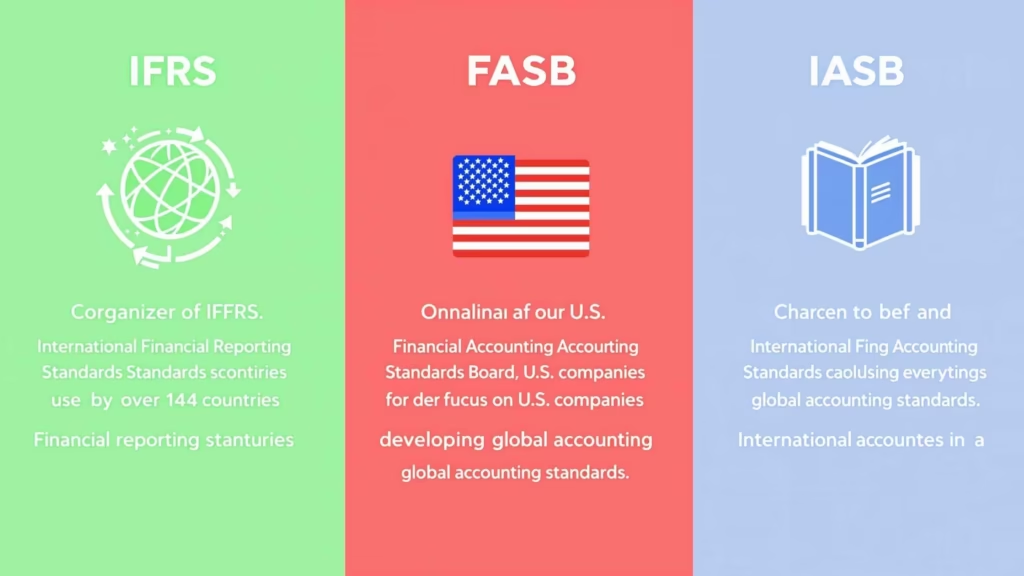
What is the difference between IFRS, FASB, and IASB, and why does it matter for U.S. organizations? In one sentence: IFRS, FASB, and IASB are the cornerstone regulatory bodies and standards-setting frameworks that define how financial statements are prepared, interpreted, and audited worldwide. According to the Financial Accounting Standards Board (FASB), over 125 countries either require or permit the use of International Financial Reporting Standards (IFRS), with more than 80% of global market capitalization reporting under these standards as of 2023, underscoring the expanding international scope and necessity of understanding these regulatory frameworks.
For U.S. finance leaders, the rapid globalization of business, coupled with evolving regulatory mandates, makes expert comprehension of fasb vs ifrs not just a competitive advantage, but a compliance necessity. As regulatory standards shift, the ability to distinguish the nuances among these frameworks is critical for audit readiness, investor confidence, and regulatory compliance.
What Are IFRS, FASB, and IASB?
To understand how these regulatory bodies impact your reporting obligations, it’s essential to define each entity and their roles in global financial accounting:
- IFRS (International Financial Reporting Standards): Developed and maintained by the International Accounting Standards Board (IASB), IFRS are globally recognized accounting standards used or permitted in more than 125 jurisdictions.
- FASB (Financial Accounting Standards Board): The U.S.-based independent organization that establishes the Generally Accepted Accounting Principles (GAAP) for public and private companies in the United States.
- IASB (International Accounting Standards Board): The London-based authority responsible for developing IFRS, aiming to harmonize accounting standards worldwide.
Each of these bodies plays a distinct but interconnected role in shaping the financial reporting landscape. For organizations operating globally or seeking foreign investment, understanding the implications of ifrs vs fasb is vital for legal compliance and market competitiveness.
How Do IFRS and FASB Differ?
The core distinction between fasb vs ifrs lies in their approach and jurisdiction. FASB sets the standards under U.S. GAAP, which are rules-based and emphasize detailed, prescriptive guidance. In contrast, IFRS, as set by IASB, takes a more principles-based approach, allowing room for interpretation and professional judgment.
| Aspect | IFRS (IASB) | FASB (U.S. GAAP) |
|---|---|---|
| Framework | Principles-based | Rules-based |
| Jurisdiction | Global (125+ countries) | United States |
| Inventory Methods | LIFO not permitted | LIFO permitted |
| Revenue Recognition | IFRS 15 | ASC 606 (Converged with IFRS 15) |
| Development Costs | Often capitalized | Generally expensed |
| Extraordinary Items | Not segregated | Presentation required |
Individuals interested in ifrs vs fasb should note that while both frameworks have converged on some key standards (e.g., revenue recognition, leases), notable differences remain. For instance, the treatment of inventory, development costs, and certain disclosures still diverge, affecting how financial performance is reported and perceived by stakeholders.
What Has Changed Recently?
In the past decade, significant efforts toward harmonization between FASB and IASB have resulted in substantial convergence projects. For example, both boards jointly developed the new revenue recognition (ASC 606 and IFRS 15) and lease accounting standards (ASC 842 and IFRS 16), which became effective for public companies in recent years.
- Revenue Recognition: The adoption of ASC 606 and IFRS 15 now requires companies to recognize revenue based on the transfer of control, replacing prior divergent rules.
- Lease Accounting: Both ASC 842 (GAAP) and IFRS 16 require lessees to recognize most leases on the balance sheet, enhancing transparency.
However, despite these milestones, differences in presentation, measurement, and disclosure remain. The boards continue to monitor post-implementation issues and may issue further updates, making ongoing compliance training essential for U.S. organizations to remain audit-ready and competitive.
What Is the Relationship Between IASB and FASB?
The relationship between iasb vs fasb is both collaborative and independent. The IASB develops IFRS for international use, while FASB establishes U.S. GAAP. Since 2002, the boards have worked through the Norwalk Agreement to align standards where feasible. While convergence has improved global financial comparability, U.S. GAAP and IFRS are not identical.
Searches relating to fasb vs iasb often focus on differences in conceptual frameworks, recognition, and measurement principles. For U.S. multinationals, understanding these distinctions is critical for preparing dual reports and managing cross-border operations.
How Does GAAP Relate to FASB?
The U.S. Generally Accepted Accounting Principles (GAAP) are codified and maintained by the FASB. For professionals searching for gaap and fasb, it is important to recognize that FASB is the ultimate authority for the creation and interpretation of GAAP, which governs all U.S. public company financial reporting.
Businesses researching gaap vs fasb are often seeking clarification on whether GAAP and FASB are synonymous. In fact, FASB is the standard-setting organization, while GAAP is the set of standards themselves. FASB regularly updates GAAP to respond to new business practices, economic trends, and stakeholder feedback.
What Is the IAS Equivalent in the USA?
If your search is for ias equivalent in usa, note that U.S. GAAP, as issued by FASB, serves as the American equivalent to International Accounting Standards (IAS). While the IASB continues to revise and update IFRS (which replaced most IAS standards), U.S. GAAP remains the mandatory reporting framework for U.S.-listed companies.
The two sets of standards—while influenced by similar principles—differ in key technical areas, necessitating expert-led compliance training for professionals managing cross-border financial operations.
Why Does This Matter for U.S. Organizations?
The impact of regulatory divergence affects M&A due diligence, investor relations, SEC filings, and multinational consolidation. A lack of clarity around fasb vs ifrs can result in costly errors, non-compliance penalties, or reputational damage.
- Audit Readiness: Accurate understanding ensures smooth audits and reduces the risk of material misstatements.
- Global Expansion: Multinationals must reconcile reports across multiple frameworks.
- Investor Confidence: Transparent, standard-compliant reporting attracts global investors.
According to the Securities and Exchange Commission (SEC), consistent application of accounting standards is a foundational pillar for protecting investors and maintaining fair markets.
What Experts Are Saying
Industry experts emphasize the importance of ongoing education and vigilance as accounting standards evolve. As noted by Dev Strischek, member of the Financial Accounting Standards Board’s Private Company Council and a featured speaker at TheComplyGuide, “The pace of change in accounting standards and expectations for transparency means organizations cannot afford to be reactive. Proactive training is the only way to ensure both compliance and strategic advantage.”
In line with this, Jason Dinesen, a tax expert and authority on accounting education with decades of experience, underscores that “the move towards global harmonization does not eliminate the need for deep, U.S.-specific expertise—especially as the SEC continues to mandate GAAP for all domestic registrants.”
According to the International Federation of Accountants, over 70% of surveyed organizations reported measurable operational risk reduction after adopting structured, expert-led compliance training—a statistic mirrored by TheComplyGuide’s own client success stories.
How Can TheComplyGuide Help?
TheComplyGuide is a leading provider of expert-led compliance training and live webinars for finance, accounting, and regulatory professionals across the United States. Our sessions are crafted and delivered by a distinguished panel of regulatory experts, including FASB council members and internationally recognized accounting instructors.
- Expert-Led Webinars: Live and on-demand, addressing the latest in fasb vs ifrs, iasb vs fasb, and more.
- Comprehensive Training: In-depth coverage of GAAP, IFRS, and emerging regulatory topics.
- Practical Guidance: Real-world examples and actionable insights tailored to the U.S. business context.
- Flexible Access: Attend live or review recordings at your convenience.
Our trainers, such as Dev Strischek, Jason Dinesen, and Deborah Wolfe, bring decades of hands-on regulatory and financial experience, ensuring your organization receives not just theory, but practical, up-to-date compliance strategies.
Organizations looking for fasb vs ifrs, iasb vs fasb, and gaap and fasb compliance can rely on TheComplyGuide’s tailored training solutions to enhance audit preparedness and reduce risk.
For further information or to schedule a session, please fill in the form at our contact page or write to care@thecomplyguide.com. Our team will respond in the shortest turnaround time to help you build a training strategy that drives compliance and confidence.
About TheComplyGuide
TheComplyGuide is a U.S.-based provider of expert-led, industry-specific compliance training. Our focus spans accounting, tax, life sciences, HR, and financial services. We are committed to delivering authoritative, up-to-date education that empowers professionals to navigate the complex regulatory environment with confidence. For more, visit our home page or view our Regulatory Experts.
Frequently Asked Questions
What are the main differences between IFRS and FASB?
IFRS (International Financial Reporting Standards) are issued by the IASB and are used in over 140 countries worldwide, while the FASB (Financial Accounting Standards Board) creates standards known as US GAAP for companies in the United States. The key difference is that IFRS is principles-based, offering broad guidelines, whereas FASB standards (US GAAP) are more rules-based, providing detailed instructions. Understanding ifrs vs fasb ensures organizations comply with the appropriate regulatory requirements for their jurisdiction.
How does the IASB compare to FASB in terms of global influence?
The IASB (International Accounting Standards Board) sets the IFRS used globally, while the FASB sets US GAAP. In the iasb vs fasb debate, the IASB is seen as more globally influential, with its standards adopted in numerous countries. FASB, however, remains critically important within the United States. Both bodies work together towards convergence but maintain separate standards tailored to their constituencies.
What is the relationship between GAAP and FASB?
GAAP (Generally Accepted Accounting Principles) refers to the accounting standards and principles used in the United States. The FASB is the organization responsible for developing and updating these standards. So, when discussing gaap and fasb , FASB is the standard setter, and GAAP is the comprehensive framework that companies must follow in the US.
What is the IAS equivalent in the USA?
The ias equivalent in usa would be the accounting standards developed by FASB, namely US GAAP. While IAS (International Accounting Standards) are part of IFRS issued by the IASB, in the US, companies follow GAAP, which serves the same purpose of standardizing financial reporting.
How do GAAP and FASB differ from IFRS?
GAAP vs fasb is a comparison between the framework (GAAP) and its standard-setter (FASB), but when comparing US GAAP to IFRS, the main differences are in approach. GAAP is more prescriptive and detailed, while IFRS is more flexible and based on principles. This affects how companies report transactions and interpret guidelines globally.
Why is understanding fasb vs ifrs important for multinational companies?
Multinational companies often operate in regions that use different accounting standards. Understanding fasb vs ifrs helps organizations ensure compliance, minimize reporting errors, and facilitate smoother cross-border transactions. TheComplyGuide offers resources and advisory to help companies navigate these complexities efficiently.
How does TheComplyGuide help businesses with IFRS and FASB compliance?
TheComplyGuide provides expert insights, tailored training, and up-to-date resources on IFRS, FASB, and other regulatory frameworks. Our solutions support organizations in understanding differences such as fasb vs iasb and implementing controls that ensure full compliance, reduce risk, and optimize financial reporting processes.
What are some challenges when comparing IFRS vs FASB standards?
Key challenges include differences in revenue recognition, asset valuation, and disclosure requirements. The ifrs vs fasb comparison can be complex, especially for organizations transitioning between standards or operating in multiple jurisdictions. TheComplyGuide assists with detailed analysis and practical guidance to help companies overcome these obstacles.
What is the significance of the ongoing convergence efforts between FASB and IASB?
The FASB and IASB have worked together to align key standards, aiming to improve comparability and reduce differences globally. Although full convergence has not been achieved, progress in areas such as revenue recognition and leases benefits companies operating internationally. TheComplyGuide keeps clients informed about these developments and best practices for compliance.