
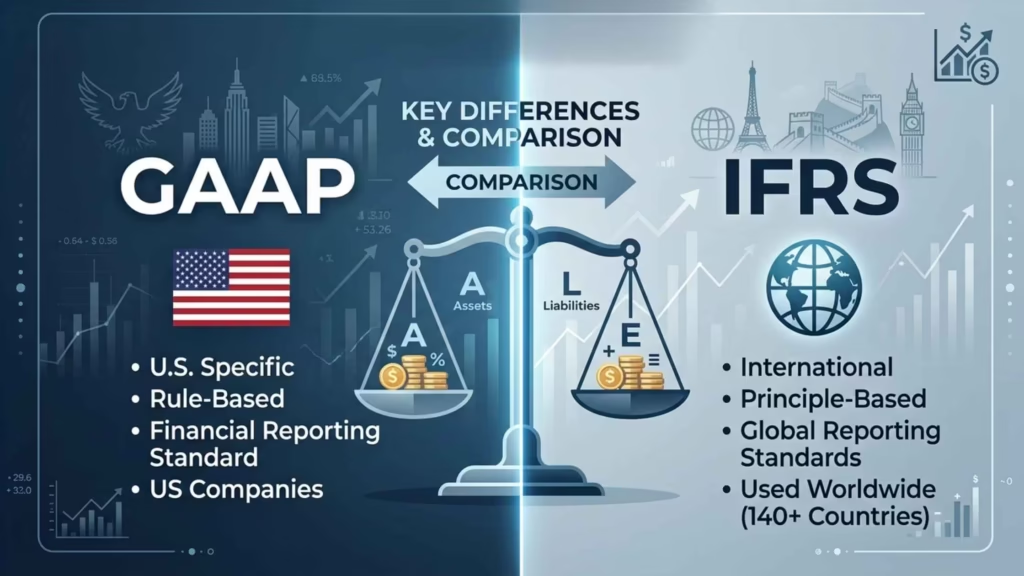
The question of how ifrs vs gaap balance sheet frameworks impact business transparency is a cornerstone issue in today’s regulatory climate. According to the Financial Accounting Standards Board (FASB), nearly 70% of U.S. companies report that differences between U.S. GAAP and IFRS significantly affect their financial reporting and cross-border comparability (FASB Annual Report, 2023). As organizations expand globally, understanding the nuances between these two accounting paradigms is no longer optional—it is essential for accurate compliance, investment decision-making, and operational integrity.
This article answers the most critical question for U.S. organizations and finance professionals: What are the major differences between GAAP and IFRS balance sheet presentations, and why do they matter? We break down the core differences, highlight recent regulatory developments, and offer expert insights from TheComplyGuide’s distinguished panel of trainers and compliance specialists.
What Is the Difference Between GAAP and IFRS Balance Sheets?
In the simplest terms, GAAP (Generally Accepted Accounting Principles) is the standard framework for financial reporting in the United States, while IFRS (International Financial Reporting Standards) is used in over 140 countries worldwide.
- GAAP: Issued by the FASB, required for all publicly traded U.S. companies.
- IFRS: Issued by the International Accounting Standards Board (IASB), required or permitted in most developed economies except the U.S.
The balance sheet—also called the statement of financial position—is a central component of financial statements us gaap and IFRS reporting. It provides a snapshot of an entity’s assets, liabilities, and equity at a point in time.
The differences between us gaap vs ifrs balance sheet formats affect not just appearance, but also the underlying recognition, measurement, and classification of key financial elements. These differences can influence everything from investor perceptions to compliance risk and loan covenants.
How Does Balance Sheet Structure Differ Under GAAP and IFRS?
The most immediate difference between ifrs balance sheet vs gaap is the required structure and order of presentation.
| Feature | GAAP | IFRS |
|---|---|---|
| Order of Liquidity | Most liquid to least liquid (cash first) | Least liquid to most liquid (non-current assets first) |
| Terminology | Balance Sheet | Statement of Financial Position |
| Current vs. Non-current Classification | Required | Required, but sometimes allows alternative presentation |
| Subtotals | Not specifically required | Certain subtotals (e.g., total assets, total equity) are required |
| Offsetting Assets/Liabilities | Generally prohibited | Permitted in limited circumstances |
| Equity Components | Less emphasis on reserves | Detailed breakdown of reserves and components of equity |
For professionals searching for balance sheet gaap vs ifrs, this table provides a quick reference to the most critical distinctions.
What Has Changed Recently?
Over the past decade, there has been significant movement toward convergence between U.S. GAAP and IFRS, led by joint initiatives from FASB and IASB. However, as of 2024, the United States continues to require GAAP for domestic issuers, while IFRS adoption remains limited to foreign private issuers listed in U.S. capital markets.
- Previous requirements: Prior to 2007, foreign companies listed in the U.S. had to reconcile their IFRS financials to GAAP.
- Current requirements: Since 2007, the Securities and Exchange Commission (SEC) permits foreign private issuers to file IFRS financials without GAAP reconciliation.
- Proposed future requirements: There is ongoing debate about whether the U.S. should allow domestic companies to use IFRS or continue with GAAP.
- Expected implementation timelines: No mandatory IFRS adoption date for U.S. companies has been set as of June 2024.
According to the SEC’s most recent statements, the U.S. remains committed to high-quality standards, but full harmonization is not imminent. This means companies operating internationally must maintain dual reporting expertise or risk compliance gaps.
What Are the Key Recognition and Measurement Differences?
Anyone researching ifrs vs gaap balance sheet should consider differences in the way assets and liabilities are recognized and measured. These differences can have a direct impact on reported financial health, debt covenants, and tax positions.
- Intangible Assets: Under GAAP, internally developed intangibles (such as R&D) are generally expensed. Under IFRS, certain development costs are capitalized if specific criteria are met.
- Property, Plant, and Equipment (PPE): IFRS allows revaluation of PPE to fair value, while GAAP requires historical cost less depreciation.
- Inventory: LIFO (Last-In, First-Out) inventory accounting is permitted under GAAP, but prohibited under IFRS.
- Leases: Both frameworks now require capitalization of most leases, but specific recognition and measurement nuances remain.
- Financial Instruments: Classification, measurement, and impairment models differ significantly, impacting balance sheet presentation.
- Offsetting: IFRS permits offsetting of assets and liabilities in limited cases if a legal right of set-off exists; GAAP is stricter.
For organizations looking for financial statements us gaap, these technical nuances can result in material differences in reported assets, liabilities, and equity.
How Do Disclosure Requirements Vary?
GAAP financial statements and IFRS financials both require comprehensive disclosures to promote transparency. However, IFRS is generally viewed as being more principles-based, while GAAP is more rules-based.
- IFRS: Requires detailed breakdowns of equity, reserves, and certain asset categories. Emphasizes materiality and encourages aggregated and disaggregated disclosures as needed.
- GAAP: Mandates specific line items, detailed footnotes, and prescriptive rules for many disclosures.
For businesses researching ifrs balance sheet vs gaap, understanding the required disclosures is essential for both compliance and effective communication with stakeholders.
What Do Experts Say About GAAP vs IFRS Balance Sheet Disclosures?
According to Manish Gupta, a finance and business management professional featured on TheComplyGuide Regulatory Experts panel, “The lack of uniformity between GAAP and IFRS often leads to confusion among stakeholders. It’s not just about technical compliance, but about how financial information is perceived and used in decision-making.”
Jason Dinesen, a tax expert and featured speaker at TheComplyGuide, emphasizes, “Without a deep understanding of the latest changes, accounting teams risk making errors that can lead to costly restatements or regulatory findings. Ongoing training is crucial as standards continue to evolve.”
TheComplyGuide’s training sessions are designed to address precisely these issues—focusing not only on what the rules say, but on how to implement them in real-world scenarios.
What Has Changed Recently in Practice?
In recent years, the FASB and IASB have issued several updates aimed at narrowing the gap between us gaap vs ifrs balance sheet presentations, especially in areas such as lease accounting (ASC 842/IFRS 16), revenue recognition (ASC 606/IFRS 15), and financial instruments (ASC 326/IFRS 9). While these updates brought some convergence, differences remain—particularly in presentation and certain measurement models.
- Lease Accounting: Both require most leases to be capitalized on the balance sheet, but the calculation of right-of-use assets and lease liabilities may differ.
- Revenue Recognition: The core principle is now similar, but industry-specific guidance and application details differ.
- Financial Instruments: Impairment models for credit losses differ, impacting reported values and disclosures.
According to the latest SEC guidance, companies must pay particular attention to these areas during financial statement preparation and external audits.
Why Does the Distinction Matter for U.S. Organizations?
For organizations operating internationally or listed on U.S. exchanges, mistakes in gaap financial statements presentation can result in:
- Regulatory penalties
- Delayed SEC filings
- Negative audit findings
- Loss of investor confidence
As noted by the FASB, “A single set of high-quality internationally accepted accounting standards would improve financial reporting comparability, but until then, companies must maintain expertise in both GAAP and IFRS.”
That is why compliance training from recognized authorities is not only recommended but essential.
How Can TheComplyGuide Help Your Organization?
TheComplyGuide delivers expert-led webinars and live training programs focused on the most pressing challenges in GAAP and IFRS reporting. Our featured experts, including Jason Dinesen, Manish Gupta, and Deborah Wolfe, bring decades of practical accounting, audit, and compliance experience across industries.
- Expert-Led Training: Sessions are developed and delivered by regulatory veterans and subject-matter authorities.
- Real-World Focus: Go beyond theory with practical exercises, case studies, and hands-on Q&A.
- Up-to-Date Content: Training incorporates the latest regulatory changes, SEC guidance, and FASB/IASB updates.
- Flexible Access: Join live webinars or access recordings at your convenience.
Organizations looking for gaap financial statements expertise can trust TheComplyGuide to bridge the knowledge gap, reduce operational risk, and prepare teams for regulatory scrutiny.
To get started or request a demo, fill out the form at TheComplyGuide Contact Page or email care@thecomplyguide.com. Our team will respond in the shortest turnaround time.
About TheComplyGuide
TheComplyGuide is a U.S.-based compliance education provider specializing in live, expert-led webinars and on-demand training across banking, accounting, life sciences, HR, and more. Our flagship programs are trusted by leading organizations to deliver regulatory clarity, practical guidance, and actionable skills.
With a faculty of industry veterans, former regulators, and celebrated compliance strategists, TheComplyGuide stands apart through its commitment to accuracy, integrity, and regulatory insight.
Invest in compliance training that delivers results—choose TheComplyGuide for your next regulatory challenge.
Frequently Asked Questions
What is the main difference between a GAAP and IFRS balance sheet?
The main difference between a GAAP and IFRS balance sheet lies in the presentation and classification of accounts. Under US GAAP, assets and liabilities are generally classified as current and non-current, with current assets appearing first. In contrast, IFRS allows companies to present assets in order of liquidity, and sometimes non-current assets may be presented before current assets. TheComplyGuide offers tailored resources to help you prepare and interpret both ifrs balance sheet vs gaap formats efficiently.
How does the classification of assets and liabilities differ in ifrs vs gaap balance sheet?
In the ifrs vs gaap balance sheet comparison, US GAAP typically requires current assets and liabilities to be listed first, while IFRS allows for more flexibility in order, sometimes prioritizing non-current items. TheComplyGuide’s solutions provide side-by-side templates and guidance to ensure your financial statements meet the appropriate standards, regardless of the framework you follow.
Are there differences in terminology used in us gaap vs ifrs balance sheet?
Yes, there are notable terminology differences between us gaap vs ifrs balance sheet. For example, ‘Common Stock’ (GAAP) versus ‘Share Capital’ (IFRS), or ‘Accounts Receivable’ (GAAP) versus ‘Trade Receivables’ (IFRS). TheComplyGuide makes these nuances clear, helping you avoid confusion when transitioning between reporting standards.
How does TheComplyGuide help with preparing balance sheet gaap vs ifrs?
TheComplyGuide offers comprehensive tools, checklists, and expert insights to help you prepare and review balance sheet gaap vs ifrs. Our platform includes comparison guides, best-practice templates, and ongoing updates on regulatory changes, ensuring your financial statements stay compliant and accurate.
What are the key disclosure requirements for gaap financial statements vs IFRS?
GAAP financial statements generally require more detailed disclosures, particularly around fair value measurements and segment reporting, compared to IFRS. IFRS emphasizes principles-based disclosure, focusing on materiality and relevance. TheComplyGuide offers tailored disclosure checklists and sample notes to support compliance with both frameworks.
How does the presentation of equity differ in ifrs balance sheet vs gaap?
In ifrs balance sheet vs gaap, IFRS typically breaks down equity into more granular components such as share capital, reserves, and retained earnings, while GAAP may present a simpler equity section. TheComplyGuide provides detailed guidance on presenting equity under both frameworks, helping you align with the latest reporting standards.
Can TheComplyGuide assist with reconciliation between financial statements us gaap and IFRS?
Absolutely. TheComplyGuide offers reconciliation templates and expert support to bridge differences between financial statements us gaap and IFRS. Our resources help you identify key adjustments, document transition impacts, and streamline dual reporting processes.
What are common challenges when switching from GAAP to IFRS for balance sheets?
Common challenges include reclassifying assets and liabilities, adapting to new disclosure requirements, and updating internal accounting systems. TheComplyGuide’s step-by-step conversion guides and training resources help organizations navigate these challenges smoothly.
How does TheComplyGuide keep users updated on changes to balance sheet reporting standards?
TheComplyGuide continuously monitors regulatory updates and promptly provides users with alerts, summary articles, and revised templates. Our expert contributors ensure you always have access to up-to-date information on both GAAP and IFRS balance sheet standards.