
What Are the Key Differences Between GAAP and IFRS?
The key differences between GAAP and IFRS are foundational to global accounting practices. In the United States, over 95% of public companies use Generally Accepted Accounting Principles (GAAP), while more than 140 countries worldwide have adopted International Financial Reporting Standards (IFRS) for public reporting purposes, according to the Financial Accounting Standards Board (FASB) and the International Accounting Standards Board (IASB).
Understanding the differences between GAAP and IFRS is critical for organizations with cross-border operations, international investors, or plans to expand globally. These distinctions affect financial reporting, compliance, audit readiness, and the ability to attract capital in different markets. GAAP is the authoritative standard for U.S. companies, while IFRS is the prevailing framework outside the United States.
Why Is Understanding GAAP and IFRS Important for U.S. Organizations?
For U.S. businesses, the choice between GAAP and IFRS is more than a technical accounting matter—it is a matter of risk, reputation, and regulatory compliance. According to the U.S. Securities and Exchange Commission (SEC), financial statements prepared under the correct framework are essential for investor confidence and regulatory adherence. Misapplication of these standards can result in audit findings, SEC scrutiny, or worse—financial misstatements and restatements.
Companies evaluating the main differences between GAAP and IFRS should be aware that the chosen framework influences revenue recognition, asset measurement, expense treatment, and disclosures. These differences can significantly impact key financial metrics, lending covenants, and even executive compensation.
How to Distinguish Between GAAP and IFRS: A Quick Comparison Table
For professionals searching for ifrs and gaap difference, the following table summarizes core distinctions:
| Accounting Topic | GAAP (U.S.) | IFRS (International) |
|---|---|---|
| Standard Setter | FASB (Financial Accounting Standards Board) | IASB (International Accounting Standards Board) |
| Approach | Rules-based | Principles-based |
| Revenue Recognition | Detailed industry guidance; ASC 606 applies | IFRS 15; broadly principles-based |
| Inventory Valuation | Allows LIFO, FIFO, and weighted average | Prohibits LIFO; allows FIFO and weighted average |
| Development Costs | Expensed as incurred | Capitalized if criteria met |
| Revaluation of Assets | Not permitted (historical cost) | Permitted for some assets |
| Extraordinary Items | Reported separately | No separate reporting |
| Statement of Cash Flows | Interest and dividends classified as operating or investing | More flexible classification |
| Component Depreciation | Optional | Required |
What Has Changed Recently?
In the past five years, both the FASB and IASB have issued major updates regarding revenue recognition, lease accounting, and financial instruments. The implementation of ASC 606 (Revenue from Contracts with Customers) and IFRS 15 (Revenue from Contracts with Customers) aimed to align some aspects of revenue recognition, but significant differences remain, especially in application detail and industry-specific guidance.
- Revenue Recognition: GAAP’s detailed, rules-based system can result in different outcomes from IFRS’s more judgment-driven, principles-based approach.
- Lease Accounting: ASC 842 and IFRS 16 have moved both frameworks closer, but differences in measurement and disclosure persist.
- Financial Instruments: U.S. GAAP’s credit loss model (CECL) and IFRS 9’s expected credit loss model diverge in calculation and timing of loss recognition.
According to the FASB’s Private Company Council, represented by experts such as Dev Strischek of TheComplyGuide, efforts continue to reduce the complexity of GAAP for private companies, but divergence from IFRS still poses practical challenges for U.S. entities with international operations.
What Are the Main Differences Between GAAP and IFRS?
Among the most searched compliance topics is main differences between gaap and ifrs, especially for companies preparing consolidated financial statements or engaging in global M&A. The differences include:
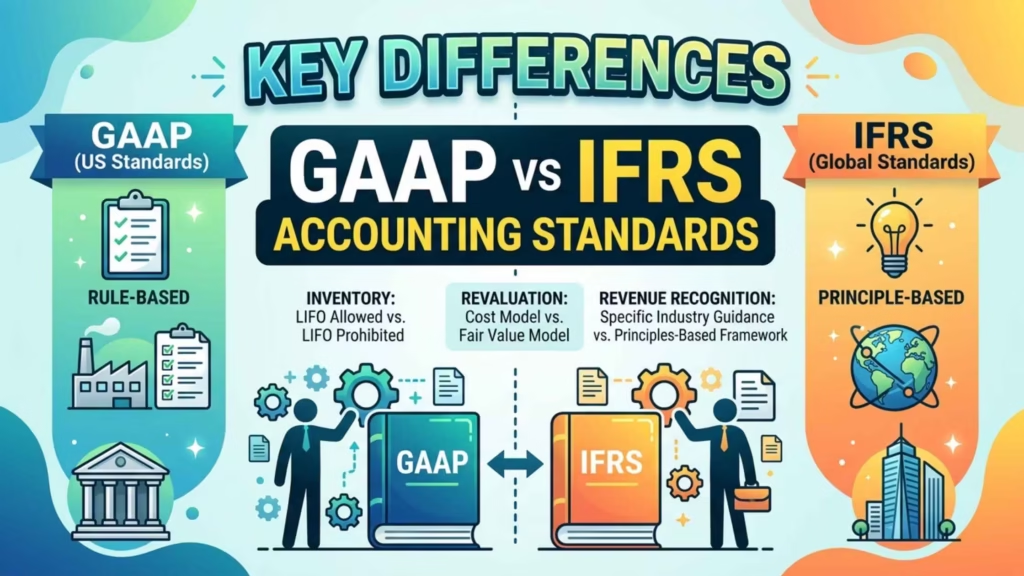
- Rules vs. Principles: GAAP is rules-based, emphasizing detailed application, while IFRS is principles-based, granting preparers more discretion.
- Inventory Methods: GAAP allows Last-In, First-Out (LIFO); IFRS prohibits it.
- Intangible Assets: IFRS allows some capitalization of development costs; GAAP requires expensing.
- Asset Revaluation: IFRS permits revaluation in certain cases, but GAAP does not.
- Extraordinary Items: GAAP reports these separately; IFRS does not recognize them.
- Component Depreciation: IFRS requires it; GAAP leaves it optional.
These ifrs vs gaap differences may seem technical, but their impact on financial ratios, loan agreements, and global comparability is profound.
How Do These Differences Impact U.S. Financial Reporting and Compliance?
Anyone researching difference between ifrs and gaap should consider the operational and compliance implications. For example:
- Comparability: U.S. entities may face difficulties benchmarking financials against international peers.
- Audit Readiness: Auditors require clear documentation and justification for the chosen framework and policies.
- Investor Relations: Inconsistent financial reporting can deter international investors.
- Regulatory Scrutiny: The SEC expects listed entities to comply strictly with GAAP and disclose material differences if referencing IFRS.
A lack of awareness regarding the differences between gaap and ifrs may result in compliance gaps, missed disclosure requirements, and increased risk exposure during regulatory audits.
What Experts Are Saying
TheComplyGuide brings together a panel of industry-recognized experts who are uniquely positioned to educate U.S. finance professionals on the nuances of global accounting standards:
- Jason Dinesen, EA, LPA, a renowned tax expert and frequent ComplyGuide speaker, observes, “Understanding both GAAP and IFRS is non-negotiable for U.S. professionals working with multinational clients. Even minor misinterpretations can lead to material misstatements or audit findings.”
- Dev Strischek, Principal at Devon Risk Advisory Group and a member of the FASB’s Private Company Council, notes, “The convergence efforts have narrowed some gaps, but there remain significant ifrs and gaap difference issues, especially for banks and lenders assessing credit risk.”
- Deborah Wolfe, Management Accountant, adds, “Companies must be vigilant about which framework they apply. The wrong choice can undermine not only compliance, but also competitiveness in attracting global capital.”
Their collective experience ensures that all training delivered by TheComplyGuide is grounded in real-world scenarios that go beyond academic theory.
How Can U.S. Organizations Prepare?
Companies evaluating ifrs vs gaap differences should take proactive steps to ensure compliance and maximize financial transparency:
- Conduct a Gap Analysis: Review which standards apply to each entity, subsidiary, or reporting unit.
- Update Accounting Policies: Align internal documentation and controls to reflect the chosen framework.
- Invest in Training: Equip finance and compliance teams with in-depth, expert-led education on the differences between gaap and ifrs.
- Monitor Regulatory Updates: Ensure awareness of ongoing FASB and IASB activities, as convergence and divergence issues continue to evolve.
- Leverage Expert Guidance: Participate in webinars and workshops led by recognized professionals, such as those offered by TheComplyGuide.
Organizations looking for key differences between gaap and ifrs must recognize that the stakes are high. The wrong interpretation or application can impact everything from tax liabilities to investor confidence.
Why Choose TheComplyGuide for Training on GAAP and IFRS?
TheComplyGuide is a U.S.-based leader in compliance education, offering expert-led live webinars designed specifically for accounting professionals, CFOs, auditors, and compliance officers. Our programs are not generic—they are developed by subject matter experts such as Jason Dinesen, Dev Strischek, and Deborah Wolfe, who bring decades of U.S. and international accounting experience.
- Expert-Led Instruction: Learn directly from regulatory veterans and accounting authorities.
- Up-to-Date Content: Courses are updated to reflect the latest FASB and IASB guidance, enforcement actions, and case studies.
- Interactive Webinars: Live Q&A ensures that your specific challenges are addressed.
- On-Demand Access: Webinar recordings are available to registered participants for ongoing reference.
- Comprehensive Coverage: From foundational differences to advanced application scenarios, every session is tailored for U.S. entities.
Don’t let knowledge gaps in ifrs and gaap difference put your organization at risk. TheComplyGuide’s training is designed to turn compliance from a check-the-box exercise into a competitive advantage.
To learn more or register for upcoming sessions, visit our training page. For customized learning solutions, fill out the contact form or email care@thecomplyguide.com. TheComplyGuide team is committed to responding in the shortest turnaround time.
About TheComplyGuide
TheComplyGuide is a U.S.-based provider of expert-led compliance training and continuing education. We serve regulated industries including finance, life sciences, HR, manufacturing, and healthcare. Our training programs are delivered by a distinguished faculty of regulatory authorities, compliance strategists, and subject matter experts featured on our Regulatory Experts page.
Our mission is to empower organizations with the knowledge, skills, and confidence needed to meet evolving regulatory expectations, minimize risk, and foster a culture of compliance and integrity.
Frequently Asked Questions
What are the key differences between GAAP and IFRS in accounting?
The key differences between GAAP and IFRS in accounting relate to their principles, rules, and requirements for financial reporting. GAAP (Generally Accepted Accounting Principles) is primarily used in the United States and is more rule-based, focusing on detailed guidelines. IFRS (International Financial Reporting Standards), used in more than 140 countries, is principle-based and allows for broader interpretation. Major distinctions can be found in revenue recognition, inventory costing, and asset revaluation. TheComplyGuide provides expert resources to help organizations navigate these differences efficiently.
How do the differences between GAAP and IFRS impact financial statements?
The differences between GAAP and IFRS impact how assets, liabilities, income, and expenses are reported. For example, inventory valuation methods like LIFO are permitted under GAAP but not under IFRS. This can affect reported profits and tax liabilities. TheComplyGuide offers practical tools and tailored guidance to help you understand these impacts and ensure your statements meet the correct standards.
Can you explain the main differences between GAAP and IFRS regarding revenue recognition?
The main differences between GAAP and IFRS in revenue recognition stem from their underlying frameworks. GAAP provides detailed, industry-specific rules, while IFRS emphasizes general principles. This means IFRS may allow more judgment in determining when revenue is recognized. TheComplyGuide’s comparison charts and checklists can help organizations quickly understand which guidance applies to their operations.
What is the IFRS and GAAP difference in asset revaluation?
The IFRS and GAAP difference in asset revaluation is significant. IFRS permits companies to revalue certain non-current assets to fair value, updating the balance sheet to reflect current market conditions. GAAP generally prohibits this, requiring assets to be carried at historical cost. TheComplyGuide’s solutions provide up-to-date insights and templates to manage these requirements.
How does TheComplyGuide assist with IFRS vs GAAP differences for multinational businesses?
TheComplyGuide assists multinational businesses by offering side-by-side comparisons, implementation guides, and training modules focused on IFRS vs GAAP differences. Our resources are designed to streamline your global compliance processes, reduce risk, and ensure accurate, timely reporting across jurisdictions.
What is the difference between IFRS and GAAP in terms of inventory accounting?
The difference between IFRS and GAAP in inventory accounting is that GAAP allows the Last-In, First-Out (LIFO) method, while IFRS does not. This can result in different cost of goods sold and ending inventory values. TheComplyGuide clarifies these distinctions and provides examples to help your team make informed decisions.
How frequently are updates to GAAP and IFRS standards released, and how does TheComplyGuide keep users informed?
Both GAAP and IFRS are updated regularly as new accounting issues arise. TheComplyGuide monitors these updates closely, providing timely alerts and update summaries to ensure your organization is always aligned with the latest standards and aware of any new key differences between GAAP and IFRS.
Why is it important to understand the main differences between GAAP and IFRS when expanding internationally?
Understanding the main differences between GAAP and IFRS is essential when entering new markets, as compliance with local regulations is mandatory. Failure to adapt can lead to reporting errors, penalties, or reputational risks. TheComplyGuide’s comprehensive resources enable your team to handle cross-border reporting challenges with confidence.
Can TheComplyGuide help with staff training on IFRS and GAAP difference topics?
Yes, TheComplyGuide offers a wide range of staff training solutions covering every IFRS and GAAP difference. Our programs are tailored to your organization’s needs, ensuring your team understands regulatory requirements and best practices for both frameworks.