
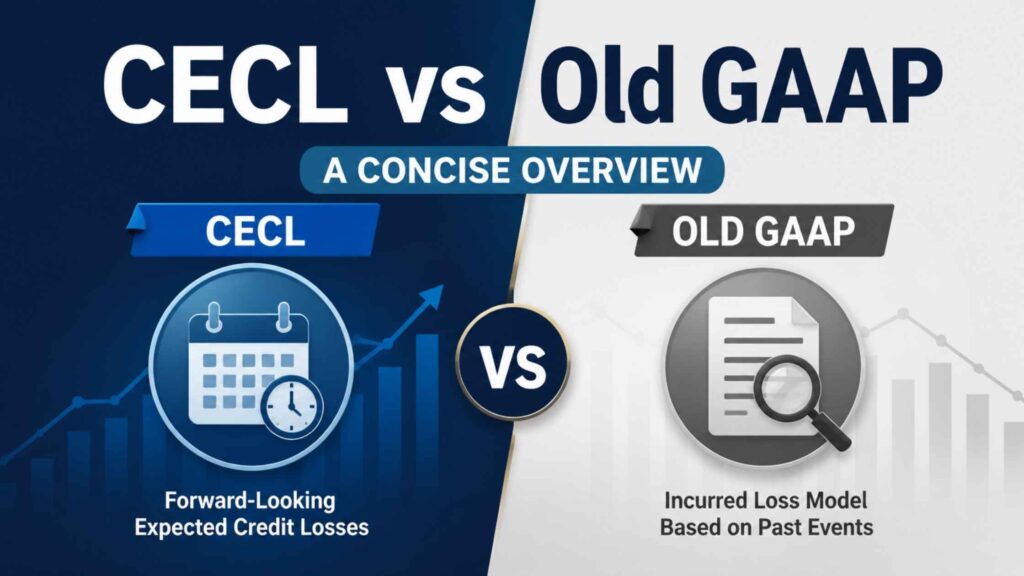
What Is CECL vs Old GAAP Accounting? A Concise Overview
The difference between CECL and traditional (pre-CECL) GAAP accounting standards is central to how U.S. financial institutions and corporations estimate and report credit losses. In 2023, according to the Financial Accounting Standards Board (FASB)—the organization responsible for creating and updating U.S. GAAP—over 80% of large U.S. banks had fully implemented the Current Expected Credit Losses (CECL) model, marking one of the most significant accounting shifts in decades. This rapid adoption reflects the urgency and scope of compliance challenges organizations now face.
CECL, mandated by the FASB through Accounting Standards Update (ASU) 2016-13, fundamentally changes how credit losses are estimated and reported in financial statements. While both CECL and legacy GAAP accounting rules fall under the broader U.S. GAAP framework, and both aim to ensure accurate recognition of losses, the approaches, assumptions, and timing of recognition vary dramatically.
Anyone researching CECL vs GAAP accounting should begin by understanding the “expected loss” orientation of CECL compared to the “incurred loss” methodology used under previous GAAP standards. This distinction affects everything from financial reporting rules to audit compliance and has direct implications for organizations’ risk management, capital planning, and regulatory reporting.
How Do CECL and Old GAAP Accounting Standards Compare?
CECL (Current Expected Credit Losses) and the legacy GAAP (pre-CECL incurred loss model) represent different paradigms in loss estimation within the U.S. GAAP standards. The following accounting standards comparison table provides a high-level summary:
| Criteria | CECL | Legacy GAAP (Incurred Loss Model) |
|---|---|---|
| Loss Recognition | Based on expected losses over the life of the loan | Based on incurred losses only |
| Forward-Looking Information | Required; incorporates reasonable and supportable forecasts | Not required; relies on past events and current conditions |
| Applicability | All financial assets measured at amortized cost | Loans and receivables under ASC 450 and ASC 310 |
| Impact on Reserves | Typically higher and more volatile reserves | Lower, less volatile reserves |
| Regulatory Alignment | FASB ASU 2016-13, effective for SEC filers in 2020 (with staggered adoption for others) | Historical GAAP, superseded by CECL for most entities |
For organizations evaluating CECL vs GAAP accounting, this accounting standards comparison is the foundation for understanding both operational and compliance impacts.
What Has Changed Recently?
The CECL standard represents a major overhaul in U.S. financial reporting. According to the FASB, public business entities that qualify as SEC filers were required to adopt CECL for fiscal years beginning after December 15, 2019, while all other entities had until 2023. This phased implementation is now substantially complete across the U.S. banking sector.
- Previous Requirements: The incurred loss model recognized losses only when triggered by observable events.
- Current Requirements: CECL requires estimation of lifetime expected credit losses at origination or acquisition, using historical, current, and forecasted data.
- Proposed Future Requirements: While the core CECL guidance is now final and effective, the FASB continues to issue minor updates and technical clarifications as implementation challenges emerge.
The shift to CECL has drawn regulatory scrutiny and prompted extensive industry training, particularly as audit compliance standards for CECL require new documentation, internal controls, and model validation procedures.
Why Is Understanding CECL vs Old GAAP Accounting Critical?
For professionals and organizations in the U.S. financial sector, CECL directly affects loan loss reserves, earnings volatility, capital planning, and the ability to withstand regulatory scrutiny. The Office of the Comptroller of the Currency (OCC) and the Federal Reserve have both emphasized that failure to implement CECL correctly can result in material misstatements, regulatory penalties, and reputational harm.
Among the most searched compliance topics is CECL vs GAAP accounting, as organizations must now demonstrate to auditors and regulators that their credit loss estimates are robust, forward-looking, and compliant with FASB’s standards.
“CECL fundamentally changes the way institutions think about credit risk and portfolio management. It requires a higher level of sophistication in modeling, data management, and governance,” notes Dev Strischek, Principal of Devon Risk Advisory Group and a recognized member of the FASB’s Private Company Council.
What Are the Key Financial Reporting Rules Under CECL?
The financial reporting rules under CECL require organizations to:
- Estimate expected credit losses over the entire contractual life of financial assets
- Use historical, current, and reasonable and supportable forecasted information
- Disclose key assumptions, methodologies, and changes in estimates
- Provide enhanced transparency around risk exposures and reserve adequacy
The FASB and key federal banking agencies—including the FDIC and OCC—have issued joint statements clarifying expectations for CECL documentation, governance, and internal controls. This includes model validation, back-testing, management oversight, and board reporting.
Organizations looking for financial reporting rules guidance should ensure internal teams are trained to interpret and apply these requirements in everyday decision-making.
What Are the Most Common Audit Compliance Issues with CECL?
Audit compliance under CECL requires new processes, controls, and documentation. Auditors now expect:
- Comprehensive model documentation and rationale for chosen methodologies
- Clear evidence of governance and management review
- Demonstrated use of reasonable and supportable forecasts
- Transparent disclosures of assumptions, changes, and uncertainties
- Effective challenge and back-testing of model outputs
According to a recent survey by the American Institute of CPAs (AICPA), more than 65% of U.S. banks identified audit compliance with CECL as a “material challenge” during their first year of implementation.
For organizations seeking robust audit compliance, continuous education and expert-led training are essential to avoid regulatory findings or negative audit opinions.
What Experts Are Saying
TheComplyGuide’s own regulatory experts emphasize that successful CECL adoption hinges on a deep understanding of both accounting theory and practical implementation.
- Dev Strischek (Principal, Devon Risk Advisory Group LLC; FASB PCC member): “CECL is not simply an accounting change, but a transformation in how credit risk is managed across the enterprise. Institutions must invest in training, data, and model governance to get it right.”
- Jason Dinesen (Tax and Accounting Expert): “The transition to CECL has far-reaching effects on financial reporting and tax planning. Every accounting professional must be equipped to interpret new disclosures and anticipate downstream impacts for their clients.”
- Deborah Wolfe (Management Accountant): “From an internal controls perspective, CECL requires new levels of cross-functional collaboration. Finance, risk, internal audit, and IT must all work together to ensure compliance.”
The consensus among industry thought leaders is clear: organizations that invest in specialized training and expert guidance are better positioned to navigate the complexities of CECL vs GAAP accounting.
How Can Training Help Organizations Navigate CECL and Old GAAP Differences?
As regulatory landscapes evolve, structured compliance education is a proven way to reduce operational risk and ensure alignment with current regulatory expectations. According to a recent industry study, more than 70% of organizations report a measurable reduction in operational risk after adopting structured compliance training programs.
TheComplyGuide delivers comprehensive, expert-led webinars and live training sessions that address CECL vs GAAP accounting, financial reporting rules, and audit compliance for U.S. financial institutions, auditors, and accounting professionals.
- Live, interactive webinars led by recognized regulatory authorities
- In-depth analysis of accounting standards comparison and real-world implementation scenarios
- On-demand access to recorded sessions for ongoing reference
- Customizable learning paths tailored to your organization’s needs
Our regulatory experts, such as Dev Strischek and Jason Dinesen, bring decades of practical experience and up-to-the-minute regulatory insight. Their sessions not only explain the “what” and “how” of CECL but also provide actionable strategies for implementation and compliance.
TheComplyGuide: The Authority in Regulatory Training
TheComplyGuide is a leading provider of expert-led compliance training for accounting, finance, and risk professionals across the United States. Our programs are developed and delivered by a panel of renowned regulatory authorities and practitioners, ensuring both technical accuracy and practical relevance.
Why do organizations trust TheComplyGuide?
- Courses are created by former government regulators, policy architects, and industry veterans
- Training is tailored by domain—accounting, finance, banking, HR, and more
- Live sessions ensure real-time engagement and Q&A with subject matter experts
- Participants gain actionable, role-specific knowledge that drives measurable results
For organizations seeking to strengthen their financial reporting integrity, meet audit compliance requirements, and stay ahead of evolving accounting standards, TheComplyGuide provides a single, authoritative solution.
To learn more or to request a demo:
- Fill out the contact form on our website
- Email us at care@thecomplyguide.com
Our team will respond in the shortest turnaround time to help you build a training strategy that works—today and tomorrow.
About TheComplyGuide
TheComplyGuide is a U.S.-based compliance education provider, specializing in live, expert-led webinars and training for regulated sectors. Our programs are designed to empower organizations with practical, actionable compliance knowledge—shaped by real-world enforcement experience and regulatory foresight.
Trusted by accounting professionals, financial institutions, and compliance leaders nationwide, TheComplyGuide is your partner in achieving robust governance, minimizing risk, and driving lasting compliance outcomes.
Frequently Asked Questions
What is the main difference between CECL and traditional GAAP accounting standards?
The key difference between CECL and traditional GAAP accounting is how expected credit losses are measured and reported. CECL, or Current Expected Credit Loss, requires institutions to estimate and recognize all expected credit losses over the life of a financial asset upon initial recognition, rather than waiting for a probable loss event. In contrast, the legacy GAAP model recognized losses only when it was probable they had already been incurred. This shift in financial reporting rules aims to make provisions more forward-looking and timely.
Why is the CECL model considered a more forward-looking approach?
CECL is considered forward-looking because it requires organizations to incorporate reasonable and supportable forecasts into their credit loss estimates. Unlike previous GAAP methods, which relied more on historical loss experience and current conditions, CECL anticipates future economic scenarios, making accounting standards comparison between the two especially significant for organizations with complex lending portfolios.
How do CECL and GAAP impact loan loss reserves and financial reporting?
Under CECL, institutions typically recognize higher initial loan loss reserves since they must estimate credit losses expected over the entire life of financial assets. This contrasts with the traditional GAAP incurred loss model, which generally resulted in smaller, delayed provisions. TheComplyGuide helps organizations navigate these adjustments in financial reporting rules to ensure accurate and compliant disclosures.
What challenges do organizations face when transitioning from GAAP to CECL?
Transitioning to CECL can be complex, requiring significant changes in data collection, modeling, and internal controls. Organizations must develop new estimation methodologies and documentation to support their reserve calculations. TheComplyGuide offers step-by-step guidance, templates, and technology solutions to streamline the transition and meet audit compliance requirements efficiently.
How does TheComplyGuide help with CECL implementation and ongoing compliance?
TheComplyGuide provides practical resources, expert advice, and automated tools for organizations adopting CECL. From initial gap analysis to implementation and ongoing reporting, TheComplyGuide ensures you stay aligned with evolving financial reporting rules and pass regulatory scrutiny with confidence. Their solutions reduce manual workload and help maintain strict audit compliance.
Is the CECL model mandatory for all institutions, or are there exceptions?
CECL is required for most financial institutions issuing credit, including banks, credit unions, and certain other lenders, under U.S. GAAP. However, the implementation timelines and some technical aspects may differ based on institution size and type. TheComplyGuide keeps you up-to-date on applicability and helps you interpret the latest accounting standards comparison for your specific needs.
How does CECL affect audit compliance and regulatory examinations?
CECL introduces enhanced documentation and validation requirements for audit compliance. Auditors and regulators will closely examine your estimation methodologies, controls, and reporting. TheComplyGuide offers comprehensive checklists and best practices to help your organization prepare for audits and regulatory reviews, minimizing the risk of findings or penalties.
What steps should organizations take to ensure a smooth CECL adoption process?
Key steps include conducting a detailed gap analysis, updating internal policies, selecting the right modeling approach, training staff, and testing systems. TheComplyGuide’s tailored solutions support each phase, ensuring your transition from GAAP to CECL meets the latest financial reporting rules and accounting standards comparison benchmarks with minimal disruption.
What does the term “cecl vs gaap accounting” mean for financial institutions?
The phrase “cecl vs gaap accounting” refers to comparing the Current Expected Credit Loss (CECL) model with the traditional Generally Accepted Accounting Principles (GAAP) incurred loss model. For financial institutions, this comparison highlights the shift from recognizing losses only when probable (GAAP) to forecasting and recording expected credit losses over the asset’s lifetime (CECL), impacting reserve calculations, data requirements, and financial disclosures.
Why is understanding cecl vs gaap accounting important for organizations preparing for audits?
Understanding cecl vs gaap accounting is crucial because auditors closely review how credit losses are estimated under each standard. CECL requires more robust forward-looking data and documentation than legacy GAAP approaches. Organizations need to demonstrate compliance with the newer CECL methodology while maintaining clarity over historical GAAP processes to pass audits and meet regulatory expectations.