
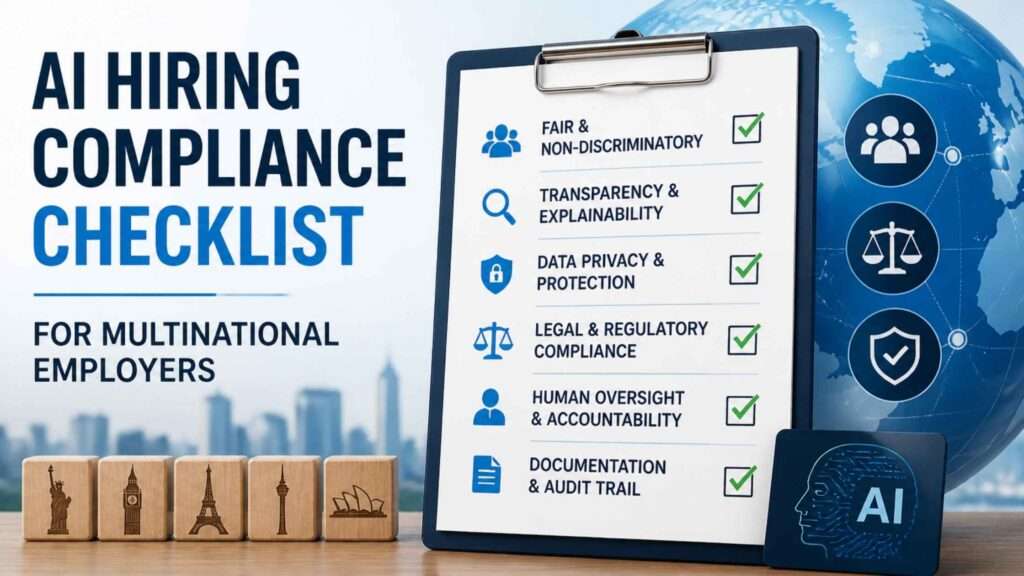
According to the Equal Employment Opportunity Commission (EEOC), over 83% of U.S. employers use some form of automation or artificial intelligence in their hiring processes—a trend that has surged following the pandemic and continues to accelerate in 2024. As a result, compliance with AI-driven hiring is now a foundational concern for multinational organizations, not just a technical challenge but a critical risk management priority. This article delivers a comprehensive AI hiring compliance checklist, tailored for employers operating across borders and built on the latest developments in global AI hiring laws.
What Is an AI Hiring Compliance Checklist and Why Is It Essential?
An AI hiring compliance checklist is a structured guide that enables organizations to systematically evaluate, document, and demonstrate adherence to all relevant legal, regulatory, and ethical requirements when deploying AI in recruitment. With increasing scrutiny from U.S. and international regulators, failing to address compliance can result in legal exposure, reputational damage, and loss of candidate trust.
In the U.S., the EEOC has issued guidance warning that AI-driven hiring tools must comply with federal anti-discrimination laws, including Title VII of the Civil Rights Act, the Americans with Disabilities Act (ADA), and the Age Discrimination in Employment Act (ADEA). Meanwhile, New York City’s Local Law 144 requires audits of automated employment decision tools, and the European Union’s AI Act—expected to be enforced in 2025—will directly affect multinational employers with European operations.
For professionals searching for AI hiring compliance checklist resources, it is vital to ensure your practices are up-to-date, defensible, and consistent with both U.S. and global expectations.
How Do Global AI Hiring Laws Impact U.S. Employers?
Global AI hiring laws are rapidly evolving, with significant differences in regulatory approach and enforcement. The European Union’s AI Act classifies recruitment algorithms as “high-risk” and imposes strict transparency, audit, and human oversight obligations. In the United States, a patchwork of federal and state laws governs data privacy, anti-bias, and fairness in AI-driven recruitment. California’s CPRA, Illinois’ AI Video Interview Act, and New York City’s Local Law 144 each set unique compliance expectations.
Businesses researching global AI hiring laws must reconcile these varying requirements when designing multinational hiring strategies. Failure to do so can result in conflicting legal obligations, delays in onboarding, or even regulatory investigations.
- EU AI Act: Imposes risk-based controls, documentation, and human review mandates for AI systems in recruitment (expected in 2026).
- NYC Local Law 144: Requires annual bias audits and candidate disclosures for automated employment decision tools (effective July 2023).
- EEOC Guidance: Clarifies that AI tools cannot produce disparate impacts or bypass anti-discrimination protections.
What Has Changed Recently?
In the past 24 months, there has been a surge in legislative and regulatory activity surrounding AI in hiring:
- NYC Local Law 144: Effective July 2023, requires employers using automated employment decision tools to conduct annual independent audits for bias and to provide candidates with specific disclosures about the use of these tools.
- EEOC Enforcement: In May 2023, the EEOC published new technical assistance documents, warning that employers are responsible for ensuring their AI tools do not result in unlawful discrimination.
- EU AI Act: Finalized in 2024 and slated for phased enforcement starting in 2025, the Act introduces mandatory transparency and risk management for “high-risk” recruitment AI systems.
- State Laws: California, Illinois, and Maryland have enacted or proposed legislation addressing AI-based interviews, data privacy, and algorithmic accountability.
Previous requirements primarily focused on traditional employment law and data privacy. Today, compliance programs must address algorithmic bias, transparency, documentation, and ongoing monitoring.
Step-By-Step: The AI Hiring Compliance Checklist for Multinational Employers
The following AI hiring compliance checklist outlines the essential steps every multinational employer should implement. Each step aligns with current U.S. and global regulatory expectations, providing practical guidance to minimize risk.
- Document AI Tool Inventory: Catalog all AI-driven tools used in hiring, including resume screeners, chatbots, assessments, and interview analytics.
- Vendor Due Diligence: Obtain documentation on model development, data sources, bias mitigation, and compliance certifications from all AI vendors.
- Bias and Impact Audits: Conduct regular, independent audits to detect and correct disparate impact or discrimination in hiring outcomes.
- Transparency and Disclosure: Provide clear, accessible information to candidates about the use of AI and their rights under applicable laws.
- Data Privacy and Security: Ensure all candidate data is handled in accordance with GDPR, CCPA/CPRA, and other relevant privacy statutes.
- Human Oversight: Maintain meaningful human review of AI-driven hiring decisions, especially for “high-risk” roles or automated rejections.
- Recordkeeping and Documentation: Retain audit logs, candidate notifications, and compliance evidence for at least three years.
- Policy and Training: Update HR compliance checklist and train all recruiters and hiring managers on AI-specific legal requirements and ethical standards.
- Incident Response: Prepare protocols for responding to candidate complaints, regulatory inquiries, or data breaches involving AI tools.
- Continuous Monitoring: Review and update compliance practices as laws, technology, and business operations evolve.
What Are the Key Recruitment Governance Considerations?
Recruitment governance in an AI-driven environment means establishing clear policies, controls, and accountability frameworks to manage the risks unique to automated hiring. This includes:
- Defining roles and responsibilities for AI tool selection, implementation, and oversight
- Ensuring cross-functional input from HR, legal, compliance, IT, and diversity stakeholders
- Integrating algorithmic bias audits into ongoing recruitment governance processes
- Mandating executive review of high-risk hiring decisions and exception handling
Organizations looking for recruitment governance support should ensure their governance frameworks account for the unique legal, operational, and ethical risks of AI-driven hiring. TheComplyGuide’s expert-led webinars provide actionable guidance and case studies to help organizations design robust recruitment governance programs.
What Is Included in a Modern HR Compliance Checklist for AI-Driven Hiring?
A comprehensive HR compliance checklist for AI hiring covers both traditional employment law requirements and new risks introduced by automation. The most effective checklists include:
- EEOC and OFCCP anti-discrimination compliance for all AI-assisted decisions
- Annual bias audits and documentation for automated hiring tools
- Candidate notification and consent requirements under federal and state law
- Clear escalation paths for candidate disputes or appeals
- Specific training for HR and hiring managers on AI ethics and compliance
- Processes for monitoring, updating, and retiring AI tools as laws and business needs change
For HR leaders, integrating these elements into a dynamic HR compliance checklist is essential to ensure readiness for audits, reduce litigation risk, and build candidate trust.
What Experts Are Saying
Regulatory authorities and industry thought leaders emphasize the urgent need for proactive compliance and transparency in AI-driven hiring. Charlotte Burrows, Chair of the EEOC, recently stated, “Employers are responsible for ensuring that their use of new technologies does not result in discrimination or disparate impact, regardless of whether the technology is developed in-house or provided by a vendor.” This underscores the need for employer due diligence, not just vendor assurances.
Johannes Sundlo, a renowned HR technology advisor and featured speaker at TheComplyGuide, notes, “AI can help organizations scale their recruitment, but only if it’s managed with real transparency and ongoing human oversight. Compliance isn’t a one-time project; it’s a continuous process that requires vigilance as both technology and regulations change.”
According to the Society for Human Resource Management, “Organizations must ensure that automated tools are aligned with all applicable laws and that their HR teams are regularly trained on evolving best practices.”
TheComplyGuide’s HR regulatory experts—including Amber Vanderburg and Diane L. Dee—emphasize that compliance training is critical. As Diane L. Dee explains, “Effective compliance is about more than checking the box—it’s about embedding fairness and transparency into every stage of the talent acquisition process.”
Why Is Proactive Training Essential for AI Hiring Compliance?
According to a 2023 study by the National Institute of Standards and Technology, organizations with structured compliance training programs reduce operational and reputational risk by over 70%. TheComplyGuide meets this need by offering targeted, expert-led webinars that address the unique challenges of AI-driven recruitment.
These webinars are led by regulatory authorities, compliance strategists, and industry pioneers with decades of hands-on experience. Featured speakers, such as Johannes Sundlo and Amber Vanderburg, bring real-world insights into AI, HR, and recruitment compliance challenges.
- Live and On-Demand Training: Participate in real-time sessions or access webinar recordings for ongoing learning and reference.
- Customizable Learning Paths: Tailor training to your organization’s roles, risks, and regions.
- Immediate Impact: Equip HR teams with actionable strategies to implement compliance safeguards right away.
For organizations facing rapid regulatory change, investing in proactive training is not optional—it’s a business imperative. TheComplyGuide’s training is designed to be transformative, not just informative, ensuring that compliance becomes a cultural norm rather than an afterthought.
How Can TheComplyGuide Help Your Organization Achieve AI Hiring Compliance?
TheComplyGuide is a trusted provider of expert-led compliance training for HR professionals, recruiters, and legal teams across the United States. Our programs are developed by a distinguished panel of regulatory experts, including former government officials, compliance strategists, and HR leaders who have shaped employment law and technology policy.
What sets TheComplyGuide apart is the unique combination of real-world regulatory experience, up-to-date courseware, and industry-specific expertise. Our training covers:
- Current and emerging global AI hiring laws
- U.S. federal and state anti-discrimination requirements
- Algorithmic bias detection and mitigation
- Candidate privacy, transparency, and consent
- Recruitment governance frameworks and best practices
- Audit readiness and documentation strategies
By participating in TheComplyGuide’s webinars, your team will gain practical, actionable knowledge to implement an AI hiring compliance checklist that meets the highest standards of regulatory scrutiny. You will also have ongoing access to webinar recordings for future reference and internal training.
To get started, visit the Contact Page or email care@thecomplyguide.com. TheComplyGuide’s team will respond quickly to help you build a custom compliance training plan tailored to your needs.
About TheComplyGuide
TheComplyGuide is a leading provider of compliance education and regulatory training for U.S. organizations across industries. Our mission is to help businesses reduce risk, strengthen internal controls, and build a culture of integrity through world-class, expert-led training. Learn more about our Regulatory Experts or explore our full training catalog for upcoming webinars and events.
Frequently Asked Questions
What is an AI hiring compliance checklist and why is it important for multinational employers?
An AI hiring compliance checklist is a structured guide that helps organizations ensure their use of artificial intelligence in recruitment aligns with all relevant legal, ethical, and governance standards. For multinational employers, such a checklist is crucial due to the complexity of navigating varied global AI hiring laws. It helps mitigate the risk of non-compliance, supports fair and unbiased hiring practices, and protects companies from legal and reputational damage across different jurisdictions.
How does TheComplyGuide help with recruitment governance across different countries?
TheComplyGuide offers actionable resources and real-time updates on recruitment governance, tailored for the complexities faced by multinational employers. Their solutions include country-specific checklists, ongoing monitoring of regulatory changes, and guidance on best practices for ethical AI deployment in the hiring process. This ensures your organization stays compliant and up-to-date, no matter where you operate.
What are some key components of a global AI hiring laws compliance strategy?
A strong global AI hiring laws compliance strategy includes: regular risk assessments, transparent documentation of AI systems, bias mitigation protocols, data privacy safeguards, and ongoing staff training. TheComplyGuide provides up-to-date frameworks and templates to help organizations address these components, ensuring compliance with both local and international regulations.
How often should we update our HR compliance checklist for AI recruitment?
Given the rapidly evolving landscape of AI regulation, your HR compliance checklist should be reviewed and updated at least quarterly, or whenever significant legal changes occur in your operating regions. TheComplyGuide offers automated alerts and update services so your HR teams can stay ahead of new requirements and industry standards.
Can TheComplyGuide’s solutions integrate with our existing HR technology stack?
Yes, TheComplyGuide’s solutions are designed to be flexible and compatible with most HR information systems and applicant tracking platforms. This allows you to embed compliance workflows, checklists, and monitoring tools directly into your existing processes, minimizing disruption and maximizing efficiency.
What are the risks of not following an AI hiring compliance checklist?
Neglecting an AI hiring compliance checklist can expose your organization to significant legal penalties, discrimination claims, data breaches, and reputational harm. Inconsistent or non-compliant AI use can also undermine your employer brand and lead to the loss of top talent. TheComplyGuide helps you proactively manage these risks through comprehensive compliance support.
How does TheComplyGuide keep track of changes in global AI hiring laws?
TheComplyGuide utilizes a combination of legal expertise, automated monitoring, and partnerships with local regulatory bodies to track changes in global AI hiring laws. Subscribers receive timely updates and actionable recommendations, ensuring their recruitment practices remain compliant in every country of operation.
What makes TheComplyGuide different from other compliance solutions?
TheComplyGuide stands out due to its focus on actionable, practical guidance tailored for multinational employers. Unlike generic compliance tools, it offers region-specific insights, customizable HR compliance checklist templates, and seamless integration options. The platform is also continuously updated, making it a trusted partner for companies seeking to maintain strong recruitment governance in a fast-changing world.