
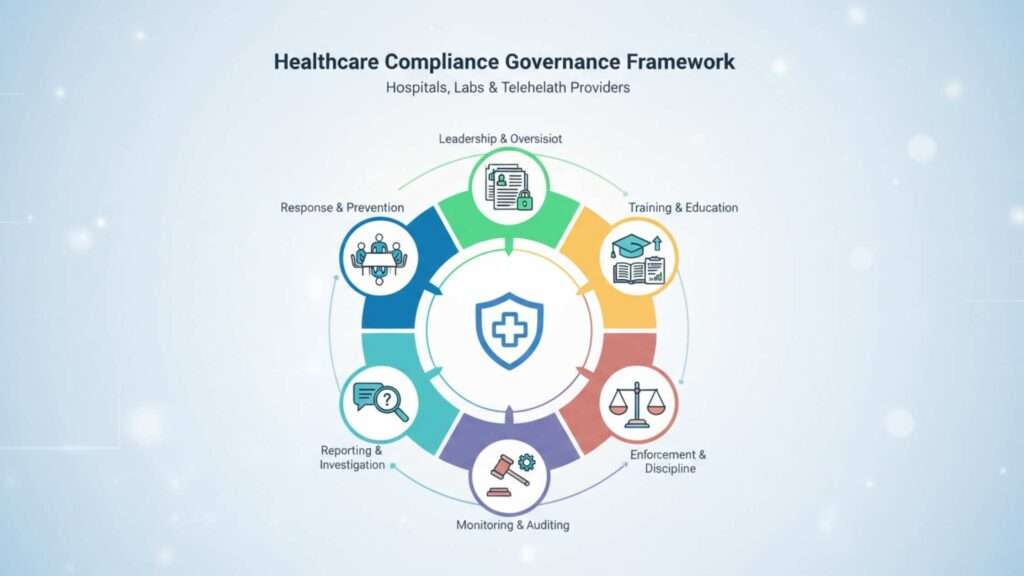
What is Healthcare Compliance Governance? Healthcare Compliance Governance is the comprehensive system of policies, oversight, and accountability that ensures hospitals, labs, and telehealth providers operate within the requirements of federal and state laws, industry standards, and ethical practices. According to the U.S. Department of Health and Human Services, more than 80% of healthcare enforcement actions in 2023 involved failures in compliance governance or risk management frameworks. This statistic highlights the urgent need for robust, proactive governance structures in healthcare organizations.
In a rapidly evolving regulatory environment, establishing a sound healthcare governance framework is not only a legal necessity but also a strategic imperative. The landscape is shaped by ongoing legislative changes, increasing scrutiny from agencies such as the Centers for Medicare & Medicaid Services (CMS), the Office for Civil Rights (OCR), and the Food and Drug Administration (FDA), and an ever-present threat of cyber intrusions. For hospitals, clinical labs, and telehealth providers, the stakes include not just fines, but reputational damage, operational disruption, and potential harm to patients.
What Has Changed Recently in Healthcare Compliance?
The last two years have seen significant regulatory shifts impacting compliance program structure across healthcare entities:
- 2023 HIPAA Guidance Updates: The OCR released new guidance on the use of online tracking technologies in healthcare, emphasizing the need for risk assessments and patient data protection even in virtual care settings.
- CMS Interoperability Rules: The push for improved electronic health record (EHR) interoperability has led to stricter requirements for data sharing, patient consent, and information blocking prevention.
- FDA Laboratory Developed Tests (LDT) Oversight: The FDA issued proposed rules in 2023 to regulate LDTs more closely, requiring labs to enhance their quality systems and compliance documentation.
- Telehealth Expansion and Audits: The COVID-19 Public Health Emergency (PHE) waivers are being phased out, with CMS and OIG increasing audits on telehealth billing and credentialing.
It is crucial for compliance leaders to stay updated, as regulatory expectations can shift quickly. TheComplyGuide’s expert-led webinars are designed to ensure your teams are prepared for both current and upcoming changes.
Why Is a Healthcare Governance Framework Essential?
A healthcare governance framework provides the blueprint for consistent, organization-wide compliance. At its core, this framework defines the structures, roles, and processes that enable leadership to oversee risk, monitor controls, and drive ethical behavior.
Organizations looking for healthcare governance framework solutions should seek a program that:
- Establishes clear lines of accountability from the board to frontline staff
- Integrates regulatory requirements from HIPAA, CMS, FDA, and state agencies
- Promotes continuous risk assessment and improvement
- Supports a culture of transparency and reporting
According to the Office of Inspector General (OIG), having a formal governance structure is a key indicator of compliance effectiveness—and a factor considered during enforcement actions and settlements.
What Are the Core Elements of Healthcare Compliance Governance?
Effective Healthcare Compliance Governance is built on several foundational pillars:
-
Leadership Oversight:
Board and executive engagement in compliance is non-negotiable. The OIG recommends that the highest levels of the organization regularly review compliance risks, audit findings, and training outcomes. -
Risk Assessment and Management:
Proactive healthcare risk management means identifying, evaluating, and mitigating compliance threats before they cause harm. This includes privacy breaches, billing errors, and patient safety incidents. -
Policies, Procedures, and Controls:
Clearly documented policies and standard operating procedures (SOPs) form the backbone of compliance. These documents must be regularly updated to reflect new laws and best practices. -
Training and Communication:
Ongoing, expert-led training is essential. As cited by the Health Care Compliance Association, organizations with structured training programs see a 60% reduction in repeat violations. -
Auditing and Monitoring:
Regular internal auditing, supported by technology where possible, helps identify gaps and measure program effectiveness. -
Incident Response and Investigation:
A clear process for reporting, investigating, and remediating compliance incidents protects the organization and its patients. -
Continuous Improvement:
Compliance is never “done.” Ongoing assessment and adjustment are vital as regulations and risks evolve.
How Does Enterprise Compliance Healthcare Differ by Setting?
Enterprise compliance healthcare frameworks must be tailored to the specific risks and regulatory pressures of hospitals, laboratories, and telehealth providers:
-
Hospitals:
- Face complex billing, privacy, and safety mandates
- Require integration between departments and IT systems
- Are subject to frequent audits from multiple regulatory bodies
-
Clinical Laboratories:
- Must comply with CLIA, FDA, and state laboratory regulations
- Face unique data integrity and test validation risks
- Increasingly under scrutiny due to LDT oversight changes
-
Telehealth Providers:
- Deal with evolving Medicare and Medicaid billing rules
- Face heightened cybersecurity and patient privacy risks
- Must adapt to post-PHE regulatory requirements
Anyone researching enterprise compliance healthcare should ensure their program reflects these distinctions, leveraging expert guidance when designing controls and policies.
What Makes an Effective Compliance Program Structure?
The OIG and U.S. Sentencing Commission have outlined what constitutes an effective compliance program structure in healthcare:
- Dedicated compliance officer with direct access to senior management
- Written standards of conduct and policies
- Ongoing risk-based training for all staff
- Robust internal reporting and investigation mechanisms
- Regular auditing of high-risk activities, such as billing and coding
- Enforcement of disciplinary standards for non-compliance
- Continuous program evaluation and improvement
Professionals frequently search for compliance program structure templates and best practices, but generic models rarely address the full complexity of healthcare operations. That’s why TheComplyGuide’s webinars draw on real-world experience from regulatory experts to help you build practical, high-impact frameworks.
What Is the Role of Healthcare Risk Management?
Healthcare risk management is the process of identifying, assessing, and mitigating threats that could compromise patient safety, data privacy, financial integrity, or regulatory compliance. According to the American Society for Health Care Risk Management, integrated risk management programs have become essential as cyber threats, fraud schemes, and enforcement activity increase in frequency and sophistication.
Searches relating to healthcare risk management continue increasing as organizations seek strategies for:
- Cybersecurity and ransomware prevention
- HIPAA and patient privacy compliance
- Credentialing and staff licensure
- Incident reporting and root cause analysis
- Emergency preparedness and business continuity
Building a risk-aware culture is a critical part of any healthcare compliance governance program. TheComplyGuide’s expert trainers bring decades of experience in risk management, helping organizations implement proactive controls and response plans.
What Experts Are Saying
Carolyn Troiano, a leading FDA compliance consultant featured by TheComplyGuide, stresses: “Effective compliance is not just about ticking boxes. It’s about building a culture of integrity and accountability, with leadership engagement at every level.”
David Nettleton, Computer System Validation authority, notes: “Software and systems validation are now central to compliance. Hospitals and labs must prioritize data integrity and audit readiness to meet evolving FDA expectations.”
According to the Office for Civil Rights, “Organizations that invest in robust compliance training and risk assessment demonstrate a clear commitment to patient trust and regulatory accountability.”
The consensus among regulatory experts is clear: organizations that treat compliance as a living, strategic function—rather than a static checklist—are better positioned to avoid costly enforcement actions and reputational harm.
How TheComplyGuide Delivers Expert Compliance Training
Organizations looking for Healthcare Compliance Governance solutions need more than generic training. They need guidance from recognized regulatory authorities who understand the unique risks and operational realities of U.S. healthcare.
- All TheComplyGuide webinars are led by industry experts with decades of hands-on experience, including former government regulators, compliance strategists, and policy architects.
- Our expert faculty includes renowned authorities such as Carolyn Troiano, David Nettleton, and other leaders in healthcare, privacy, and risk management.
- Each live webinar is designed around the latest regulatory updates, enforcement trends, and practical implementation strategies.
According to the Health Care Compliance Association, organizations that invest in regular, targeted compliance education see a 60% improvement in audit outcomes and a 43% reduction in regulatory penalties.
With TheComplyGuide, you get more than information—you gain actionable insights, real-world examples, and access to recordings for ongoing reference.
Why Choose TheComplyGuide for Healthcare Compliance?
-
Expert-Led Training:
Sessions are delivered by recognized regulatory authorities who have shaped industry standards. -
Actionable Content:
Every webinar is designed to provide step-by-step guidance—not just theory, but practical tools you can implement immediately. -
Continuous Updates:
Our content is continuously updated to reflect the latest regulatory changes, enforcement priorities, and best practices. -
Flexible Learning:
Access live events and on-demand recordings to fit your schedule. -
Immediate Impact:
Clients report improved audit readiness, reduced risk, and greater staff confidence after completing our programs.
Don’t let preventable gaps become tomorrow’s violations. TheComplyGuide’s programs are trusted by hospitals, labs, and telehealth providers nationwide for their depth, precision, and real-world impact.
About TheComplyGuide
TheComplyGuide is a leading provider of expert-led compliance training for healthcare organizations in the United States. Our panel of experienced regulatory professionals delivers live, actionable education that empowers your teams to stay ahead of complex and evolving regulatory demands.
To join an upcoming webinar or discuss your organization’s needs:
- Fill out the contact form for a prompt response
- Or email us at care@thecomplyguide.com
Our team is committed to responding in the shortest turnaround time.
Conclusion: Take the Lead in Healthcare Compliance Governance
In today’s environment, Healthcare Compliance Governance is not a luxury—it is the foundation for operational excellence, patient trust, and regulatory success. Investing in a robust healthcare governance framework, supported by ongoing risk management and expert-led training, is the surest way to protect your organization and your patients.
TheComplyGuide stands ready to help you build, strengthen, and sustain your compliance program structure, no matter your organization’s size or specialty. Equip your teams with the knowledge, confidence, and skills they need to thrive—now and into the future.
Frequently Asked Questions
What is Healthcare Compliance Governance and why is it important for hospitals, labs, and telehealth providers?
Healthcare Compliance Governance refers to the systems, policies, and oversight mechanisms that ensure healthcare organizations operate within legal, ethical, and regulatory boundaries. For hospitals, labs, and telehealth providers, robust governance is crucial for protecting patient data, ensuring quality care, and maintaining trust with stakeholders. TheComplyGuide helps organizations strengthen their healthcare compliance governance by providing tailored frameworks and tools for ongoing compliance and risk mitigation.
How does a healthcare governance framework help my organization stay compliant?
A healthcare governance framework provides a structured approach to managing compliance, risk, and quality across all levels of your organization. It defines roles, responsibilities, reporting structures, and standard operating procedures that support compliance with regulations and accreditation requirements. TheComplyGuide offers comprehensive frameworks that are easy to implement and adapt for hospitals, labs, and telehealth providers, ensuring ongoing readiness for audits and regulatory changes.
What are the key elements of an effective compliance program structure in healthcare?
An effective compliance program structure includes clear policies and procedures, regular staff training, risk assessments, monitoring and auditing processes, and a system for reporting and addressing violations. TheComplyGuide supports organizations by helping them build and maintain these elements, ensuring that compliance is not only achieved but also sustained as part of daily operations.
How does TheComplyGuide address healthcare risk management for providers?
TheComplyGuide integrates healthcare risk management into its compliance solutions by identifying, assessing, and prioritizing organizational risks. Our platform provides actionable recommendations and tracking tools that allow hospitals, labs, and telehealth providers to mitigate risks related to patient safety, data privacy, billing, and more. This proactive approach minimizes threats and enhances overall compliance.
What makes enterprise compliance healthcare different from standard compliance efforts?
Enterprise compliance healthcare involves a holistic, organization-wide approach that aligns compliance initiatives with business strategy, risk management, and operational processes. Unlike ad-hoc or department-specific compliance programs, enterprise compliance ensures consistency and accountability across all functions. TheComplyGuide’s solutions are designed to scale with your organization, ensuring enterprise-wide compliance and governance.
Can TheComplyGuide help with compliance for telehealth services?
Yes, TheComplyGuide offers specialized compliance frameworks for telehealth providers, addressing unique challenges such as cross-state licensure, data security, and digital patient consent. Our tools and resources keep telehealth organizations up-to-date with evolving telemedicine regulations and best practices within a unified healthcare governance framework.
How often should a healthcare organization review and update its compliance policies?
Healthcare organizations should review and update their compliance policies at least annually, or whenever there are significant regulatory updates or operational changes. TheComplyGuide provides automated alerts and review checklists to help ensure your compliance program structure remains current and effective.
What are the benefits of using TheComplyGuide for my compliance and governance needs?
TheComplyGuide streamlines compliance with user-friendly tools, expert guidance, and customizable templates tailored for hospitals, labs, and telehealth providers. Our platform helps you reduce compliance risks, save time, and build a culture of accountability and transparency, all while supporting your organization’s healthcare compliance governance goals.