
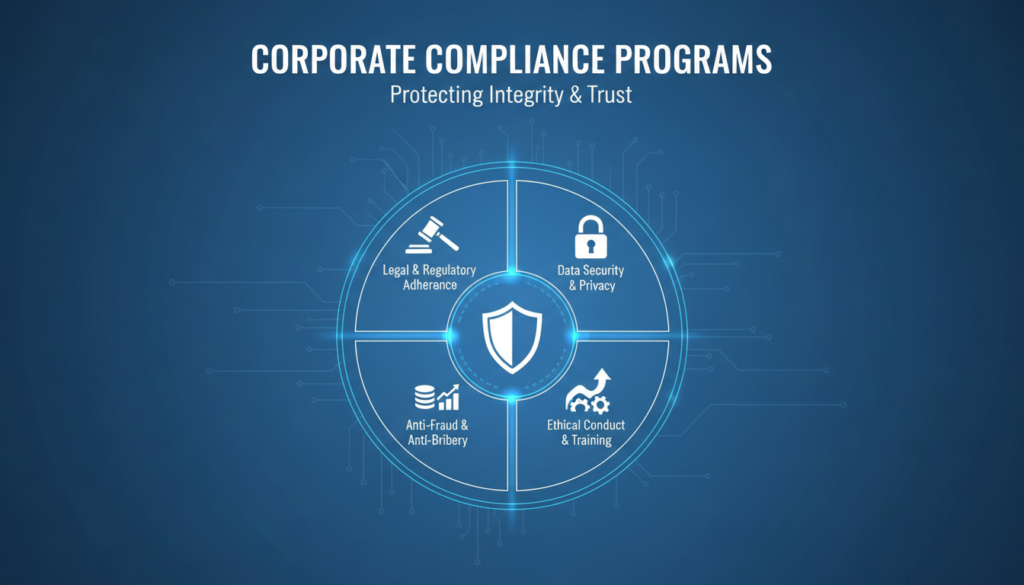
What Is a Corporate Compliance Program and Why Is It Essential?
A corporate compliance program is a structured set of internal policies, processes, and controls designed to ensure that an organization and its employees adhere to laws, regulations, and ethical standards. According to the U.S. Department of Justice, effective compliance programs are a key factor in mitigating penalties and reducing risk during enforcement actions (DOJ Guidance, 2023).
More than 70% of organizations report a measurable reduction in operational risk after implementing structured compliance training (SHRM, 2023). This statistic highlights why a proactive approach to compliance is not just a legal safeguard—it’s a business imperative.
In today’s regulatory climate, U.S. organizations face heightened scrutiny from agencies such as the DOJ, SEC, HHS, and OSHA. Compliance isn’t optional—it’s foundational for sustainable business success.
What Are the Core Elements of Effective Corporate Compliance Programs?
At their core, effective corporate compliance programs are built on seven key pillars, as outlined by the U.S. Sentencing Guidelines and reinforced by regulatory agencies:
- Clear standards and written policies that define expectations and prohibited conduct.
- Leadership commitment—“tone at the top” is set by senior management.
- Ongoing training and communication to educate all employees.
- Robust monitoring and auditing to detect and prevent violations.
- Reporting mechanisms (e.g., hotlines, whistleblower channels) for safe disclosure.
- Consistent enforcement of disciplinary measures for noncompliance.
- Continuous improvement through regular review and updates.
Corporate compliance programs must be tailored to the organization’s size, industry, and risk profile, ensuring both legal and ethical obligations are met.
What Are Real-World Examples of Compliance Programs?
To illustrate these principles, let’s look at several examples of compliance programs that have set industry standards or responded to significant regulatory challenges:
- Healthcare (HIPAA Compliance): Major hospitals and health systems have established multi-layered compliance frameworks addressing data privacy, breach notification, and employee training. These programs include mandatory annual HIPAA training, strict audit trails, and breach simulation drills (HHS HIPAA Enforcement, 2023).
- Banking (BSA/AML Programs): U.S. banks are required by the Bank Secrecy Act to implement anti-money laundering (AML) programs. These include rigorous customer due diligence, transaction monitoring, and suspicious activity reporting. Recent enforcement actions have highlighted the need for continuous improvement and staff training (FinCEN Releases, 2024).
- Life Sciences (FDA Compliance): Pharmaceutical and medical device manufacturers employ compliance programs focused on FDA requirements for product safety, quality assurance, and software validation. Regular audits, supplier oversight, and employee certification are common features.
- Workplace Safety (OSHA): Manufacturers and construction firms operate compliance programs to meet OSHA standards—covering training on hazard communication, incident reporting, and periodic safety drills.
- Data Security (Cybersecurity): Organizations in finance and healthcare increasingly implement compliance programs aligned with NIST Cybersecurity Framework. These cover employee awareness, continuous risk assessments, and incident response planning.
These examples of compliance programs demonstrate how industry leaders integrate legal, ethical, and operational safeguards to reduce risk and protect reputation.
What Are Common Corporate Compliance Examples Across Industries?
Corporate compliance examples can range from anti-bribery training in global supply chains to robust whistleblower protections in financial services. A few notable corporate compliance examples include:
- Code of conduct rollouts that address conflicts of interest, anti-harassment, and anti-retaliation standards.
- Automated transaction monitoring in banking to flag unusual activity as part of BSA/AML compliance.
- Mandatory e-learning modules on HIPAA or GDPR for all staff with access to sensitive data.
- Annual workplace violence prevention training for healthcare and retail employees.
- Supplier code of ethics audits in manufacturing and retail.
These initiatives are integral to strong corporate compliance plans, ensuring that compliance is embedded in day-to-day business activities.
What Do Corporate Compliance Plans Typically Include?
Corporate compliance plans are the documented blueprint for ensuring ongoing adherence to regulatory and ethical obligations. Key components include:
- Written policies and procedures tailored to specific regulations (e.g., FCPA, HIPAA, SOX).
- Assigned compliance officers and clear organizational accountability.
- Risk assessments to identify and prioritize compliance threats.
- Regular training and awareness campaigns for all levels of staff.
- Internal controls and audit processes to detect gaps.
- Incident response plans for managing breaches or violations.
- Mechanisms for anonymous reporting and investigation.
- Periodic review and revision based on regulatory changes and audit findings.
Companies evaluating corporate compliance plans should ensure they are living documents—regularly tested, updated, and aligned with evolving legal requirements.
What Do Corporate Ethics Programs Commonly Include?
Corporate ethics programs commonly include formal codes of ethics, regular employee education, and leadership-driven values. These programs are not only about obeying the law but promoting an organizational culture that prioritizes integrity, fairness, and transparency.
- Comprehensive code of conduct, accessible and understandable for all staff.
- Scenario-based ethics training sessions, often led by external experts.
- Leadership communications reinforcing ethical expectations.
- Systems for reporting ethical concerns without fear of retaliation.
- Ethics hotlines and third-party ombudsman services.
- Regular assessment and benchmarking of ethical climate.
These elements help organizations move from mere compliance to true ethical leadership, reducing the risk of high-profile violations.
What Are Some Recent Examples of Corporate Compliance Violations?
Recent years have seen several high-profile examples of corporate compliance violations across industries. These cases illustrate the significant consequences organizations face when compliance programs are inadequate or ignored:
- Foreign Corrupt Practices Act (FCPA) Violations: In 2023, the SEC and DOJ imposed millions in fines on a U.S. multinational for inadequate anti-bribery controls in its overseas subsidiaries (SEC Press Release, 2023).
- HIPAA Data Breaches: Healthcare organizations have paid record settlements for failing to secure patient data, often due to gaps in employee training and system controls (HHS, 2023).
- Banking AML Failures: In 2024, a regional bank was fined for not filing timely suspicious activity reports and lacking adequate staff training, highlighting the need for up-to-date compliance programs (FinCEN, 2024).
- Workplace Discrimination: The EEOC brought actions against employers for failing to address systemic harassment, underscoring the importance of robust HR compliance and training programs (EEOC, 2024).
These examples of corporate compliance violations serve as reminders that compliance failures can result in substantial legal, financial, and reputational harm.
What Has Changed Recently?
The pace of regulatory change in the U.S. has accelerated over the past 24 months. Key updates relevant to corporate compliance programs include:
- DOJ’s 2023 Revised Evaluation of Corporate Compliance Programs: Emphasizes the importance of continuous training, data-driven monitoring, and executive accountability (DOJ Guidance, 2023).
- SEC’s Focus on ESG (Environmental, Social, Governance): Proposed rules demand more transparent reporting and risk management for U.S. public companies (SEC, 2024).
- OSHA’s Expanded Whistleblower Protections: New guidance strengthens anti-retaliation provisions and enforcement actions (OSHA, 2024).
- HHS Updates to HIPAA and Cybersecurity: Proposed modifications require enhanced data protection and response protocols (HHS, 2024).
Organizations must continuously monitor new regulations, adapt their compliance plans, and retrain employees to remain compliant.
What Experts Are Saying
Leading compliance authorities agree: “Compliance is not a box to check—it’s an ongoing commitment to integrity and operational excellence,” says David Nettleton, a leading FDA compliance specialist and speaker at TheComplyGuide.
Dr. Michael C. Redmond, a cyber security SME and another featured speaker at TheComplyGuide, emphasizes, “Continuous improvement and employee engagement are the hallmarks of a resilient compliance program.”
According to the DOJ, “Prosecutors will consider whether the program is well-designed, applied earnestly, and works in practice—not just on paper” (DOJ, 2023).
How TheComplyGuide Delivers Expert-Led Compliance Training
TheComplyGuide is a U.S.-based leader in compliance education, delivering paid webinars and live training sessions led by nationally recognized regulatory experts. Our faculty includes former government regulators, industry consultants, and compliance veterans with decades of practical experience.
- David Nettleton: FDA compliance and computer system validation
- Dr. Michael C. Redmond: Cyber security, business continuity, and disaster recovery
- Ronald Adler: HR audits, employment law, and risk management
- Doug Keipper: BSA/AML and anti-money laundering training
- Diane L. Dee: HR compliance and workplace investigations
- Paul R. Hales: HIPAA privacy and security
- Amber Vanderburg: Talent development and organizational ethics
Our compliance webinars are interactive, case-based, and updated with the latest regulatory guidance. Participants receive access to session recordings for ongoing reference.
Unlike generic online courses, TheComplyGuide’s training is tailored to U.S. businesses and delivered by authorities who have shaped industry standards.
To learn more or schedule a session, complete the contact form or email care@thecomplyguide.com. Our team responds promptly to all inquiries.
What You Risk by Not Investing in Compliance Training
Failing to implement effective corporate compliance programs can expose organizations to:
- Hefty regulatory fines and penalties
- Costly litigation and settlement expenses
- Operational shutdowns and lost business
- Irreparable reputational damage
- Increased scrutiny from regulators and stakeholders
Proactive investment in compliance training is proven to lower risk, foster a culture of accountability, and safeguard long-term business success.
About TheComplyGuide
TheComplyGuide is a leading U.S.-based provider of expert-led regulatory compliance training. We specialize in live and on-demand webinars, serving professionals across life sciences, banking, HR, finance, and healthcare. Our programs help organizations build strong corporate compliance plans, avoid costly violations, and develop a culture of ethical leadership. To learn more, visit TheComplyGuide.com.
Frequently Asked Questions
What are corporate compliance programs, and why do organizations need them?
Corporate compliance programs are structured initiatives designed to ensure that organizations and their employees adhere to laws, regulations, industry standards, and internal policies. These programs help mitigate risks, prevent unethical or illegal activities, and foster a culture of accountability and integrity. Organizations need them to minimize legal exposure, maintain reputational trust, and operate efficiently within regulatory frameworks.
Can you share some real-world examples of compliance programs across industries?
Yes! Examples of compliance programs include anti-money laundering (AML) efforts in banks, HIPAA compliance in healthcare, anti-bribery and anti-corruption programs in multinational corporations, and data privacy initiatives following GDPR in tech companies. Each of these corporate compliance examples is tailored to address the unique risks and regulations of its industry.
What are the key components of effective corporate compliance plans?
Effective corporate compliance plans typically include risk assessments, clear written policies, regular employee training, robust reporting mechanisms, internal monitoring and auditing, and a process for continuous improvement. TheComplyGuide offers frameworks and templates that help organizations build and maintain these essential elements efficiently.
What types of corporate compliance violations are most common, and how can they be prevented?
Examples of corporate compliance violations include bribery, fraud, data breaches, insider trading, and violations of safety standards. Prevention strategies involve regular training, strong internal controls, whistleblower protection, and proactive monitoring—solutions that TheComplyGuide’s toolkits and guidance are specifically designed to support.
What are some examples of corporate compliance programs that TheComplyGuide can help implement?
TheComplyGuide assists organizations in building and maintaining a wide range of programs, including anti-harassment and discrimination policies, environmental compliance, trade sanctions adherence, and cybersecurity protocols. Our ready-to-use templates and step-by-step guides make it easy to launch, update, and monitor these initiatives.
What do corporate ethics programs commonly include?
Corporate ethics programs commonly include a written code of conduct, ethical decision-making frameworks, conflict of interest policies, training modules, and channels for confidential reporting. These elements help cultivate a culture of ethical behavior and compliance throughout the organization. TheComplyGuide offers customizable solutions to establish and reinforce these critical ethics components.
How do examples of compliance programs differ between small businesses and large enterprises?
While the core principles remain the same, examples of compliance programs in small businesses are often more streamlined and focused on key risk areas, whereas large enterprises require more comprehensive, multi-layered programs due to increased complexity and regulatory obligations. TheComplyGuide provides scalable tools and resources suitable for both small teams and global organizations.
How does TheComplyGuide streamline the process of building a compliance program?
TheComplyGuide offers step-by-step templates, policy libraries, automated reminders, and interactive training materials. These resources guide organizations from initial risk assessment through policy rollout and ongoing monitoring, making it easier to create effective and sustainable corporate compliance programs without the need for extensive in-house expertise.