
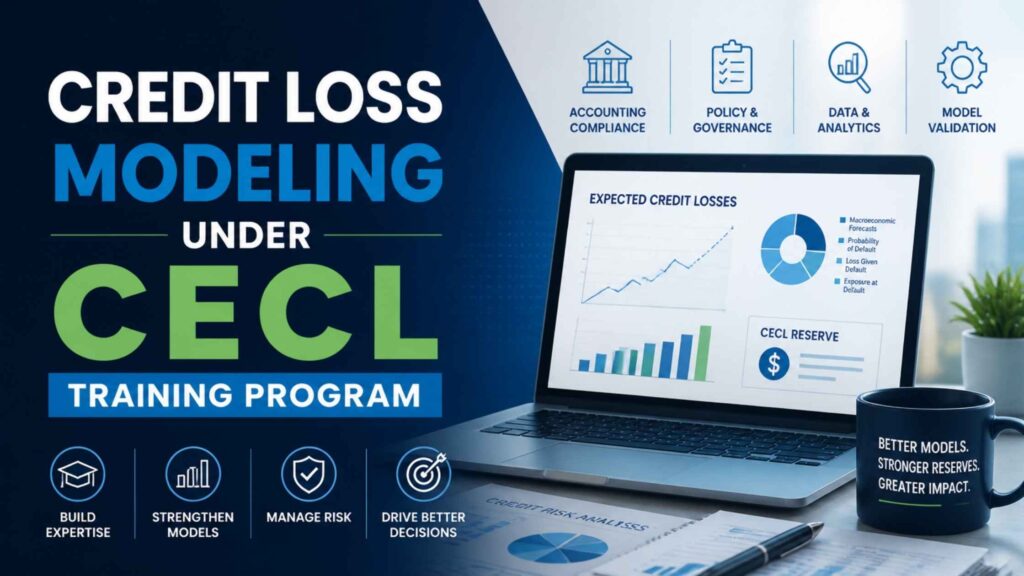
What Is Credit Loss Modeling Under CECL?
Credit loss modeling under the Current Expected Credit Loss (CECL) standard is the process banks and financial institutions use to estimate the potential losses in their credit portfolios over the life of a loan. According to the Financial Accounting Standards Board (FASB), CECL fundamentally shifts the methodology from an incurred loss model to a forward-looking, expected loss model, significantly impacting the way organizations assess and report credit risk.
The U.S. Securities and Exchange Commission reported that since CECL’s phased implementation began in 2020, financial institutions have increased their allowance for credit losses by an average of 30% or more, reflecting the new requirement to estimate lifetime losses at origination.
For professionals searching for cecl credit loss modeling, understanding this new regulatory landscape is not just about compliance—it is about building resilient credit portfolios, safeguarding profitability, and securing stakeholder trust.
Why Is CECL Credit Loss Modeling So Important Now?
The CECL standard, issued by FASB under Accounting Standards Update (ASU) 2016-13, is one of the most significant changes to bank accounting in decades. Its goal is to ensure that expected credit losses are recognized earlier and with greater transparency.
According to the Federal Reserve, CECL implementation has become a key focus for regulatory examinations, and inadequate compliance can expose organizations to enforcement actions, restatements, and loss of market confidence.
- Earlier recognition of losses: Institutions must now estimate and book expected losses at loan origination, not just when losses become probable.
- Forward-looking data: The standard requires the use of reasonable and supportable forecasts, making data quality and modeling expertise paramount.
- Greater transparency: Enhanced disclosures and analytics are required for both internal and external stakeholders.
The shift to CECL has also intensified the demand for professionals skilled in forecasting losses, building financial risk models, and leveraging accounting analytics to meet both regulatory and business objectives.
What Has Changed Recently?
Since CECL’s effective dates began in January 2020 for SEC filers and 2023 for all other institutions, several noteworthy updates have shaped best practices:
- 2023: The FASB issued clarifications on the use of historical loss information and expectations for “reasonable and supportable” forecasts.
- 2022-2024: Joint statements by the Office of the Comptroller of the Currency (OCC) and the Federal Deposit Insurance Corporation (FDIC) have emphasized the need for robust model risk management and documentation for CECL models.
- 2024: Regulatory scrutiny has increased on smaller banks and credit unions, with examiners focusing on whether institutions can justify the assumptions and methodologies behind their CECL credit loss modeling.
These changes make expert-led compliance training critical for institutions that want to avoid costly remediation efforts and regulatory penalties.
How Do You Build Effective CECL Credit Loss Models?
To meet CECL’s requirements, organizations must develop credit loss models that are methodologically sound, well documented, and able to withstand regulatory scrutiny. The process typically includes:
- Data Collection: Gather historical loss data, segmentation variables, economic indicators, and qualitative factors.
- Model Selection: Choose from approaches such as loss rate, roll rate, probability of default/loss given default (PD/LGD), or discounted cash flow models.
- Forecasting Losses: Integrate macroeconomic forecasts and reasonable, supportable assumptions to project future losses.
- Validation and Backtesting: Regularly validate models against actual outcomes, document assumptions, and adjust as needed.
- Governance and Documentation: Maintain rigorous documentation of model design, data sources, assumptions, and controls to meet regulatory expectations.
Businesses researching cecl credit loss modeling should ensure their teams are proficient in both statistical and qualitative modeling techniques, understand the nuances of financial risk models, and are able to translate accounting analytics into actionable insights.
What Are the Risks of Inadequate Training in CECL Credit Loss Modeling?
Inadequate training can lead to critical missteps such as:
- Underestimating or overestimating loss reserves, resulting in regulatory action or investor mistrust.
- Failure to support forecasts with reasonable and supportable data, leading to model validation failures.
- Insufficient documentation, exposing the institution to enforcement actions by agencies like the OCC and FDIC.
- Missed opportunities to leverage accounting analytics for strategic business advantage.
According to the Federal Reserve, organizations that invest in comprehensive, expert-led CECL training report higher confidence in regulatory exams and better alignment between risk management and business strategy.
What Experts Are Saying
“CECL isn’t simply about compliance. It’s about building a data-driven culture that can anticipate, measure, and respond to credit risk in real time,” observed Dev Strischek, Principal of Devon Risk Advisory Group and member of FASB’s Credit Losses Transition Resource Group.
The OCC has stated, “Examiners will focus on whether an institution’s allowance for credit losses is well supported, documented, and based on reasonable and supportable forecasts.”
Industry experts continue to warn that many institutions underestimate the ongoing resources needed for model governance, validation, and robust documentation.
TheComplyGuide’s expert panel, including Dev Strischek and other seasoned regulatory trainers, brings decades of direct experience in credit risk management, regulatory policy, and accounting analytics to every live training session.
How TheComplyGuide Equips You for CECL Compliance
TheComplyGuide is a U.S.-based leader in expert-led, live compliance training for regulated industries. Our CECL Credit Loss Modeling Under CECL Training Program is designed for banking, credit union, and finance professionals who need actionable skills—not just theoretical knowledge.
- Expert-Led Sessions: Our trainers, including regulatory luminaries like Dev Strischek, deliver content grounded in current regulatory expectations and best practices.
- Live Interactive Webinars: Attendees engage directly with experts, ask questions, and participate in real-world case studies.
- On-Demand Access: Recordings are made available to participants for ongoing reference and compliance audits.
- Role-Specific Focus: Training modules are tailored for credit risk officers, finance teams, internal auditors, and model risk managers.
Organizations looking for forecasting losses, financial risk models, and accounting analytics all benefit from our comprehensive and practical approach. Our programs are rooted in the latest regulatory guidance, ensuring that your team is always ahead of the compliance curve.
Key Features of TheComplyGuide’s CECL Credit Loss Modeling Program
- Comprehensive Curriculum: Covers all aspects of CECL—from data governance and model development to backtesting, documentation, and audit readiness.
- Regulatory Alignment: Every session reflects the latest guidance from FASB, OCC, FDIC, and Federal Reserve.
- Real-World Tools: Participants receive templates and best-practice documentation frameworks for use in their own institutions.
- Continuing Education: Qualifies for CPE/CE credits for finance and risk professionals.
- Immediate Impact: Past attendees report improved regulatory exam performance and reduced operational risk.
If your search is for financial risk models or accounting analytics training that delivers more than just theory, TheComplyGuide is the trusted resource for U.S. professionals.
Why TheComplyGuide? Our Difference—Expertise, Precision, and Results
TheComplyGuide is not a generic provider. We offer domain-specific, U.S.-centric compliance education developed and delivered by experts who have shaped regulatory policy and have led compliance programs at major U.S. institutions. Our regulatory experts include practitioners who have served on FASB advisory panels, led bank risk management functions, and developed industry-leading model validation protocols.
Our approach is proactive: Instead of “checking the box,” we help your institution build a culture of credit risk awareness, robust model governance, and operational excellence that stands up under regulatory scrutiny.
What Is Included in the CECL Credit Loss Modeling Training Program?
- Deep dives into CECL methodology—from lifetime loss estimation to segmentation and scenario analysis.
- Practical workshops on forecasting losses using macroeconomic indicators and internal data.
- Hands-on sessions on financial risk models, including PD/LGD, roll rate, and discounted cash flow approaches.
- Guidance on accounting analytics—turning data into actionable, auditable reports for management and regulators.
- Best practice documentation and validation protocols to prepare for regulatory exams and audits.
Participants leave with a toolkit of templates, case studies, and access to recordings for continued learning and compliance support.
How to Enroll and Get in Touch
Ready to transform your approach to CECL credit loss modeling? Getting started is simple:
- Fill out the contact form at TheComplyGuide Contact Page.
- Email us directly at care@thecomplyguide.com.
- Receive a prompt response—our team will guide you through scheduling, pricing, and tailored learning paths.
Don’t let knowledge gaps or outdated practices put your institution at risk. Secure your place in the next expert-led session and ensure your team is prepared for the future of credit risk management.
About TheComplyGuide
TheComplyGuide is a U.S.-based authority in compliance training, known for connecting organizations with world-class regulatory experts. Our live, interactive webinars are tailored to the unique needs of regulated industries and are trusted by compliance professionals nationwide.
Our programs are developed and delivered by a distinguished faculty of former regulators, industry strategists, and policy leaders. Each brings decades of experience and practical insight, ensuring every session is current, actionable, and impactful.
Discover why leading banks, credit unions, and financial organizations across the United States choose TheComplyGuide for their compliance training needs.
Frequently Asked Questions
What is the CECL Credit Loss Modeling Under CECL Training Program by TheComplyGuide?
The CECL Credit Loss Modeling Under CECL Training Program offered by TheComplyGuide is a comprehensive course designed to help professionals understand and implement the Current Expected Credit Loss (CECL) standard. It covers the regulatory background, methodologies for estimating credit losses, practical modeling techniques, and best practices for compliance and reporting. The program is suitable for financial analysts, risk managers, accountants, and others involved in credit risk and compliance.
Who should attend the CECL credit loss modeling training?
The training is ideal for professionals in financial services, including risk managers, credit analysts, accountants, auditors, and regulatory compliance officers. If your role involves forecasting losses, building financial risk models, or utilizing accounting analytics for CECL reporting, this program is tailored for you.
How does TheComplyGuide’s program help with forecasting losses under CECL?
TheComplyGuide’s program provides step-by-step guidance on forecasting losses in compliance with CECL requirements. Participants learn to apply quantitative and qualitative techniques, leverage historical data, and integrate forward-looking information. The course includes hands-on exercises and real-world case studies to build practical forecasting skills.
What financial risk models are covered in the training?
The training covers a range of financial risk models relevant to CECL, including Probability of Default (PD), Loss Given Default (LGD), Exposure at Default (EAD), vintage analysis, roll-rate models, and discounted cash flow methods. TheComplyGuide ensures that participants gain both theoretical understanding and practical application skills.
Does the program include instruction on accounting analytics for CECL?
Yes, accounting analytics are a key component of the training. TheComplyGuide’s program teaches participants how to use data analytics to support CECL model development, validation, and ongoing monitoring. This includes data sourcing, cleaning, aggregation, and visualization techniques essential for robust CECL reporting.
What solutions does TheComplyGuide offer beyond training?
In addition to the CECL credit loss modeling training program, TheComplyGuide offers advisory services, model validation, custom workshops, and ongoing support for CECL implementation. These solutions are designed to help organizations meet regulatory expectations and improve internal risk management capabilities.
Is the training program suitable for both beginners and experienced professionals?
Absolutely. TheComplyGuide’s CECL training is structured to benefit both those new to credit loss modeling and seasoned professionals seeking deeper insights into advanced CECL methodologies, financial risk models, and accounting analytics.
How does the program keep up with regulatory changes related to CECL?
TheComplyGuide continuously updates its training content to reflect the latest regulatory guidance and industry best practices. Participants receive updates on new developments in CECL compliance, ensuring their knowledge and skills remain current.
How can my organization enroll in TheComplyGuide’s CECL Credit Loss Modeling program?
Enrollment is simple—visit TheComplyGuide’s website to view upcoming course schedules and register online. Organizations can also request customized group sessions or contact TheComplyGuide’s support team for tailored training and solutions.