
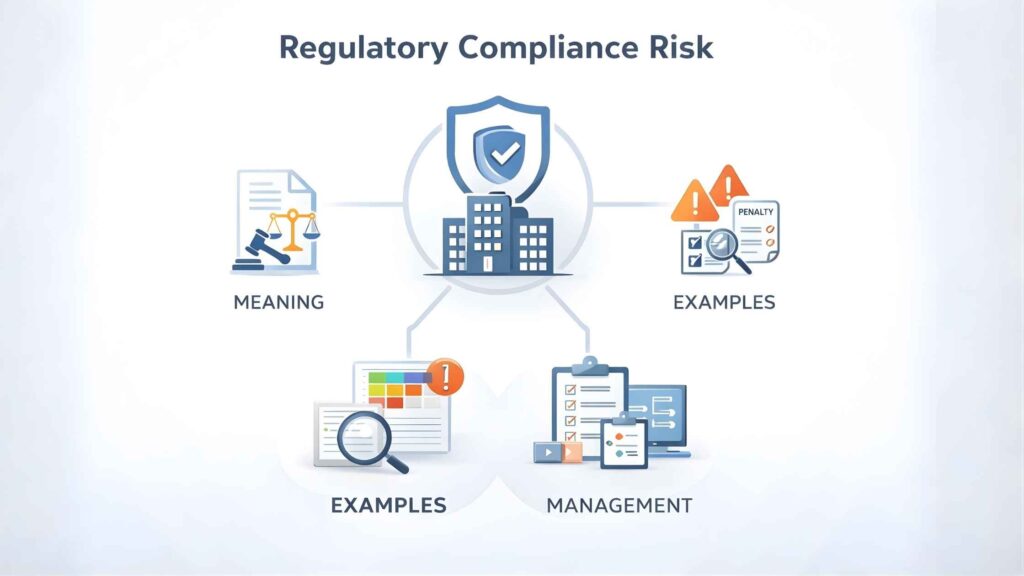
Regulatory compliance risk is one of the most urgent and costly threats facing U.S. businesses today. According to the U.S. Federal Reserve, financial institutions alone spend over $270 billion annually on compliance and regulatory obligations, illustrating the immense scale and seriousness of this risk. This figure continues to rise as new rules and enforcement priorities emerge across industries.
But what is regulatory compliance risk, why does it matter to your organization, and how can you manage it effectively to avoid significant legal penalties and reputational harm?
What Is Regulatory Compliance Risk?
Regulatory compliance risk refers to the potential for losses, penalties, or reputational damage that arise when an organization fails to adhere to laws, regulations, or internal policies. These risks are not limited to large corporations—small and mid-sized businesses are equally vulnerable.
In essence, regulatory compliance risk is the threat that a company will be found non-compliant with the rules governing its operations, whether those rules come from federal, state, or local authorities, or from industry-specific bodies.
- Examples include:
- Failing to comply with HIPAA privacy requirements in healthcare
- Ignoring anti-money laundering obligations in banking
- Overlooking FDA labeling standards in life sciences
- Violating OSHA safety rules in manufacturing
- Misclassifying employees under labor law
The consequences of regulatory compliance risk can include substantial fines, loss of business licenses, class action lawsuits, and irreparable brand damage.
Why Is Regulatory Compliance Risk Important?
The cost of non-compliance risk is staggering. According to the Ponemon Institute, the average cost of compliance for U.S. organizations is $5.47 million, but the cost of non-compliance soars to $14.82 million when considering legal penalties, business disruption, and lost productivity.
Moreover, regulatory scrutiny is intensifying. In 2023, the U.S. Department of Justice and the Securities and Exchange Commission issued a combined total of over $6 billion in corporate fines and settlements for compliance failures. The message is clear: compliance is not optional—it is foundational to business survival.
What Are Common Types of Regulatory Compliance Risk?
Regulatory compliance risk manifests in various ways depending on your industry, jurisdiction, and business model. The most common types include:
- Financial Regulatory Risk: Failure to adhere to banking, anti-money laundering, or tax laws
- Health & Safety Risk: Breaches of OSHA, FDA, or public health regulations
- Data Privacy Risk: Non-compliance with HIPAA, CCPA, or GDPR requirements
- Employment Law Risk: Violations of wage and hour laws, discrimination statutes, or workplace investigation protocols
- Environmental Risk: Neglecting EPA, Clean Air Act, or hazardous materials regulations
Each type of risk requires a tailored compliance risk management approach to reduce exposure and ensure operational continuity.
How Is Regulatory Compliance Risk Assessed?
Effective management starts with a thorough regulatory risk assessment. This structured process involves identifying applicable regulations, evaluating current controls, and determining the likelihood and impact of potential compliance violations.
- Mapping all relevant federal, state, and industry regulations to your operations
- Reviewing internal policies and procedures for alignment
- Assessing the effectiveness of training, monitoring, and reporting systems
- Documenting gaps or weaknesses that could result in compliance failures
A robust regulatory risk assessment helps you prioritize high-risk areas and allocate resources efficiently.
What Has Changed Recently?
The regulatory landscape in the United States is evolving at a record pace. In the past 24 months, several key changes have affected compliance risk profiles for U.S. businesses:
- Data privacy: New state-level privacy laws (e.g., California Privacy Rights Act, Virginia Consumer Data Protection Act) have expanded obligations for organizations handling consumer data.
- ESG Reporting: The Securities and Exchange Commission (SEC) has proposed new environmental, social, and governance disclosure rules for public companies, expected to be finalized in 2024.
- Healthcare: The Office for Civil Rights (OCR) has updated HIPAA enforcement priorities, focusing on timely breach notification and ransomware preparedness.
- Banking: The Financial Crimes Enforcement Network (FinCEN) has implemented new anti-money laundering requirements under the Corporate Transparency Act, impacting millions of U.S. businesses.
- Workplace Safety: OSHA has increased maximum penalties and issued new guidance on COVID-19 protocols and whistleblower protections.
These developments underscore the need for continuous regulatory monitoring and ongoing compliance training.
What Are Real-World Examples of Regulatory Compliance Risk?
- Healthcare: A hospital system was fined $6.8 million for failing to protect patient data under HIPAA, after an employee’s unauthorized access led to a major breach.
- Banking: A regional bank incurred $37 million in penalties for anti-money laundering compliance failures, including insufficient due diligence and poor transaction monitoring.
- Manufacturing: An industrial company faced OSHA fines exceeding $500,000 after repeated workplace safety violations led to employee injuries.
- Life Sciences: A pharmaceutical manufacturer was penalized by the FDA for non-compliance risk in its labeling and quality assurance processes, resulting in a costly product recall.
- HR & Employment: A national retailer paid $1.2 million to settle claims of wage and hour non-compliance risk, following a Department of Labor investigation.
Each of these incidents could have been prevented—or costs significantly reduced—through proactive compliance risk management.
How to Manage Regulatory Compliance Risk Effectively?
Managing regulatory compliance risk is not a one-time event. It requires an integrated, ongoing approach that combines leadership commitment, expert training, and robust controls. Leading practices include:
- Leadership Buy-In: Executive support is essential to foster a culture of compliance and allocate sufficient resources for compliance risk management.
- Ongoing Training: Regular, expert-led compliance education ensures that employees understand their regulatory obligations and how to identify and report potential risks.
- Monitoring & Auditing: Implement continuous monitoring and regular internal audits to detect issues before they escalate.
- Clear Policies & Procedures: Develop, document, and update policies aligned with current laws and regulations.
- Incident Response: Establish protocols for investigating and remediating potential compliance failures—including timely reporting to authorities.
TheComplyGuide’s expert-led webinars and live training sessions are trusted by organizations nationwide to build these competencies and reduce compliance failures.
Why Do Compliance Failures Still Happen?
Despite the best intentions, many organizations fall short in their compliance efforts. The most common reasons include:
- Lack of up-to-date training on new regulations
- Failure to conduct periodic regulatory risk assessment
- Inadequate internal controls or documentation
- Underestimating the impact of non-compliance risk
- Poor communication between compliance, legal, and operational teams
These gaps increase the likelihood of compliance failures and expose organizations to potentially ruinous legal penalties.
What Experts Are Saying
According to the U.S. Department of Justice, “Effective compliance programs are not static; they must be dynamic and responsive to changing risks, business lines, and regulatory expectations.” This viewpoint is echoed by TheComplyGuide’s panel of regulatory experts, who stress the importance of continuous learning and practical, role-based compliance training.
Diane L. Dee, an HR and compliance expert featured on TheComplyGuide, notes: “A proactive approach to regulatory compliance risk is critical. Regular training and robust policies reduce exposure to legal penalties and foster a culture of accountability.” Her insights are drawn from decades of guiding organizations through complex employment law and HR compliance challenges.
Similarly, David Nettleton, an FDA compliance authority, emphasizes: “Maintaining validated systems and current documentation is vital. Regulatory changes—and enforcement actions—can happen quickly. Organizations must be audit-ready at all times.”
These thought leaders, alongside other recognized authorities in banking, tax, health, and cybersecurity, present live webinars through TheComplyGuide, ensuring your team benefits from the most current, actionable expertise.
How TheComplyGuide Supports Compliance Risk Management
TheComplyGuide is a U.S.-based leader in expert-led compliance training, serving organizations across healthcare, banking, life sciences, HR, and more. Our mission is to help businesses reduce regulatory compliance risk and avoid costly compliance failures.
- Live & On-Demand Webinars: Interactive sessions led by former regulators, compliance strategists, and subject-matter experts
- Real-World Scenarios: Practical examples, case studies, and industry-specific best practices
- Customized Training: Tailored content based on your organization’s unique risk profile and regulatory exposure
- Immediate ROI: Organizations report measurable reductions in operational risk and improved audit performance after participating in TheComplyGuide programs
For organizations looking for regulatory compliance risk solutions, TheComplyGuide’s training is an investment that delivers both peace of mind and tangible business value.
How to Get Started With TheComplyGuide
Accessing TheComplyGuide’s expertise is simple:
- Explore our training offerings at TheComplyGuide.com
- Contact us using the online form or by emailing care@thecomplyguide.com
- Our team will respond promptly to schedule a discovery call or demo tailored to your needs
Don’t let preventable gaps turn into tomorrow’s violations. Invest in compliance risk management that strengthens governance, minimizes non-compliance risk, and drives lasting outcomes.
About TheComplyGuide
TheComplyGuide is a premier provider of expert-led compliance training for U.S. organizations across highly regulated industries. Our faculty includes former government regulators, legal professionals, and industry pioneers in FDA, OSHA, banking, HR, and more.
Every session is built on the principles of experience, expertise, authority, and trustworthiness (EEAT). Our programs are designed to empower your workforce, reduce regulatory compliance risk, and ensure your business is always ready for the next regulatory challenge.
To learn more or to schedule a training session, visit our Contact Page or email care@thecomplyguide.com. TheComplyGuide’s support team is committed to the shortest turnaround time in the industry.
Key Takeaways
- Regulatory compliance risk is rising and affects every U.S. business
- Non-compliance risk leads to severe financial and reputational consequences
- Effective compliance risk management requires ongoing training, robust controls, and expert support
- Recent regulatory changes demand continuous learning and proactive adaptation
- TheComplyGuide offers the expertise, resources, and training your organization needs to stay ahead
Frequently Asked Questions
What is regulatory compliance risk and why does it matter?
Regulatory compliance risk refers to the potential for an organization to violate laws, regulations, or standards that apply to its industry or operations. This type of risk matters because failure to comply can result in serious consequences, including legal penalties, reputational damage, financial losses, and operational disruptions. Effectively managing regulatory compliance risk helps organizations avoid these negative outcomes and maintain trust with stakeholders.
Can you give examples of regulatory compliance risk in business?
Examples of regulatory compliance risk in business include failing to adhere to data protection laws like GDPR, not following anti-money laundering rules in financial services, or breaching environmental regulations in manufacturing. Each of these compliance failures can trigger investigations, fines, and other sanctions that threaten business continuity.
How does TheComplyGuide help organizations with compliance risk management?
TheComplyGuide offers a suite of services and tools designed to streamline compliance risk management. This includes automated compliance checklists, policy templates, training modules, and tailored advisory to help organizations identify, assess, and mitigate regulatory compliance risk. These solutions ensure businesses stay updated with changing regulations and reduce the likelihood of non-compliance risk.
What is a regulatory risk assessment and why is it important?
A regulatory risk assessment is a systematic process of identifying and evaluating risks associated with laws and regulations relevant to your business. It is important because it helps organizations prioritize compliance efforts, allocate resources effectively, and proactively address areas that could lead to compliance failures. TheComplyGuide assists businesses in conducting thorough regulatory risk assessments as part of their risk management strategy.
What are the consequences of non-compliance risk for organizations?
The consequences of non-compliance risk can be severe and far-reaching. Organizations may face legal penalties such as fines, sanctions, or even criminal charges. Additionally, non-compliance can damage reputation, erode customer trust, disrupt business operations, and lead to loss of revenue or market access. Proactive compliance risk management, as enabled by TheComplyGuide, helps organizations avoid these costly outcomes.
How can businesses reduce their exposure to compliance failures?
Businesses can reduce their exposure to compliance failures by implementing a robust compliance program, conducting regular regulatory risk assessments, training employees, and keeping policies up to date. TheComplyGuide provides the tools, resources, and expert guidance needed to build and maintain effective compliance frameworks that minimize risk and foster a culture of compliance.
Why should organizations choose TheComplyGuide for compliance solutions?
Organizations choose TheComplyGuide for its comprehensive, user-friendly, and customizable compliance solutions. The platform combines technology and expert insights to simplify compliance risk management, offering features like automated alerts, audit trails, and regulatory updates. This helps organizations stay compliant, avoid legal penalties, and focus on growth while reducing the burden of regulatory compliance risk.
How often should regulatory compliance risk be reviewed?
Regulatory compliance risk should be reviewed on a regular basis, typically annually or whenever there are significant changes in laws, business operations, or industry standards. Ongoing monitoring is essential to quickly identify and address emerging risks. TheComplyGuide makes it easy to schedule and document these reviews, ensuring that compliance remains a continuous and proactive process.