
 ON-DEMANDAI for Professionals
AI Risk Management, Governance, & Audit Readiness Essentials
6-month access · Certificate included
$195
Marketing teams collect enormous amounts of customer and campaign data every day. The challenge is turning that data into meaningful insights that drive better business decisions.
This practical webinar is designed specifically for marketers, marketing analysts, business professionals, and anyone with little or no coding experience .
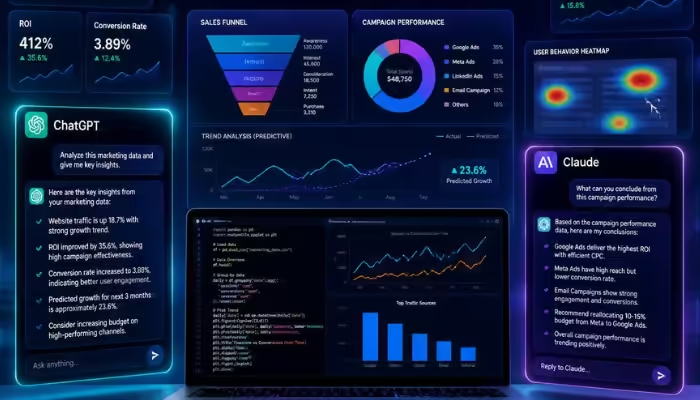
You’ll learn, step by step, how to use AI tools such as ChatGPT and Claude, together with Python, to clean, analyze, visualize, and interpret marketing data. By the end of the session, you’ll have a practical framework that you can apply to virtually any marketing dataset.
Marketing decisions are only as good as the data behind them. Whether you’re analyzing customer purchases, campaign performance, product demand, or seasonal buying patterns, AI can dramatically simplify the entire analysis process.
In this hands-on webinar, you’ll learn how to perform an end-to-end marketing data analysis using a large real-world dataset containing more than 1.5 million records .
Rather than spending hours writing complex code, you’ll discover how AI tools like ChatGPT and Claude can generate Python code for you, allowing you to focus on interpreting results instead of learning programming syntax.
During the webinar, we’ll guide you through every stage of the analytical process—from importing raw data to producing professional visualizations and business recommendations.
By the end of the session, you’ll understand how to use AI to automate repetitive data analysis tasks, identify meaningful patterns, and generate insights that support smarter marketing decisions.
Use AI tools such as ChatGPT and Claude to generate Python code for marketing data analysis
Understand the role of Python in modern marketing analytics
Import large datasets into Google Colab for analysis
Clean, standardize, and prepare marketing data for AI-driven analysis
Perform exploratory data analysis (EDA) to identify trends and customer behaviors
Calculate key marketing metrics such as: Customer counts
Product popularity
Average transaction value
Campaign performance
Revenue by customer segment
Seasonal sales trends
Create professional visualizations including: Bar charts
Line charts
Scatter plots
Heat maps
Distribution plots
Interpret analytical results and convert them into actionable business recommendations
After completing this webinar, you’ll have a practical, repeatable workflow for analyzing marketing data using AI. Instead of relying on manual spreadsheet analysis or advanced programming skills, you’ll learn how to leverage AI to accelerate your work, improve reporting accuracy, and uncover insights that help drive smarter marketing decisions. Whether you’re evaluating campaign performance, understanding customer behavior, or presenting data-driven recommendations to stakeholders, the techniques covered in this session can be applied immediately to your own marketing data.

Reuben Bernard is an alumnus of the Indian Institute of Management, Bangalore. He has nearly two decades of experience in B2B digital marketing, product marketing, event marketing, developing and implementing GTM strategies, hiring and building world-class teams, new business ideation, and driving businesses to meet and exceed revenue and profitability targets.
Over the past 18 months, he has been a power user of AI tools . He has shared his knowledge and experience with hundreds of working professionals and small business owners through hands-on sessions; both webinars and in-person seminars. These sessions have immensely helped participants increase their productivity through the use of AI tools.
His experience includes working at lead tech companies including startups, mid-size, and Fortune 1000 companies. A considerable portion of his work experience had been at US-based companies with businesses catering to the North American markets. He also serves as an Adjunct Professor, teaching Business Strategy, Marketing, and Entrepreneurship, and a Member of the Board of Studies, at the Pondicherry Technological University, India.
View his LinkedIn profile here .
View LinkedIn profile →A nationwide retail chain wants to better understand its customers and identify seasonal purchasing trends to improve business performance. As the data analyst, your objective is to analyze historical transaction data and answer important business questions, including:
ON-DEMANDAI for Professionals ON-DEMANDAI for Professionals
 ON-DEMANDAI for Professionals