
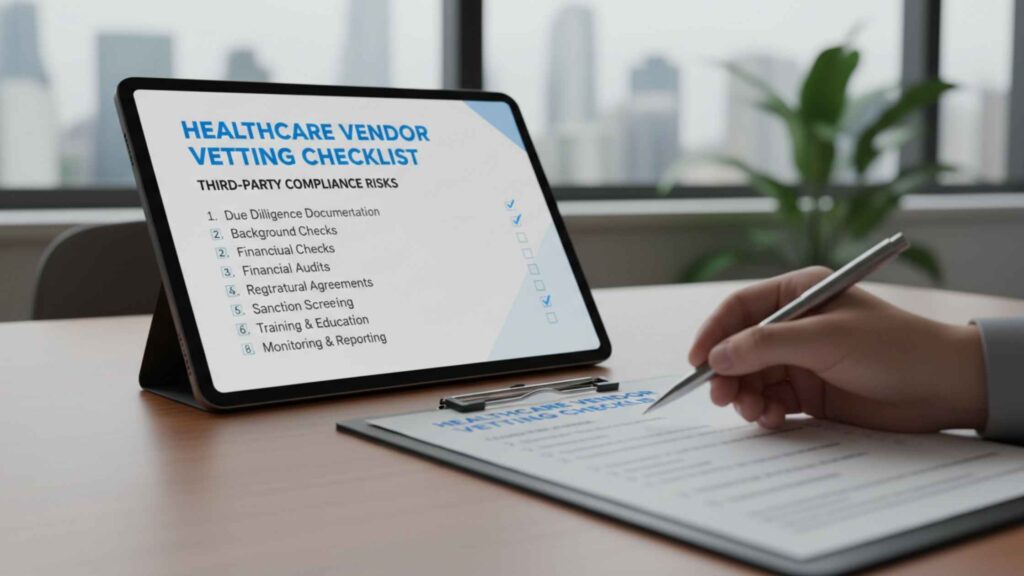
What is the most effective way to reduce kickback and third-party risk in healthcare vendor relationships? The answer lies in a robust, up-to-date healthcare vendor vetting checklist that aligns with evolving regulatory requirements and industry best practices. According to the Office of Inspector General (OIG), over $2 billion in healthcare fraud recoveries in 2023 were linked to improper vendor relationships and third-party risks, highlighting the critical need for thorough vetting and compliance oversight in the U.S. healthcare sector. (Source: OIG Semiannual Report to Congress, 2023)
In this comprehensive guide, you will learn how to build, implement, and optimize a healthcare vendor vetting checklist that actively reduces exposure to kickback schemes, strengthens your compliance posture, and supports your organization’s integrity. Whether you are a compliance officer, procurement specialist, general counsel, or health system executive, this article details actionable steps and expert-backed insights to help you stay ahead of regulatory scrutiny and enforcement trends.
Why Is Healthcare Vendor Compliance Critical?
Healthcare vendor compliance is not just a regulatory checkbox—it is foundational to protecting patient welfare, organizational reputation, and operational continuity. The U.S. Department of Health and Human Services (HHS) and the OIG have made clear that vendor relationships are a top enforcement priority, especially under the federal Anti-Kickback Statute (AKS) and the False Claims Act (FCA).
- Non-compliance can result in substantial civil monetary penalties, criminal prosecution, and exclusion from federal healthcare programs.
- Improper vendor arrangements frequently lead to investigations, whistleblower actions, and reputational harm that can take years to repair.
Organizations looking for Healthcare Vendor Compliance must focus on both regulatory mandates and operational best practices to avoid these pitfalls.
How Have Regulations Changed Recently?
What has changed in the last 24 months? Regulatory expectations for vendor vetting and third-party oversight have grown stricter, with several significant developments:
- OIG Compliance Program Guidance (2023): The OIG’s revised General Compliance Program Guidance now requires organizations to demonstrate a proactive approach to vendor oversight, including risk-based due diligence and ongoing monitoring.
- Anti-Kickback Statute Settlements: Recent high-profile AKS enforcement actions have targeted not just direct payments, but also indirect benefits and remuneration involving third-party healthcare vendors.
- CMS Focus on Data Integrity: The Centers for Medicare & Medicaid Services (CMS) have emphasized the importance of accurate vendor data and documentation during audits and claims reviews.
Previously, many organizations relied on annual vendor checks. Now, continuous risk-based monitoring and detailed compliance audit checklist processes are essential. Proposed rules in 2024 are expected to further clarify vendor risk assessment requirements and expand reporting obligations for covered entities and business associates under HIPAA and Medicare/Medicaid programs.
What Is the Healthcare Vendor Vetting Checklist?
The healthcare vendor vetting checklist is a structured set of procedures and documentation requirements designed to evaluate, onboard, and monitor third-party healthcare vendors for compliance with federal and state regulations.
This checklist typically covers:
- Verification of vendor credentials, licensing, and exclusions (OIG, SAM, state databases)
- Assessment of ownership and control interests
- Review of past compliance history and litigation
- Evaluation of anti-kickback statute compliance policies and agreements
- Confirmation of data privacy and security practices (HIPAA, HITECH, state law)
- Analysis of billing, reimbursement, and marketing practices
- Risk scoring and categorization for ongoing monitoring
For professionals searching for healthcare vendor due diligence, a checklist-based approach delivers consistency, transparency, and defensible documentation for audits and investigations.
How to Conduct Healthcare Vendor Due Diligence: Step-by-Step
Effective healthcare vendor due diligence is a multi-stage process. Here is how leading organizations, guided by TheComplyGuide’s expert trainers, approach this critical task:
-
Pre-Engagement Screening:
- Obtain and verify business identifiers (EIN, NPI, state licenses)
- Screen against OIG, GSA SAM, and state exclusion lists
-
Documentation & Policy Review:
- Request copies of compliance policies, anti-kickback training records, and code of conduct
- Review sample agreements for AKS “safe harbor” compliance
-
Vendor Risk Assessment:
- Score vendor by regulatory exposure, financial risk, service criticality, and history of violations
-
Onboarding & Training:
- Require attestation to compliance standards and completion of onboarding training modules
- Document all due diligence steps and approvals
-
Ongoing Monitoring & Auditing:
- Implement scheduled and ad hoc compliance audit checklist reviews
- Track incidents, complaints, and new regulatory developments
This process ensures a defensible record of due diligence for every third-party healthcare vendor engaged by your organization.
What Are the Most Common Compliance Risks Facing Third-Party Healthcare Vendors?
What are the biggest compliance challenges with third-party healthcare vendors? The most significant risks include:
- Kickback schemes: Undisclosed payments, gifts, or incentives in exchange for referrals or business.
- False claims: Vendors submitting or enabling fraudulent claims to Medicare, Medicaid, or commercial payers.
- Data breaches: Inadequate HIPAA safeguards or improper data sharing resulting in privacy violations.
- Excluded parties: Contracting with vendors or individuals barred from federal healthcare programs due to prior fraud or abuse.
- Lack of documentation: Insufficient or inconsistent recordkeeping that cannot withstand regulatory scrutiny during audits.
Anyone researching vendor risk assessment should recognize that OIG, DOJ, and CMS have increased enforcement activity in these risk areas, often resulting in multimillion-dollar settlements and mandatory corporate integrity agreements.
How Does a Compliance Audit Checklist Reduce Kickback and Third-Party Risks?
A well-designed compliance audit checklist functions as both a preventive and detective control in vendor oversight programs. For organizations committed to anti-kickback statute compliance, a checklist helps to:
- Ensure all vendor arrangements are reviewed for potential remuneration or referral risks
- Document the business necessity and fair market value of services provided
- Verify ongoing compliance with federal and state regulations at each stage of the vendor lifecycle
- Standardize the review process for new and existing vendors
- Facilitate rapid response to regulatory inquiries or audit requests
According to OIG guidance, organizations with documented, consistently applied vendor vetting and auditing processes are less likely to face severe penalties in the event of a compliance violation.
What Experts Are Saying
TheComplyGuide’s panel of regulatory experts, including noted compliance specialists and former government auditors, consistently emphasize the importance of third-party oversight:
- David Nettleton, FDA Compliance Specialist, states: “Healthcare organizations must treat vendor management as an extension of their own compliance program—gaps in vendor oversight are among the most common findings in regulatory audits.”
- Carolyn Troiano, FDA Compliance Consultant, adds: “Documentation of each step in the vendor vetting process is your first—and often best—defense against allegations of improper relationships or billing practices.”
- Paul R. Hales, Attorney at Law, advises: “With increasing scrutiny on HIPAA and kickback violations, organizations need to ensure that every vendor agreement is reviewed for compliance, not just legal formality.”
- Dr. Michael C. Redmond, Cyber Security SME, highlights: “Vendor cybersecurity and data integrity are as important as financial controls in today’s environment—breaches can trigger both regulatory fines and reputational loss.”
The consensus is clear: a strong healthcare vendor vetting checklist, coupled with ongoing training, is now a non-negotiable part of effective compliance management.
How TheComplyGuide Supports Healthcare Vendor Compliance Training
Expert-led compliance education is the fastest way to reduce risk and build a culture of accountability. TheComplyGuide offers live, instructor-led webinars and on-demand training sessions covering every aspect of healthcare vendor compliance, including:
- Building and implementing a healthcare vendor due diligence program
- Conducting effective vendor risk assessments
- Documenting anti-kickback statute compliance protocols
- Responding to compliance audit checklist findings and remediating gaps
- Preparing for OIG, CMS, and DOJ audits
All programs are developed and delivered by recognized authorities with decades of regulatory experience. For example, David Nettleton’s expertise in FDA compliance and computer system validation, and Carolyn Troiano’s leadership in regulatory audits, ensure that every session is grounded in real-world operational requirements.
To learn more about upcoming training opportunities, visit TheComplyGuide’s Regulatory Experts page or review the latest course offerings at TheComplyGuide.com.
What Sets TheComplyGuide Apart?
TheComplyGuide is a U.S.-based leader in compliance education, trusted by hospitals, health systems, practice groups, and suppliers nationwide. What differentiates TheComplyGuide?
- Domain expertise: Courses are authored and presented by former regulators and compliance officers, not generic trainers.
- Practical focus: Every training is rooted in actionable, real-world scenarios with step-by-step implementation guidance.
- Immediate ROI: Organizations report measurable reductions in compliance gaps and audit findings after participating in TheComplyGuide’s webinars.
- Accessible support: TheComplyGuide’s team responds rapidly to inquiries—just fill out the contact form or email care@thecomplyguide.com for tailored recommendations.
Do not let preventable kickback and third-party risks endanger your organization. TheComplyGuide’s expert-led training is your fastest path to robust healthcare vendor compliance and peace of mind.
About TheComplyGuide
TheComplyGuide is a U.S.-based provider of expert-led compliance training and education for healthcare, finance, life sciences, HR, and other highly regulated industries. With a distinguished faculty of regulatory experts, TheComplyGuide equips organizations to meet and exceed federal and state compliance requirements. All programs emphasize real-world skills, practical implementation, and measurable results. Discover more at TheComplyGuide.com.
How to Get Started
Ready to strengthen your healthcare vendor compliance program? To schedule a discovery call, request a demo, or inquire about group training, simply:
- Fill out the contact form
- Email care@thecomplyguide.com
TheComplyGuide’s team will respond with the shortest turnaround time and provide a tailored plan for your needs.
Frequently Asked Questions
What is a Healthcare Vendor Vetting Checklist and why is it important?
A Healthcare Vendor Vetting Checklist is a structured set of criteria and processes used to assess third-party healthcare vendors before establishing business relationships. It is crucial for ensuring Healthcare Vendor Compliance, mitigating potential legal and regulatory risks, and safeguarding your organization against issues like fraud, kickbacks, and privacy violations. By thoroughly vetting vendors, healthcare organizations can ensure they are working only with reputable, compliant partners.
How does TheComplyGuide help reduce kickback and third-party compliance risks?
TheComplyGuide offers specialized tools and resources that streamline the vetting of third-party healthcare vendors. Our solutions help organizations maintain anti-kickback statute compliance by providing automated checks, documentation templates, and ongoing monitoring. This reduces the risk of engaging with vendors that could expose your organization to fines or reputational damage due to non-compliance or unethical practices.
What are the key steps in healthcare vendor due diligence?
Key steps in healthcare vendor due diligence include verifying vendor credentials, assessing regulatory compliance, reviewing financial stability, checking references, and evaluating reputational risks. TheComplyGuide provides a comprehensive framework and checklists to ensure every aspect of due diligence is covered, so you can confidently approve or deny vendor relationships based on objective data and compliance standards.
Why is vendor risk assessment essential in healthcare?
Vendor risk assessment is critical in healthcare because third-party vendors often handle sensitive patient data, provide clinical services, or support operational processes. Any weaknesses in a vendor’s compliance or security posture can directly impact patient safety and your organization’s regulatory standing. TheComplyGuide’s solutions make it easy to conduct regular, thorough vendor risk assessments and address any identified risks proactively.
How does a compliance audit checklist support ongoing vendor compliance?
A compliance audit checklist provides a repeatable process for regularly reviewing vendor activities, contracts, and performance against regulatory standards. TheComplyGuide offers customizable compliance audit checklist templates that help organizations systematically identify gaps, document remediation efforts, and demonstrate due diligence during audits or inspections.
What features does TheComplyGuide offer for managing third-party healthcare vendors?
TheComplyGuide offers vendor onboarding automation, real-time compliance monitoring, document management, risk rating tools, and reporting dashboards. These features enable healthcare organizations to efficiently manage third-party healthcare vendors throughout the entire vendor lifecycle, from initial vetting and contracting to ongoing monitoring and renewal.
How can TheComplyGuide assist with anti-kickback statute compliance?
TheComplyGuide helps organizations achieve and maintain anti-kickback statute compliance by providing up-to-date policy templates, automated screening against exclusion lists, and best-practice workflows for documenting vendor interactions. This reduces the likelihood of inadvertent violations and supports a robust compliance culture within your organization.
How often should healthcare organizations re-evaluate their vendors?
Healthcare organizations should conduct vendor reviews at least annually, or more frequently for high-risk vendors or when there are changes in regulations or business arrangements. TheComplyGuide facilitates scheduled and ad hoc assessments, ensuring your vendor network remains compliant and aligned with your organization’s risk tolerance.
What sets TheComplyGuide apart from other healthcare vendor compliance solutions?
TheComplyGuide stands out for its intuitive platform, healthcare-specific compliance expertise, and ability to adapt to the evolving regulatory landscape. Our solutions are designed to address the unique challenges of Healthcare Vendor Compliance, offering tailored guidance and automated tools that simplify even the most complex compliance processes.