
What Are Healthcare Fraud Risk Indicators, and Why Do They Matter?
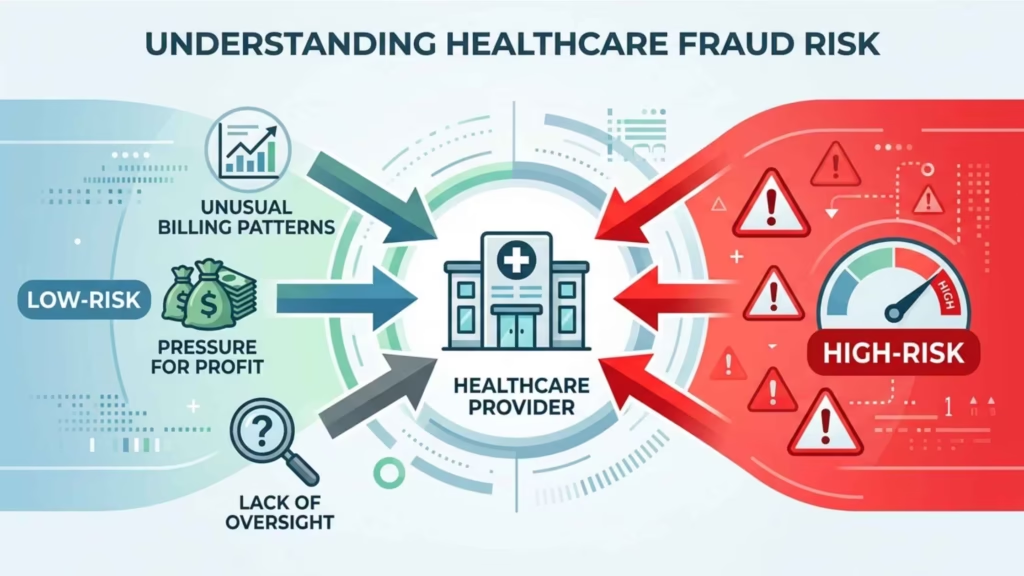
Healthcare fraud cost the United States an estimated $100 billion in 2023, according to the National Health Care Anti-Fraud Association. This figure underscores the immense challenge facing regulators and providers as they prepare for even stricter scrutiny in 2026. Healthcare fraud risk indicators are measurable signals—ranging from unusual billing patterns to regulatory violations—that flag potential fraud, waste, or abuse within healthcare organizations.
Recognizing these indicators is not just a regulatory expectation. It is a critical operational necessity. Providers that fail to identify and address these risks often find themselves in high-risk categories—facing intensified audits, payment suspensions, and reputational damage. According to the U.S. Department of Health and Human Services, the detection and mitigation of fraud risk indicators have become top priorities for compliance teams and executives alike.
How Are Providers Assessed for Fraud Risk?
Providers are increasingly evaluated using sophisticated models that aggregate healthcare fraud risk indicators into comprehensive profiles. Federal agencies and commercial payers rely on advanced analytics and artificial intelligence to spot anomalies in claims data, patient records, and provider behavior.
For professionals searching for fraud risk scoring healthcare, it is essential to understand that these models factor in variables such as billing outliers, claim frequency, diagnosis-procedure mismatches, and the use of high-risk codes. The Centers for Medicare & Medicaid Services (CMS) and the Office of Inspector General (OIG) use such scoring to prioritize audits and investigations.
- High claim volumes relative to peers
- Unusual treatment patterns
- Frequent use of outlier billing codes
- Patient overlap with other flagged providers
- History of regulatory noncompliance
These factors, when combined, raise provider audit risk—often triggering pre-payment reviews, on-site inspections, and even referrals to law enforcement.
What Has Changed Recently?
The regulatory landscape for healthcare fraud detection has evolved rapidly in recent years. In 2023, the OIG updated its Fraud Risk Indicator list to include new data points on telehealth, opioid prescribing, and value-based payment models. These changes reflect shifting fraud schemes and the adoption of new care delivery technologies.
- Previous requirements: Focused primarily on fee-for-service billing anomalies and basic coding compliance.
- Current requirements: Include real-time data analytics, broader scope of claim types (telehealth, DME, home health), and deeper integration of patient outcome metrics.
- Proposed future requirements: Will likely require integration with national compliance monitoring systems, mandatory reporting of certain risk scores, and increased transparency in provider relationships.
According to the OIG’s 2024 Annual Report, enforcement agencies now use multi-source data feeds and predictive analytics to identify providers at elevated risk for fraud, waste, or abuse. The report notes a 17% increase in provider audits initiated from data-driven referrals versus traditional complaints.
What Are the Most Common Healthcare Fraud Risk Indicators?
The following table summarizes the most prevalent healthcare fraud risk indicators tracked by regulators and payers in 2026:
| Indicator | Description | Regulatory Source |
|---|---|---|
| Billing Outliers | Claims volume or dollar amount significantly higher than peer averages | CMS, OIG |
| Diagnosis-Procedure Mismatch | Frequent use of unrelated diagnosis and procedure codes | CMS, State Medicaid |
| High-Risk Codes | Frequent use of codes with known fraud risk (e.g., DME, home health) | OIG Fraud Indicators |
| Provider-Patient Overlap | Patients appearing on multiple flagged provider rosters | CMS, MACs |
| Data Inconsistencies | Discrepancies between submitted claims and medical records | OIG, DOJ |
Why Do Providers Move Into High-Risk Categories?
Providers are pushed into high-risk categories when they consistently exhibit multiple healthcare fraud risk indicators or fail to remediate identified issues. Key reasons include:
- Insufficient internal controls: Weak compliance programs allow fraudulent or erroneous billing to continue undetected.
- Poor compliance culture: Lack of leadership emphasis on regulatory compliance and ethical behavior.
- Inadequate training: Failure to provide ongoing education on evolving regulations and new fraud schemes.
- Reactive compliance approach: Addressing issues only after a regulator or payer flags them, rather than proactively monitoring risk.
- Outdated technology: Relying on legacy systems that cannot detect or prevent emerging fraud tactics.
Organizations looking for healthcare compliance risk metrics should routinely benchmark their internal audit results, compliance monitoring systems, and staff training participation rates against industry best practices.
What Experts Are Saying
Experts widely agree that a proactive, data-driven approach is the most effective way to mitigate provider audit risk. According to Richard E. Cascarino, one of TheComplyGuide’s featured regulatory experts, “Organizations that integrate continuous monitoring and real-time analytics into their compliance programs are better equipped to identify anomalies before they become enforcement priorities.”
David Nettleton, an FDA compliance specialist with extensive experience in software validation, notes, “Healthcare organizations must move beyond static audits to dynamic compliance monitoring systems that adapt to new fraud patterns. The future of fraud prevention lies in leveraging validated technology and robust training for all staff.”
The Office of Inspector General (OIG) has also emphasized the importance of early detection. In a recent public statement, the OIG highlighted the critical role of ongoing education and expert-led training in reducing fraud risk across the provider landscape.
How Can Organizations Stay Ahead of Regulatory Scrutiny?
To avoid being categorized as high risk, organizations must implement a multi-layered strategy grounded in the latest compliance best practices. This includes:
- Establishing robust internal controls and regular risk assessments
- Leveraging advanced compliance monitoring systems
- Participating in expert-led compliance training designed for healthcare professionals
- Using fraud risk scoring healthcare tools to proactively identify red flags
- Benchmarking performance against healthcare compliance risk metrics
- Responding promptly to regulator feedback and audit findings
For organizations evaluating OIG fraud indicators, enrolling in live, expert-led webinars from TheComplyGuide ensures up-to-date understanding of enforcement priorities and evolving risk factors.
TheComplyGuide: Expert-Led Training for Sustainable Compliance
TheComplyGuide is a U.S.-based compliance education provider specializing in live, expert-led webinars for healthcare professionals. Our programs are developed by recognized authorities such as Richard E. Cascarino, David Nettleton, and Carolyn Troiano—each with decades of regulatory experience and a proven track record guiding organizations through complex compliance landscapes.
According to a recent industry study, more than 70% of organizations report a measurable reduction in operational risk after adopting structured compliance training programs. TheComplyGuide addresses this need by offering purpose-built courses tailored to the healthcare sector, including in-depth sessions on healthcare fraud risk indicators, provider audit risk, and compliance monitoring systems.
Training is available through live webinars, which are interactive and led by experts with deep regulatory backgrounds. Recordings are provided for future reference. There are no generic, self-paced courses—each session is designed to deliver actionable insights and real-world strategies aligned with current enforcement priorities.
Why Choose TheComplyGuide for Healthcare Compliance?
- Expertise: Our trainers are regulatory veterans, including former auditors, policy architects, and compliance strategists.
- Relevance: Programs are updated regularly to reflect the latest federal and state regulatory changes, OIG fraud indicators, and enforcement trends.
- Practicality: Every session includes real-world case studies, interactive Q&A, and actionable checklists.
- Results: Organizations that invest in our training report improved audit outcomes, reduced provider audit risk, and a more robust compliance culture.
Don’t let preventable gaps in compliance expose your organization to unnecessary risk. TheComplyGuide’s programs are not only informative—they are transformative, delivering measurable results and equipping your team to face tomorrow’s challenges with confidence.
How to Access TheComplyGuide’s Healthcare Compliance Training
Getting started with TheComplyGuide is simple:
- Visit the Contact Page and fill out the inquiry form.
- Or email the team directly at care@thecomplyguide.com.
TheComplyGuide’s team responds promptly and can provide tailored recommendations based on your organization’s risk profile and training needs.
About TheComplyGuide
TheComplyGuide is a leading provider of compliance training and regulatory education for highly regulated industries across the United States. Known for its expert-led webinars and authoritative courseware, TheComplyGuide equips healthcare, finance, HR, and life sciences professionals to meet evolving regulatory challenges with confidence. All training is delivered live by seasoned regulatory experts, ensuring actionable guidance and up-to-date compliance strategies.
For the latest course offerings and to learn more about our distinguished panel of speakers, please explore our website or contact us today.
Frequently Asked Questions
What are Healthcare Fraud Risk Indicators, and why are they important for 2026?
Healthcare Fraud Risk Indicators are specific patterns, behaviors, or red flags that can signal heightened potential for fraudulent activity within healthcare organizations. As regulatory scrutiny intensifies in 2026, understanding these indicators becomes essential for providers to identify vulnerabilities, reduce exposure to costly investigations, and maintain trust with payers and regulators.
What factors push providers into high-risk categories according to fraud risk scoring healthcare models?
Fraud risk scoring healthcare models assess factors like abnormal billing patterns, repeated upcoding, high volumes of high-reimbursement procedures, sudden spikes in claim frequency, and gaps in documentation. Providers flagged for multiple high-risk behaviors are often placed in high-risk categories, increasing their chances of audit or enforcement.
How do healthcare compliance risk metrics help prevent fraud?
Healthcare compliance risk metrics provide quantifiable measures of a provider’s adherence to regulations and best practices. By tracking metrics such as claim denial rates, error percentages, and frequency of corrective actions, organizations can proactively detect compliance gaps and address emerging fraud risks before they escalate.
What is provider audit risk, and how can it impact healthcare organizations?
Provider audit risk refers to the likelihood that a healthcare provider will be selected for a regulatory or payer audit based on identified risk factors. High provider audit risk can lead to operational disruptions, reputational damage, financial penalties, and even exclusion from payer networks if issues are uncovered.
How do OIG fraud indicators influence provider risk assessments?
OIG fraud indicators are benchmarks or warning signs published by the Office of Inspector General to help identify potential fraud schemes. Providers displaying these patterns—such as excessive services, inconsistent coding, or high outlier payments—are more likely to be flagged for investigation. Integrating OIG fraud indicators into risk assessments helps organizations stay ahead of enforcement trends.
What role do compliance monitoring systems play in managing fraud risk?
Compliance monitoring systems are software tools that continuously track and analyze provider activities, claims, and documentation. By automating the detection of anomalies and flagging high-risk behaviors, these systems enable real-time intervention and support a culture of proactive compliance, minimizing the likelihood of fraud and regulatory breaches.
How does TheComplyGuide help providers address Healthcare Fraud Risk Indicators?
TheComplyGuide offers tailored solutions that identify, monitor, and mitigate Healthcare Fraud Risk Indicators. Their platform leverages advanced analytics, up-to-date regulatory intelligence, and workflow tools to help providers detect risk factors early, reduce audit exposure, and demonstrate ongoing compliance to regulators and payers.
Can TheComplyGuide assist with fraud risk scoring healthcare and improving compliance metrics?
Absolutely. TheComplyGuide provides robust capabilities for fraud risk scoring healthcare organizations, offering dashboards and reporting tools that visualize risk scores, track healthcare compliance risk metrics, and benchmark provider performance against industry standards. This data-driven approach empowers organizations to prioritize resources and remediate risk efficiently.
What are the benefits of using TheComplyGuide’s compliance monitoring systems?
TheComplyGuide’s compliance monitoring systems offer continuous, automated oversight of billing, coding, and documentation activities. Benefits include real-time fraud detection, reduction of manual compliance workloads, enhanced provider audit risk management, and actionable insights to maintain alignment with OIG fraud indicators and regulatory changes.