
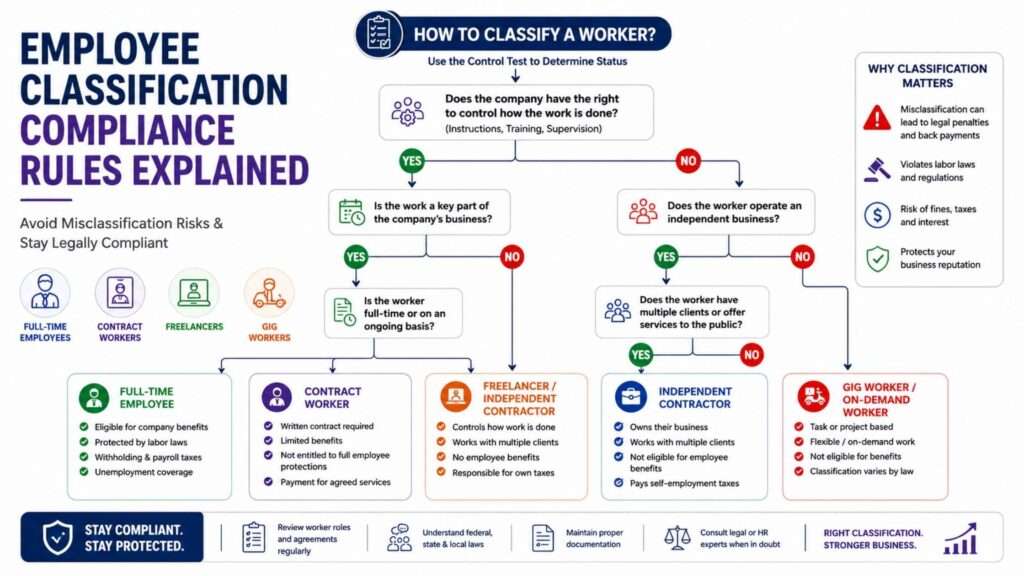
What is employee classification compliance, and why is it critical for every U.S. business? In brief, it is the process of correctly determining whether your workers should be categorized as employees or independent contractors under federal and state law. According to the U.S. Department of Labor, more than 10% of U.S. employers have misclassified at least one worker, resulting in billions of dollars in unpaid wages, taxes, and benefits each year (U.S. Department of Labor, 2023).
Missteps in classification expose organizations to severe financial and legal consequences. With the regulatory landscape evolving rapidly, staying current with employee classification compliance rules is no longer optional—it’s essential to protecting your business from costly penalties and reputational damage.
What Is Employee Classification Compliance?
Employee classification compliance is the process by which employers determine a worker’s status as either an employee or an independent contractor, ensuring alignment with federal Fair Labor Standards Act (FLSA) guidelines and state labor laws. This classification affects tax obligations, benefits eligibility, overtime, and legal protections. The Internal Revenue Service (IRS) and Department of Labor (DOL) both enforce strict standards to prevent misclassification, and noncompliance can result in audits, fines, and lawsuits.
- Employees are protected by wage and hour laws, entitled to benefits (like health insurance, unemployment, and workers’ compensation), and subject to payroll tax withholding.
- Independent contractors are self-employed, generally control how their work is performed, and are responsible for their own taxes and benefits.
The key challenge for organizations? Correctly interpreting and applying contractor vs employee rules in day-to-day operations, especially as remote and gig work arrangements proliferate.
Why Is Employee Classification So Important?
Incorrect classification can have a domino effect, leading to back wages, tax penalties, and legal actions. Businesses researching employee classification compliance often underestimate the scope of federal and state enforcement.
According to the IRS, worker misclassification is a top enforcement priority, with the agency conducting thousands of random audits yearly. The DOL’s Wage and Hour Division recovered more than $230 million in back wages for misclassified workers in 2023 alone (U.S. Department of Labor, 2023).
- Financial Impact: Misclassification can result in double payment of FICA taxes, unpaid overtime, and retroactive benefit costs.
- Legal Exposure: Employers face lawsuits, class actions, and even criminal charges for willful violations.
- Reputational Damage: Public enforcement actions can harm employer brand and disrupt business operations.
In short, compliance is not just about avoiding fines—it’s about sustaining the health and reputation of your organization.
How to Distinguish Contractor vs Employee Rules
How do you determine if a worker is an employee or a contractor? The answer lies in the application of multiple legal tests, each with specific criteria.
- IRS Common Law Test: Focuses on behavioral control, financial control, and the type of relationship.
- DOL Economic Realities Test: Asks whether the worker is economically dependent on the employer or truly in business for themselves.
- State Laws: Some states, such as California (AB5), use stricter “ABC” tests to determine status.
For professionals searching for contractor vs employee rules, it’s crucial to assess:
- Who sets the schedule and work process?
- How is the worker paid (per project vs. salary/hourly)?
- Are tools and materials provided by the employer?
- Does the worker serve multiple clients?
- Is the relationship ongoing or project-based?
Even a small oversight in documentation or process can result in a misclassification finding during an audit.
What Are the Misclassification Penalties?
What happens if your organization gets it wrong? The consequences of misclassification can be sweeping and severe.
- Back Taxes: Organizations may owe years of unpaid Social Security, Medicare, and unemployment taxes.
- Wage and Hour Violations: Retroactive overtime and minimum wage payments can be ordered.
- Benefits Liability: Workers may claim entitlement to benefits, including health coverage and retirement plans.
- Federal and State Fines: Both levels of government can impose civil and criminal penalties.
- Legal Fees: Defending against lawsuits and investigations can be costly.
According to the U.S. Department of Labor, misclassification penalties can reach tens of thousands of dollars per employee, not including unpaid benefits and damages.
In high-profile cases, companies have paid millions in back wages and penalties. Organizations looking for strategies to avoid these outcomes should invest in proactive compliance education and review.
What Are the Labor Law Risks of Misclassification?
What labor law risks do companies face by misclassifying workers? The risks extend beyond financial penalties and include increased vulnerability to lawsuits, regulatory scrutiny, and loss of government contracts.
- Class Action Lawsuits: Groups of misclassified workers may seek damages collectively.
- Enforcement Actions: Federal and state agencies actively target industries with high rates of misclassification, such as construction, hospitality, and the gig economy.
- Loss of Bids and Contracts: Government agencies may bar noncompliant companies from public contracts.
- Personal Liability: In some cases, company executives can be held personally liable for violations.
Searches relating to labor law risks have increased as agencies ramp up audits and enforcement priorities.
What Has Changed Recently?
Regulatory requirements for employee classification are evolving rapidly at both federal and state levels:
- Department of Labor Final Rule (2024): In January 2024, the DOL issued a final rule clarifying the “economic realities” test for classifying workers under the FLSA. The rule emphasizes control, opportunity for profit, skill, permanency, and integration of the worker’s role. This replaces the prior 2021 guidance and is now in effect.
- State Law Developments: States like California, Massachusetts, and New Jersey have adopted stricter “ABC” tests, making it harder to classify workers as independent contractors.
- Heightened Enforcement: Joint federal-state task forces are ramping up audits, targeting industries with high misclassification rates.
Employers must review current practices and documentation to ensure compliance with the latest standards, as prior methods may no longer be sufficient.
What Experts Are Saying
Leading compliance professionals and regulatory authorities stress the importance of ongoing training for HR, legal, and operational teams.
“Employee classification is the foundation of workforce compliance. A single mistake can expose organizations to years of back pay, tax penalties, and regulatory scrutiny. Regular training is the most effective way to avoid costly errors.”
— Diane L. Dee, SPHR, SHRM-SCP, President, Advantage HR Consulting, and featured expert at TheComplyGuide
“Regulatory agencies have made clear that misclassification will not be tolerated. Employers must understand not only federal criteria, but also evolving state and local requirements. Ignorance is no defense.”
— Ronald Adler, President-CEO of Laurdan Associates and HR audit specialist, TheComplyGuide speaker
According to the Society for Human Resource Management (SHRM), “failure to invest in compliance training is one of the top predictors of costly misclassification lawsuits.”
How TheComplyGuide Helps You Stay Compliant
TheComplyGuide is a U.S.-based provider specializing in expert-led compliance training for every industry. Our live webinars are designed to help you understand, implement, and document compliance with employee classification rules—directly from industry leaders with decades of regulatory experience.
- Featured Speakers: Our programs are led by top HR compliance authorities such as Diane L. Dee, Ronald Adler, Amber Vanderburg, and Margie Faulk—each bringing real-world insights and actionable guidance.
- Course Coverage: We cover federal and state requirements, recent regulatory changes, documentation best practices, and risk mitigation strategies.
- Interactive Learning: Participants gain hands-on experience through scenario-based analysis, Q&A with experts, and post-webinar access to session recordings.
- Trusted by Leaders: Our clients include Fortune 500s, public agencies, and small businesses nationwide.
Organizations evaluating employee classification compliance should recognize that proactive, expert-led training is the only way to ensure readiness for audits, avoid mistakes, and minimize exposure to misclassification penalties and labor law risks.
To see how TheComplyGuide can help your organization stay ahead of compliance challenges, simply contact us or email care@thecomplyguide.com. Our team will respond promptly—because when it comes to compliance, every moment counts.
What Sets TheComplyGuide Apart?
TheComplyGuide delivers more than just information. We provide clarity, context, and practical tools to help your organization implement and sustain compliant practices. Our webinars are:
- Developed by Recognized Experts: Every session is created and delivered by authorities with direct regulatory and enforcement experience.
- Continuously Updated: We monitor regulatory changes so your training is always current and actionable.
- Designed for Real-World Application: Learn how to document decisions, audit your processes, and communicate compliance across your organization.
By investing in live training with TheComplyGuide, you protect your business from preventable errors and position your team as compliance leaders. Don’t risk costly mistakes—choose the authority trusted by America’s top employers.
About TheComplyGuide
TheComplyGuide is a U.S.-based compliance training leader, delivering expert-led live webinars across HR, finance, healthcare, banking, and life sciences. Our programs are trusted by organizations nationwide to provide up-to-date, actionable compliance education designed for rapid regulatory change.
To connect with our experts, schedule a webinar, or discuss your compliance needs, fill in our contact form or email care@thecomplyguide.com. Our team will assist you with the shortest turnaround time.
Frequently Asked Questions
What is employee classification compliance and why does it matter?
Employee classification compliance refers to the process of correctly categorizing workers as employees or independent contractors according to federal, state, and sometimes local laws. Proper classification is essential to ensure workers receive the benefits and protections they are entitled to and that companies avoid legal and financial risks. Non-compliance can lead to audits, penalties, and damage to your business reputation.
What are the main differences between contractor vs employee rules?
Contractor vs employee rules outline how a worker’s status is determined. Employees typically work under the direction and control of the employer, receive regular wages, and may qualify for benefits. Contractors operate independently, control how and when they work, and are responsible for their own taxes and insurance. Misunderstanding these rules can result in misclassification and compliance issues.
What are the potential misclassification penalties for businesses?
Misclassification penalties can include back taxes, fines, unpaid overtime, benefits liabilities, and even criminal charges in severe cases. Government agencies may also impose additional penalties for each misclassified worker, and you could face lawsuits from workers seeking compensation. TheComplyGuide helps businesses avoid these penalties by ensuring proper classification and documentation.
How do labor law risks relate to employee classification?
Labor law risks arise when businesses fail to comply with wage and hour laws, tax obligations, or worker protections due to incorrect classification. This can lead to audits, government investigations, and costly litigation. Using a solution like TheComplyGuide can help you navigate complex labor laws and reduce your company’s exposure to risk.
How can TheComplyGuide help my business with employee classification compliance?
TheComplyGuide offers an intuitive platform designed to guide businesses through every aspect of employee classification compliance. With automated assessments, up-to-date legal guidance, and actionable checklists, TheComplyGuide reduces guesswork and helps you meet all regulatory requirements confidently and efficiently.
How often do contractor vs employee rules change?
Contractor vs employee rules can change frequently, especially as new federal, state, or local laws are passed. Courts may also interpret existing rules differently over time. TheComplyGuide continuously monitors legislative and regulatory updates, ensuring your classification practices remain compliant with the latest requirements.
What steps should I take if I think I’ve misclassified a worker?
If you suspect a worker has been misclassified, it’s important to take corrective action quickly. Review the worker’s role and responsibilities, consult with legal counsel or a compliance expert, and consider using TheComplyGuide’s platform to conduct a thorough assessment. Promptly correcting misclassifications can help minimize misclassification penalties and legal exposure.
Is TheComplyGuide suitable for businesses of all sizes?
Yes, TheComplyGuide is designed for companies of every size, from startups to large enterprises. Its scalable solutions and customizable features make it easy for any organization to manage employee classification compliance, reduce labor law risks, and ensure peace of mind.
What makes TheComplyGuide different from other compliance solutions?
TheComplyGuide stands out for its user-friendly interface, real-time updates on changing regulations, and expert-backed guidance tailored to your specific workforce. Unlike generic compliance tools, TheComplyGuide focuses specifically on employee classification compliance, helping you confidently navigate contractor vs employee rules and avoid misclassification penalties.