
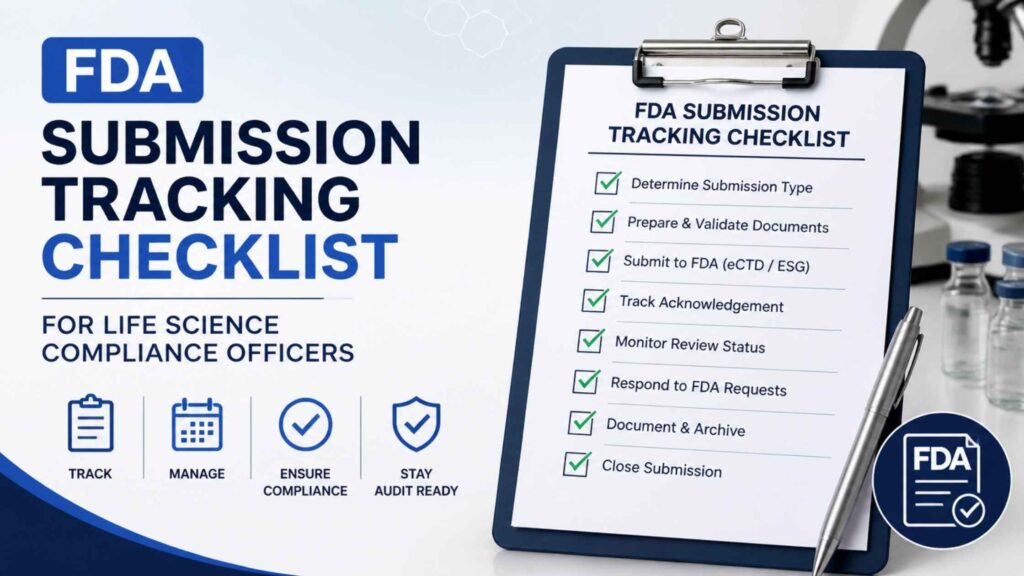
What Is the FDA Submission Tracking Checklist and Why Does It Matter?
An FDA submission tracking checklist is a structured tool that ensures every regulatory requirement and milestone is met during the FDA submission process. According to the U.S. Food and Drug Administration, 36% of first-time submissions in the life sciences sector are delayed due to incomplete documentation, missing data, or procedural errors (FDA, 2023). These delays can cost companies millions in lost market opportunity and expose them to compliance risk.
Life science compliance officers are tasked with ensuring that submissions to the FDA—whether for drugs, biologics, or medical devices—are meticulously prepared, tracked, and reported. With regulatory requirements evolving rapidly, a robust checklist is no longer a convenience; it is a necessity for audit readiness, operational efficiency, and long-term trust with regulators.
How to Use the FDA Submission Tracking Checklist: A Step-by-Step Guide
To maximize success, organizations should treat the FDA submission tracking checklist as a living document. It should guide every phase of submission management, from initial planning to post-submission follow-up. Below is a concise, actionable guide for compliance officers:
-
Define Submission Scope:
Identify the product, indication, and regulatory pathway. Determine whether your submission falls under NDA, ANDA, BLA, PMA, or 510(k). -
Review FDA Filing Requirements:
Consult current FDA regulations and guidance documents. Confirm that all preclinical, clinical, and manufacturing data meet statutory and regulatory standards. -
Assemble Compliance Documentation:
Gather all required documents—protocols, data sets, labeling, CMC information, and correspondence logs. Ensure that document control systems are validated and compliant with 21 CFR Part 11. -
Complete Regulatory Submission Checklist:
Use a standardized regulatory submission checklist to confirm inclusion of all mandatory modules and attachments. -
Internal Review and Quality Control:
Conduct internal audits using the checklist. Address gaps and deficiencies before finalizing the submission package. -
Pre-Submission Communication:
Engage with the FDA through pre-IND, pre-NDA, or Q-submission meetings as appropriate. Document all feedback and adjust the submission accordingly. -
Submission Management and Tracking:
Use electronic submission management tools to log milestones, manage version control, and track correspondence. -
Monitor for Information Requests:
After submission, monitor for FDA information requests. Respond promptly and document each communication for audit readiness. -
Archive and Maintain Records:
Ensure all submission-related records are archived in accordance with FDA retention policies and are accessible for future audits or supplements.
By following this structured approach, compliance officers can significantly reduce the risk of submission rejections or costly delays.
What Has Changed Recently? Key FDA Submission Developments
The FDA submission process is not static. Over the past 24 months, several notable changes have impacted life science compliance:
- eCTD Mandate Expansion: As of May 2023, the FDA requires most marketing submissions for drugs and biologics to use the Electronic Common Technical Document (eCTD) format. This extends to certain device submissions, increasing the need for electronic submission management and structured data.
- Real-World Evidence and Data Integrity: The FDA has issued new guidance on the use of real-world data and digital health technologies, emphasizing data integrity and traceability (FDA Guidance, 2023).
- Remote Regulatory Audits: The FDA has accelerated the use of remote document reviews and virtual inspections, raising the bar for audit readiness and digital compliance documentation.
- Submission Timelines: Certain expedited review pathways (e.g., Breakthrough Therapy, Fast Track) now require more proactive communication and stricter adherence to regulatory submission checklist milestones.
Compliance officers must stay alert to these shifts, as failing to adapt can result in avoidable noncompliance and regulatory setbacks.
What Are the Essential Elements of an FDA Submission Tracking Checklist?
An effective FDA submission tracking checklist for life science compliance should cover the following categories:
- Submission Type and Regulatory Pathway: NDA, ANDA, BLA, PMA, 510(k), De Novo, etc.
- Module Requirements: Administrative information, summaries, quality, nonclinical, and clinical modules (for eCTD).
- FDA Filing Requirements: Confirm all data, certifications, and forms required by the relevant center (CDER, CBER, CDRH).
- Compliance Documentation: Standard operating procedures (SOPs), validation reports, and correspondence logs.
- Regulatory Submission Checklist Completion: Attestation that all required sections are complete and formatted correctly.
- Submission Management: Tracking tools for version control, submission status, and regulatory feedback.
- Audit Readiness Review: Evidence of internal review, gap analysis, and corrective actions.
- Archiving and Record Retention: Secure storage of submission and supporting materials for FDA access.
For organizations looking for the most up-to-date FDA submission tracking checklist, participation in expert-led training is strongly recommended.
Why Is the FDA Submission Process So Challenging?
The FDA submission process involves multiple departments—R&D, regulatory affairs, quality, manufacturing, and clinical operations. Each must align on format, content, and timing. The consequences of error are severe: a single missing element can trigger a refuse-to-file letter, halting progress for months.
According to recent FDA enforcement data, the most common reasons for submission delays are incomplete compliance documentation, lack of data integrity, and failure to adhere to the regulatory submission checklist. The FDA’s increased emphasis on electronic records, data traceability, and quality management has only heightened these challenges.
What Experts Are Saying
Industry leaders consistently emphasize the importance of meticulous planning and ongoing training for submission management. David Nettleton, a renowned FDA compliance specialist and featured trainer at TheComplyGuide, has stated:
“A risk-based approach to FDA submissions, reinforced by a robust tracking checklist, is essential for preventing regulatory setbacks and ensuring audit readiness. Companies that invest in expert-led compliance training are far better equipped to navigate the complexities of FDA requirements and avoid costly mistakes.” — David Nettleton, FDA Compliance Specialist, TheComplyGuide Regulatory Expert
Carolyn Troiano, another highly regarded FDA compliance consultant and frequent presenter at TheComplyGuide, notes:
“The FDA’s increased focus on data integrity and electronic documentation makes it imperative for life science compliance officers to maintain comprehensive, audit-ready records. A well-structured FDA submission tracking checklist is the foundation of successful regulatory affairs.” — Carolyn Troiano, FDA Compliance Consultant, TheComplyGuide Regulatory Expert
These perspectives are echoed by the FDA itself, which has underscored the necessity of real-time submission tracking and proactive compliance strategies in recent guidance.
Common Pitfalls and How to Avoid Them
- Incomplete Documentation: Missing or inconsistent data remains the top reason for FDA submission rejections. Always use a regulatory submission checklist and have documents independently verified.
- Poor Version Control: Submission management failures—such as outdated SOPs or duplicate files—create confusion and risk. Use electronic systems that track every change.
- Late Responses to FDA Requests: Delays in responding to FDA information requests can result in extended review times or even application withdrawal.
- Inadequate Training: Staff unfamiliarity with FDA filing requirements or compliance documentation standards can lead to avoidable errors.
Organizations that proactively address these issues through training and standardized processes see higher submission acceptance rates and fewer regulatory setbacks.
The Role of Expert-Led Training in Enhancing Submission Success
According to a recent industry study, more than 70% of organizations report a measurable reduction in operational risk after adopting structured compliance training programs. TheComplyGuide meets this demand by delivering comprehensive, expert-led FDA compliance training designed to address the unique challenges of the FDA submission process.
Our programs are led by recognized authorities in regulatory affairs, including FDA compliance veterans, former government regulators, and policy architects. These experts have guided hundreds of organizations through successful submissions, audits, and regulatory inspections.
TheComplyGuide’s offerings include:
- Live, instructor-led webinars focused on FDA submission tracking checklist best practices
- On-demand access to recorded sessions for ongoing reference
- Customizable training modules for submission management and audit readiness
- In-depth workshops covering eCTD, data integrity, and compliance documentation
Organizations looking for practical, actionable guidance on the FDA submission process can benefit directly from our expert-led sessions, which are tailored to the realities of U.S. regulatory expectations.
How to Get Started with TheComplyGuide
TheComplyGuide is a leading provider of expert-led compliance training for life science organizations throughout the United States. Our exclusive network of trainers, including regulatory affairs professionals, FDA compliance specialists, and documentation experts, ensures that your team receives the most current, relevant, and actionable education available.
To explore our full training portfolio, including upcoming FDA compliance webinars, visit our homepage or review the credentials of our regulatory experts.
Ready to elevate your team’s submission management capabilities? Contact us using our contact form or email care@thecomplyguide.com. Our team is committed to providing rapid response and tailored solutions to meet your compliance training needs.
About TheComplyGuide
TheComplyGuide is a U.S.-based leader in expert-led compliance education, specializing in life sciences, healthcare, finance, HR, and more. Our mission is to empower organizations to achieve regulatory excellence and operational resilience through world-class training and guidance.
Our courses are shaped by the real-world experience of former regulators, compliance strategists, and policy authorities, ensuring that your organization is always ready for the next challenge—whether it’s an FDA submission, audit, or new regulatory development.
Invest in your compliance future today. Don’t let preventable gaps turn into tomorrow’s violations. Choose TheComplyGuide for clarity, context, and confidence in every regulatory journey.
Frequently Asked Questions
What is an FDA submission tracking checklist and why is it essential for life science compliance?
An FDA submission tracking checklist is a structured tool that helps life science compliance officers systematically manage and monitor every stage of the FDA submission process. It ensures all documentation, regulatory filing requirements, and deadlines are met, reducing the risk of errors or omissions. Using such a checklist is vital for maintaining regulatory compliance and avoiding costly delays or rejections during the submission process.
How does TheComplyGuide support regulatory submission checklist management?
TheComplyGuide offers digital solutions designed to automate and streamline the regulatory submission checklist for life science organizations. Our platform centralizes submission management, provides real-time tracking, alerts for upcoming tasks, and seamless collaboration tools to ensure that all FDA filing requirements are fulfilled accurately and on time.
What are the benefits of using TheComplyGuide for the FDA submission process?
TheComplyGuide simplifies the FDA submission process by offering guided workflows, automated reminders, and integrated compliance documentation management. This reduces manual effort, minimizes errors, and helps regulatory affairs teams maintain audit readiness throughout the entire submission lifecycle.
How does TheComplyGuide help with FDA filing requirements and documentation?
Our platform provides templates aligned with FDA filing requirements, ensuring that each submission contains all the necessary compliance documentation. The solution tracks document versions, approval statuses, and provides up-to-date guidance on evolving regulatory standards, making it easier to prepare complete and compliant submissions.
Can TheComplyGuide improve audit readiness for regulatory affairs teams?
Absolutely. TheComplyGuide maintains a clear audit trail of all submission activities, approvals, and communications. This transparency supports audit readiness by ensuring that regulatory affairs professionals can quickly retrieve evidence and demonstrate compliance during FDA inspections or internal audits.
How does submission management work in TheComplyGuide’s system?
Submission management within TheComplyGuide is intuitive and centralized. Teams can create, assign, and track tasks related to each submission, set deadlines, and collaborate in real time. The platform offers dashboards and reporting features to monitor progress and identify bottlenecks before they impact regulatory timelines.
Is TheComplyGuide suitable for all life science compliance projects?
Yes, TheComplyGuide is designed to support regulatory affairs and compliance teams across pharmaceuticals, biotechnology, and medical device sectors. Its flexible FDA submission tracking checklist and customizable workflows accommodate the unique requirements of various life science compliance projects.
How does TheComplyGuide keep compliance documentation up to date?
TheComplyGuide regularly updates its compliance documentation library to reflect the latest FDA guidelines and industry standards. Users receive notifications when requirements change, ensuring that all regulatory submission checklist items are current and that documents prepared for the FDA submission process remain compliant.
What makes TheComplyGuide different from manual regulatory submission tracking methods?
Unlike manual tracking with spreadsheets or emails, TheComplyGuide automates every step of the submission management process. Its centralized system reduces administrative burden, increases data accuracy, and enhances collaboration—helping regulatory affairs teams focus on strategic life science compliance priorities.